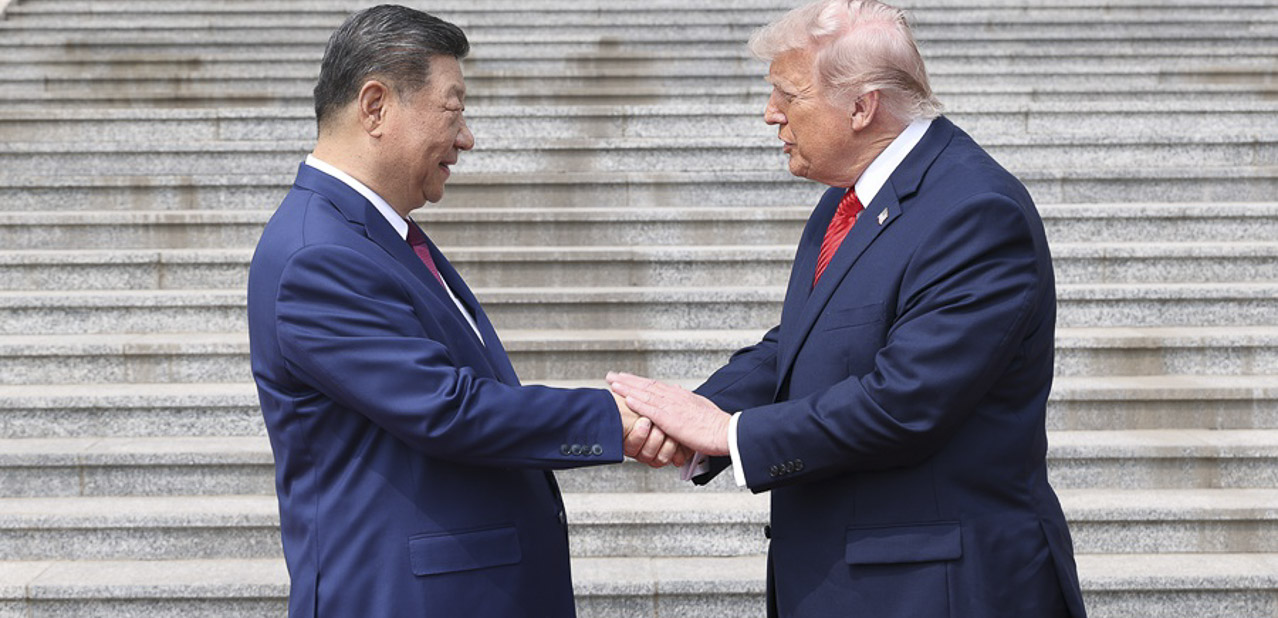
The first state visit by a sitting US president since 2017, the 13–15 May Xi–Trump summit was the defining event of the month. No major agreements were reached on tariffs, export controls or Taiwan, but the tariff truce was extended to November, agricultural market access was opened, and a purchase of 200 Boeing aircraft secured.
Days later, Vladimir Putin arrived for a 25th visit to Beijing, signing over 40 cooperation documents. The back-to-back summits at a moment of wider geopolitical strain, positioned the PRC as a principal venue for major-power dealings.
In domestic policy, the month's most consequential move was financial: the sharpest escalation since late 2022 in closing gaps in the PRC's financial perimeter, with a sweeping cross-border brokerage wind-down, a first-ever over-the-counter derivatives rule, and a parallel tightening in Hong Kong, all landing within weeks.
geopol: back-to-back diplomacy
President Trump's state visit to the PRC, 13–15 May, previously postponed following US–Israeli strikes on Iran, marked the first since 2017. Concluding cordially, the talks produced no major agreements on tariffs, export controls or Taiwan, nor any joint communiqué.
Wang Yi 王毅 Foreign Minister called it 'historic', lauding a 'constructive PRC–US relationship of strategic stability' as the summit's headline yield. Most PRC analysts agreed, with some, including Zheng Yongnian 郑永年 of CUHK (Chinese University of Hong Kong), claiming it could prove more momentous than Nixon's 1972 visit. Others were more cautious, pointing to structural impasses, the approaching 2026 midterm elections and bipartisan Washington consensus on a hardline approach to the PRC.
Putin arrived in Beijing on 19–20 May for his 25th visit, with a substantially fuller agenda. Over 40 agreements on economy, energy and transport were inked, accompanying a declaration on a 'multi-polar world order'. Yet the performance concluded with no detail on a long-stalled Power of Siberia 2 gas pipeline. Xiao Bin 肖斌 Chinese Academy of Social Sciences argued that the back-to-back summits signal how major powers are obliged to maintain at least a minimum level of strategic communication, with the PRC gaining ground as a 'stabilising anchor'.
macro: financial perimeter, soft demand
May saw other ground gained: the fastest escalation since late 2022 in closing offshore financial gaps. Eight agencies joined in launching a two-year clean-up of ‘illegal’ cross-border securities trading, mandating for the first time the wind-down of existing offshore retail accounts. Existing clients may sell holdings and withdraw funds from their overseas accounts; new purchases and fresh deposits are barred; new purchases and inbound transfers are barred. Proposed fines reach C¥1.85bn (~US$254m) for Futu and C¥411m (~US$56m) for Tiger Brokers. A parallel China Securities Regulatory Commission rule subjects over-the-counter swaps, forwards and non-standardised options to licensing from 16 November 2026. Hong Kong Monetary Authority ordered banks to deactivate mainland clients' investment account functions, doing the same from the Hong Kong side. As grey retail brokerage channels close, approved routes such as QFII, Stock Connect, Wealth Management Connect and licensed onshore derivatives are widening to compensate.
Beneath the perimeter moves, domestic demand stayed soft. Industrial profits at large firms rose 24.7 percent y-on-y in April and exports climbed 14.1 percent, but retail sales barely grew and private investment turned negative again. The Iran war pushed the producer price index to a three-year high while the consumer index stayed subdued: supply-driven reflation, not demand recovery. The People's Bank of China kept the loan prime rate unchanged for a 12th month and used its Q1 policy report to reframe 'moderately loose' policy as a transmission fix rather than a signal of broad easing. The summit gave Beijing room to hold that mix unchanged.
trade: truce, not settlement
Despite disruption in the Strait of Hormuz, exports rose 14.1 percent y-on-y in April as overseas buyers built inventories. Imports surged by 25.3 percent over 2025, driven by higher prices and similar stockpiling dynamics. The trade surplus widened to some US$85bn from US$51bn in March. The summit extended the tariff truce to 10 November 2026, agreed bilateral boards on trade and investment, and opened reciprocal cuts on at least US$30bn-worth of products. Beijing pledged to buy 200 Boeing aircraft; the US provided engine and parts guarantees.
Yet the dispute remains a 'truce' rather than a final settlement, notes Tu Xinquan 屠新泉 of UIBE (University of International Business and Economics): substantive progress on export controls is unlikely, cutting to core national-security interests on both sides. Zheng Yongnian 郑永年 urges a sequenced approach to generate a 'virtuous cycle’: trade first, then political trust, then security.
On extraterritorial pressure: invoking April regulations on countering extraterritorial jurisdiction, Beijing barred agencies or individuals from assisting the EU's subsidy probe into Nuctech, a PRC security-inspection firm whose airport and border scanners hold a substantial share of the EU market. PRC firms were also banned from complying with US sanctions on five refiners processing Iranian crude, though this relied on a 2021 measure rather than the newer, broader regulations (and risks further tit-for-tat escalation).
The Mineral Resources Law enactment rules, effective 15 June, codify in statute what Beijing has until now exercised through ad hoc export controls. 'Strategic' minerals are to be listed on four criteria: national security, resource endowment, external dependence and supply chain resilience. A five-year reserve lock and emergency requisition powers are also mandated.
China Photovoltaic Industry Association is consulting until 18 June on a cost-determination standard for the crystalline silicon chain; if adopted, it gives PRC firms a domestic reference point in dumping margin disputes.
industry: capacity, competition and control
Revised steel capacity replacement rules, issued 18 May, raise the nationwide replacement ratio to 1.5:1: any firm adding one tonne of new capacity must retire 1.5 tonnes of old. The rule applies uniformly, ending an earlier advantage for key steel-producing regions. Substantive mergers qualify for a lower 1.25:1 ratio. Long-idle 'zombie' capacity is barred from replacement; after May 2028, capacity transfers between firms require a substantive M&A transaction. The shift converts capacity from a tradable quota into a question of corporate control.
Not without a little pressure, seventeen national industry associations issued voluntary domestic trade guidelines targeting payment discipline: settlement within 30 days where possible, no later than 60, with overdue interest tied to the one-year loan prime rate. Ministry of Finance and State Administration for Market Regulation extended the same logic to public procurement, banning discriminatory supplier thresholds and using reference prices and data monitoring to curb price manipulation. The broader push pulls anti-involution governance into buyer-supplier relationships, platform conduct and public purchasing alike.
environment: Beautiful China report card
The 'Beautiful China' assessment protocol, issued 7 May, set a 100-point provincial scoring system across air, water, marine, soil and solid waste targets through to 2035. Provinces rated 'unqualified' must remedy their deficits within a time limit, tying environmental goals to public accountability criteria.
New guidance on eco-compensation strengthens transfer payments across major watersheds, including the Yangtze and Yellow Rivers, protected areas and key ecosystems. Those who protect the environment should receive more benefit from it.
energy: grid records and green direct connection
Grid infrastructure investment broke records in early 2026, driven by the complexity of integrating distributed renewables into a system facing stubborn demand growth, from AI data centres to end-use electrification. A new Notice more directly connects green power to multi-user arrangements, attracting interest from industrial and zero-carbon parks. NEA (National Energy Administration) issued a call on 26 May for 'AI+' energy scenario projects, envisaging AI support across grid planning, new energy, hydro, nuclear and fossil fuels.
ag: food safety, pork and summit gains
Two food safety cases pushed risk up the supply chain. One Shuanghui pork batch was found to have lincomycin residue some 38 times above the legal limit; yangmei (bayberry) buying sites in Zhangzhou used banned preservatives and sweeteners. Both cases raise the stakes for farms and purchase points, demanding stronger supplier checks, batch testing and cold-chain traceability.
On the pork cycle: MARA (Ministry of Agriculture and Rural Affairs) cut its sow herd target from a routine 39m to some 37.5m head, shifting from holding sow numbers to tracking the full chain (sows, piglets, fattening pigs and large farms), to spot capacity shifts and curb surplus sooner. The PRC–US summit brought concrete ag gains: 425 US beef plants were granted five-year registration extensions, 77 new plants were added, and poultry imports from affected US states were restored.
sci-tech: agents, Huawei and manufacturing
A joint opinion on rollout of AI agents, issued 8 May, extends governance beyond generative content to agent 'behaviour': external tool use, internal system access, task sequencing, process-level judgments and execution triggering. For PRC firms, regulation now acts on what agents do, not only what they produce.
Huawei announced the Tau Scaling Law, an alternative to Moore's Law that measures semiconductor progress by a time constant rather than chip size. The firm is seeking to establish it as an industry standard, with a target of transistor densities equivalent to 1.4nm chips by 2031.
A Qiushi article by the Minister of Industry and Information Technology urges an end to the decline in the manufacturing share of GDP; firms should lift margins through new tech rather than price competition.
governance: law as leverage
One year on, the Private Economy Promotion Law is taking effect: Zheng Shanjie 郑栅洁 National Development and Reform Commission director, pledged to open major national projects to private firms, backed by a 34-point State Administration for Market Regulation plan and a C¥500bn (~US$69bn) Ministry of Finance guarantee scheme.
The push tacitly concedes the law's limits: private investment fell 5.2 percent in January–April. A draft revision of the SOE Assets Law, the first update since 2009, would codify '1+N' reform gains and clarify SASAC's supervisory role.
social policy: drugs, hukou and school standards
Priority review and a dedicated procurement channel are being set up for drugs on the encouraged paediatric R&D list. Pharma regulation moved on three fronts: a long-dormant data exclusivity regime was finally operationalised, closing off cost-free generic replication of originator drug trial data; new rules on medical reps sever commercial incentives linking them to prescribing; and the Medical Insurance Law reached its second NPC reading.