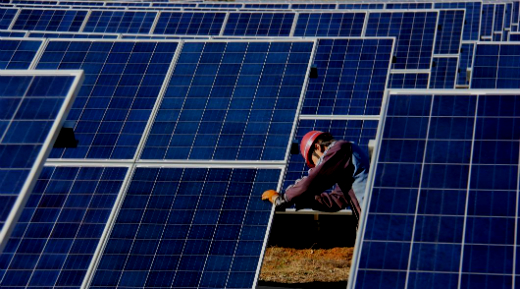
Seven agencies released ‘Guiding opinions on building a green finance system’ on 31 August 2016, setting a framework for financing green development goals and COP21 commitments.
high price of sustainable development
As part of the 2015 Paris Agreement, China committed to reducing CO2 emissions per unit of GDP by 60-65 percent on 2005 levels and increasing the share of non-fossil fuels in primary consumption to around 20 percent by 2030. In line with this, the 13th 5-year plan, passed March 2016, made ‘green development’ central to the long-term growth strategy.
C¥3-4 tn is required annually to achieve these goals, says Ma Jun 马骏 People’s Bank of China (PBoC) chief economist, with 85 percent needed from private finance.
giving the green light
The ‘Guiding opinions’ officially define ‘green finance’ for the first time: financial services that support environmental protection, clean energy, energy saving, and green infrastructure. They seek to encourage green projects by
- merging existing funds, such as energy-saving and environmental protection earmarked funds, into a single National Green Development Fund used for
- injections straight into projects’ capital funds to provide base equity for investments and reduce leverage
- setting up PPP funding models
- setting project models and standards
- calling on localities to set up regional development funds for local green industries and encouraging private and international capital to set up private green development funds
- incentivising lending through loan interest subsidies, relending and guarantees, while aiming to integrate green credit into the macroprudential assessment framework
- increasing benefits for green credit, while constraining loans to industries with overcapacity
diversifying funding
Many of the ‘Guiding opinions’ focus on setting up a regulatory environment to diversify private financing and support by
- encouraging pension funds, insurance funds and other long-term funds to carry out green investment
- encouraging institutional investors to cover environmental and social risks in credit risk stress tests
- developing carbon trading and carbon pricing
- creating a national carbon emissions market by 2017
- developing financing instruments based on emission rights, energy saving and other environmental rights and interests
- developing green insurance
- increasing environmental liability insurance pilots, working towards promoting compulsory insurance and increasing insurers’ role in environmental risk supervision
- encouraging coordination between Ministry of Environmental Protection (MEP) and China Insurance Regulatory Commission (CIRC)
- supporting insurance institutions to innovate green products and services, including insurance for product quality and safety, forestry, shipping, agriculture and animal husbandry, and climate change catastrophe
washing green bonds clean
Recent attempts to increase green projects’ private financing channels have focused on green bonds. Since PBoC and NDRC released related regulations at end 2015, the green bond market has grown rapidly; China issued half the world’s green bonds in Q1 2016. But concerns about greenwashing, fragmented standards and guidelines, and obstacles to internationalising the market, among other difficulties, have hampered development. The ‘Guiding opinions’ seek to overcome these concerns by
- unifying standards and guidelines
- previously, PBoC and CBRC regulated green bonds issued on the interbank market; CSRC regulated corporate green bonds on the Shanghai and Shenzhen stock exchanges; NDRC regulated enterprise bonds
- increasing financial channels and addressing mismatches between the timing of environmental projects and bond maturities
- researching third-party evaluation and ranking standards for green credit
- developing mandatory environmental information disclosure requirements for listed and bond-issuing firms
- raising awareness of environmental protection, ecological civilisation and green financing possibilities
- overcoming limited domestic understanding on the importance of environmental, social and governance (ESG) factors in analysing investment risks
- developing green bond quotas, stock market indices and related products
international reach
The ‘Guiding opinions’ close with a focus on internationalisation, advocating
- continuing efforts to push the G20 Green Finance Research Group agenda
- encouraging domestic investors to issue green bonds in foreign markets
- creating entry opportunities for foreign investors through mechanisms such as a joint venture green development fund
Unified standards may still not meet international criteria. Currently, clean coal projects can qualify as ‘green’. While sensible in coal-rich and -dependent China, this conflicts with many international standards, causing headaches for international investors. New PBoC regulations issued 17 February 2016 eased foreign institutional investors’ entry to the domestic interbank bond market, but capital controls restricting investors from converting their funds and leaving the market will continue to pose an obstacle.
roundtable
groom green investors, promote green finance
Hong Lei 洪磊 | China Financial News
The disparity between social responsibility and immediate commercial benefit needs addressing. There should be a larger role for long-term institutional funds like pension funds, and diversified investment tools, such as private and mutual funds or wealth management products, to move maturities from short- to mid- and long-terms. Tax breaks for the wealthy to finance projects’ early stages, and tax breaks for ‘green’ firms, can help make green development mainstream.
developing green finance systems will call on localities
Wang Yao 王遥 | Global Times
Development should be based on local conditions, and reform should tackle imbalances in local industrial chains and underdeveloped service sectors that lack institutional and professional capacity. Local green finance coordinating groups should be set up to oversee related financial policies and tools. Platforms should be established for agencies and firms to support financial tools. Green finance asset management platforms are also needed to connect government, firms and financial institutions, modeled on green investment banks.
green finance by rule of law
Zhang Chenghui 张承惠 | People’s Daily
NPC should formulate a Green Finance Promotion Law, while integrating green credit, bonds, and insurance into the revised Securities Law, Commercial Bank Law and Insurance Law. Provincial People’s Congresses should do more to promote local green finance. Banks should take social, as well as criminal and administrative, responsibility for reviewing and evaluating their projects’ environmental impact. Green and internet finance are key for China to raise its institutional voice.
carbon quota allocation for 7,000 firms imminent
Jiang Zhaoli 蒋兆理 | Xinhua
NDRC will issue carbon emission quotas from October 2015 to end June 2017; the market will launch in January 2017, and is likely to expand from 2020. The total market size will be five billion tonnes on launch; the proposed nine exchanges would be insufficient considering exchanges’ average capacity in developed countries. NDRC is working on different quota allocation methods, where quotas will be given out in monthly batches to firms, for monthly market growth. Central government will control standards and methods, while provincial authorities will focus on quota allocation and law implementation and supervision.
context
19 Sep 2016: PBoC and NDRC agree to unify green bonds standards to avoid supervisory arbitrage Sina
5 Sep 2016: Ant Financial (Alibaba Group’s financial services affiliate) and UNEP set up first global green finance association. UNEP announces it will release a second report on integrating financial systems with sustainable development principles, highlighting fintech
4-5 Sep 2016: a green finance report is written into the G20 leaders’ communique for the Hangzhou summit G20 China
3 Sep 2016: 21 main financial institutions' green credit balance stood at C¥7.26 tn as of end June 2016, reports CBRC, accounting for 8 percent of all loans, while the NPL ratio is only 0.41 percent, lower than the average of 1.35 percent CBRC
31 Aug 2016: seven agencies, including PBoC, CBRC, NDRC, MoF and MEP, release ‘Guiding opinions on developing a green financial system’
6 Jul 2016: Bank of China’s Luxembourg and New York branches issue US$3 bn in green bonds; three times oversubscribed Xinhua
22 Apr 2016: Shenzhen Stock Exchange releases ‘Notice on green corporate bonds pilot’ SZSE
15 Apr 2016: China Central Depository & Clearing (CCDC) issues two green bond indices, based on samples of 759 and 413 bonds respectively, with valuations of C¥2.45 tn and C¥1.85 tn CCDC
17 Mar 2016: 13th 5-year plan sets ‘green’ as one of its five development principles State Council
16 Mar 2016: Shanghai Stock Exchange releases a notice on more policy support for green bonds, including ‘green channels’ SSE
17 Feb 2016: PBoC issues Announcement No. 3 of 2016 on foreign institutional investors investing into the interbank bond market, effective the same day PBoC
22 Jan 2016: NDRC releases a notice on launching a national carbon market in 2017 NDRC
31 Dec 2015: NDRC issues ‘Green bonds issuance guidance’, targeting 12 sectors NDRC
22 Dec 2015: PBoC allows green bonds to be issued in the interbank bond market
22 Oct 2015: Agricultural Bank of China issues US$1 bn in green bonds on the London Securities Exchange Xinhua
21 Sep 2015: ’Ecological civilisation master plan’ sets national strategy for a green finance system, highlighting developing market incentives for industry to invest in environmental protection
22 Apr 2015: China Society for Finance and Banking, a PBoC-backed research institution, launches the multisectoral Green Finance Committee, tasked with investigating green finance reforms State Council
12 Dec 2014: NDRC releases ‘Interim measures for carbon emission rights trading’, laying out national market and supervisory frameworks NDRC
25 Apr 2014: NPC issues new Environment Protection Law, effective 2015, continuing to encourage environment protection liability insurance NPC
21 Feb 2013: MEP and CIRC jointly launch environment liability insurance pilots MEP
24 Feb 2012: CBRC issues ‘green credit guidance’, laying out rules for financial institutions and banks to support energy saving and environmental protection initiatives CBRC
13 Jan 2012: NDRC launch seven carbon emission trading pilots in Beijing, Tianjin, Shanghai, Chongqing, Hubei, Guangdong and Shenzhen NDRC
12 Jul 2007: MEP, PBoC and CBRC issue ‘Opinions on implementing environmental protection policy and regulation to guard against credit risk’, signalling the launch of a green credit system MEP
in the spotlight
Industrial Bank 兴业银行
The first bank to adopt Equator Principles, a risk management framework, in China, its new president has set targets for 2020 including C¥1 tn in green financial assets to serve 10,000 green financial firms. One of 12 national joint-stock commercial banks, though ranked below the five state-owned banks, it advised Fujian as it became the ninth national carbon emission exchange. Clarification on national resource and asset ownership, and environmental damage compensation, is critical for pushing firms to adjust their means of production, says the bank’s research team.

Ma Jun 马骏 | PBoC chief economist and China Society for Finance and Banking’s Green Finance Committee director
A World Bank, IMF and Deutsche Bank veteran, Ma represents PBoC in the G20 Green Finance Research Group. He speaks for China in international publications such as UNEP Finance Initiative’s report on investor duties and obligations in six Asian markets, and chairs the PBoC-affiliated Green Finance Committee. Policy uncertainty creates risk, says Ma, arguing the quick release of the ‘Guiding opinions’ following Central Leading Group for Deepening Reform review in August shows broad government consensus and commitment to attract the necessary private capital.