stimulus finally dropped—how is this shifting policy?
- liquidity flows to equities
- Beijing remains committed to turning negative sentiment
- little evidence of serious fiscal stimulus coming
Monetary stimulus arrived on 24 September 2024.
Now that the dust has settled a little, let’s assess what’s happened through a domestic lens. The catalyst for the measures was clear: profits in major industries had fallen to a paltry 0.5 percent by August 2024, and the purchasing managers index hovered below 50 points, indicating continued contraction.
The response received global media coverage. It included
- lowering the RRR by 0.5 percentage points
- further cuts are possible depending on market conditions
- cutting the 7-day repo rate from 1.7 to 1.5 percent
- reducing mortgage interest via additional cuts made in the loan prime rate
- two new monetary policy instruments
- a tool for insurance and securities funds to swap assets for high-liquidity PBoC (People’s Bank of China) assets
- a re-lending program to fund stock buybacks for qualified firms
- new 'Opinions' from CSRC (China Securities Regulatory Commission) aimed to
- easing real estate further
- lowering minimum deposits to 15 percent
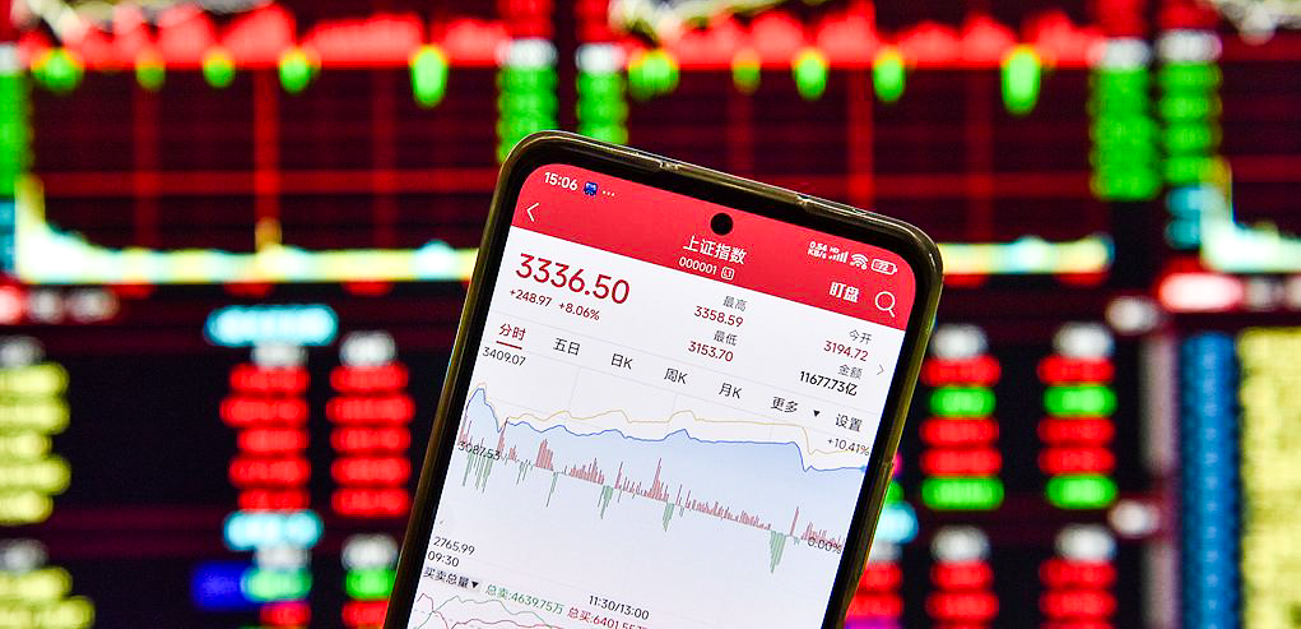
Markets behaved as expected
- the Shanghai Composite rose 20 percent leading up to the 1 October holiday, its best performance ever
- bond yields finally rose: investors moved assets to equities, ending an asset famine of concern all 2024
- for all Beijing’s efforts since 2022 to keep the RMB from further devaluing against the USD, it crossed the 7:1 redline
- real estate deals rose over the October, signalling a turn for the better
And Beijing quickly intervened to avert too much speculation. PBoC-affiliated Financial News reminded banks not to allow consumption loans, which enjoy rock-bottom interest rates, to be used on stock purchases.
the coming of forward guidance
Has the political tide turned? Not at all. The economy is still swinging on the trapeze to what the Party centre fully expects to be a more sustainable footing aligned with its ‘new development philosophy’. The latest actions have merely jolted market actors in the right direction. This reflects its belief that the economy is fundamentally sound and malaise is related to a lack of confidence. Rising asset prices should now, in principle, spark new economic activity.
The altered tone coming from monetary authorities is notable. New PBoC tools will, for starters, offer C¥800 bn in liquidity to capital markets, notes Pan Gongsheng 潘功胜 PBoC governor, rising to at least C¥2.4 tn depending on market conditions. Doing what is needed to stabilise markets and get prices rising again is the clear message—a spin on the ‘forward guidance’ US central bankers have used to mould expectations.
The July Third Plenum call to robustly manage expectations seems to be in play, thinks Luo Zhiheng 罗志恒 Yuekai Securities chief economist. Policy signalling matters, argues Zhang Ming 张明, a CASS (Chinese Academy of Social Sciences) Institute of Finance deputy director, allowing markets to imagine a rosier future.
visible hand on capital markets
Rather than a raw stimulus, the new measures and messaging are better read as a capital market boost and, above all, for equities. Expanding direct financing to serve indigenous innovation has been the aim for years, not least via VC (venture capital).
VC development was again on the agenda of the State Council executive meeting on 18 September 2024 that sought to strengthen its institutional foundations.
Yet VC funds cannot raise money for startup investment if IPOs, the PRC’s main exit pathway, fail to step up. With stock prices falling over the past three years, CSRC has restricted listings, averting further market dilution. A spike in equity prices is needed to break the trend, redirecting funds to preferred sectors.
Stocks rise when liquidity enters the market, insists Yu Yunhui 余云辉 CASS World Socialism Research Centre. Today’s bull market is due to PBoC’s ‘visible hand’ steering funds to the market by mobilising bank reserves. Macro effects on equity prices have been analysed, yet the reverse, too, matters: liquidity injected into capital markets burnishes balance sheets, allowing firms to expand.
New monetary policy tools have changed the logic of equity markets, explains Xu Gao 徐高 Bank of China Securities chief economist, creating a direct line between stocks and PBoC-created currency, with trillions in support promised. In doing so, PBoC weakens links between economic performance and prices, hinting at a market more similar to others around the world. Regulators must be watchful, preventing stock price bubbles by ensuring equity financing grows as liquidity flows in.
waiting on the fiscal side
A turning point may be at hand, contends Ren Zeping 任泽平 Soochow Securities’ chief economist. Yet sustained recovery demands serious fiscal stimulus to balance the monetary side. The Politburo urged reinforcing incremental measures on 26 September 2024, hinting at more to come.
However, NDRC's (the National Development and Reform Commission) heralded press conference conference on 8 October failed to declare the anticipated support. Markets tumbled, with the Shanghai Composite dropping 7 percent the next day.
Stimulus has been done with, for now, the NDRC implied. The next chance to strike a spark, above all via bond issuance, will be a meeting of the Standing Committee of the National People’s Congress in late October. Serious tweaking may have to await December’s CEWC (Central Financial Work Conference).
An early case in point of ‘forward guidance’, a multi-year ultra long-term bond program announced at the 2024 Two Sessions, promised observers a fiscal stimulus, flipping adverse expectations. A proposal gaining traction domestically comes from Liu Shijin 刘世锦, a former State Council Development Research Centre vice chair: C¥10 tn in bonds should be issued, and used to boost consumption, not least via public services.
Benefits are multifold, including
- generating more in-demand bonds
- raising consumption
- curbing inequality
Better use of ultra long-term bonds, as the Politburo urges, foreshadows an increase in issuance (over C¥1 tn in 2024), though it is difficult to imagine a centre committed to incremental macro controls will decuple bond issuances. The December CEWC, when Beijing outlines its economic policy for 2025, is likely to decide in favour.
economists

Xu Gao 徐高 | Bank of China Securities chief economist
Historic stock rallies on the mainland and Hong Kong can be attributed only to the 24 September 2024 press conference. For Xu, monetary easing beyond market expectations re-set investor calculations on policy. After over a year of measures locked into catchup with the economy’s slide, shock and awe are back in fashion, snapping markets into place.
With winter slowing construction in northern regions, the stimulus may go unrecorded this year, especially if complementary fiscal spending fails to come with it. Easing will indeed favour recovery, yet household and local state deleveraging leaves the Centre as the only genuine big spender on the scene. The Politburo’s call to better use ultra long-term bonds and local government special bonds hints that Beijing gets the point.
An economist with experience at Everbright Securities, UBS Securities, the WB and IMF, Xu is an associate researcher at Peking University’s National School of Development, a member of the China Chief Economist Forum, and a columnist for financial media. He holds a PhD in Economics from Peking University and an MA and BA in Engineering from Southwest Jiaotong University.

Yu Yunhui 余云辉 | CASS World Socialism Research Centre researcher
Equities are up: seeing PBoC direct liquidity to markets, investor confidence in future gains is recovering. It is a first for PBoC to wade into influencing domestic asset prices in equities, bolstering the RMB.
Orthodoxy is in error claiming boosting the monetary base must undermine the RMB: firms are nurtured by directing liquidity to production and circulation, whereas inflation is driven by directing it to consumption. A revaluing RMB is evidence of PBoC expertly curating asset prices, in this case the listed value of firms, by sending them funds.
CSRC must now change its ways. Its director’s replacement before the Lunar New Year holiday came as no surprise: curtailing listings and clamping down on trading, the regulator had hurt companies. PBoC succeeded in sparking a bull run; CSRC is on notice to ensure the run's survival.
Fujian born, Yu took a PhD from Xiamen University before working in securities firms like Haitong and Topsperity. He was appointed head of Fujian Lantian Academy while holding concurrent positions at CASS, joining the Red Culture Research Association’s academic committee. Yu is a Marxist-left voice as a columnist on finance and geoeconomics, favouring shrinking the US dollar’s influence in the PRC.