The Party promises to end discrimination against private business and solve long-standing legal issues in property rights protection.
setting the groundwork
Xi is developing an ambitious domestic agenda for his second term, commencing with consolidation of power at the 2017 Party congress. Improving property rights protection, a priority of Liu He 刘鹤 (see profile), Xi’s chief economic adviser, is high on the list. Passed 30 Aug 2016 by the Deepening Reform Leading Group, the Party’s ‘Opinions’ on the issue were finally issued in late November. While they outline a broad reform program, state media stressed a focus on protecting private property: rebalancing power between individuals and the state, and reassuring the public that their personal and corporate assets are inviolable.
The ‘Opinions’ call for
- strengthening the property rights legal system, especially through drafting the Civil Code and abolishing legal discrimination against private property holders
- resolving prominent long-standing property rights disputes, offering state compensation
- holding officials accountable for harming private business, and adopting a principle of no retroactivity and maximum leniency for private business misconduct during the early reform period
- specifying legal procedures around private property disposal to minimise impact on business and protect assets deemed irrelevant of persons of interest and their families from seizure
- maximum judicial discretion in property rights disputes, including banning use of criminal charges against private business in normal economic disputes with the state, and assuming innocence if criminal cases against them are murky
- banning official interference in court cases involving private business, and setting up a mechanism to ensure governments honour contractual obligations whoever the principals are, and pay compensation for violation
- clarifying procedures around state expropriation of collective land and private property, and the criteria, form and amount of state compensation
pardon you, sort of
Business owners fear reprisals for so-called ‘sins’ committed in the reform period, such as the appropriation of assets in the early management buyout phase of SOE privatisation from 1998-2005 (see Gu Chujun 顾雏军 profile). The system is stacked against them, with preferential treatment for SOEs, officials refusing to make due payment, and a biased judiciary. Such patterns have prompted many to nurture personal ties with influential officials, while sending assets and families overseas. The Party sought to reassure the private sector in October 2016, foreshadowing a blanket ‘pardon’, and dismissing anxieties over ‘sins’ as uncalled for.
The ‘Opinions’ direct the judiciary to bar retroactive application of laws to business practices, and make swift examples of headline cases of injustice against private business. This political gesture to stem capital flight was welcomed by advocates such as Tian Wenchang 田文昌 All China Lawyers Association criminal defence chief (see profile).
elevating the judiciary
The ‘Opinions’ assign a strong role to the Supreme People’s Court (SPC), which is eager to expand its judicial power in civil and commercial law. SPC, also the first central agency to respond, pledged to
- resolve high-profile property rights disputes with an understanding of ‘sensitivities’
- expedite overturning ‘major’ misjudgements involving executives of and investors in private enterprises
- make no retroactivity a judicial principle, taking into account that relevant laws were either outdated or nonexistent when many private businesses started
- treat SOEs and the private sector equally
- clearly distinguish economic disputes from contractual fraud, personal assets from corporate assets, and relevant from non-relevant assets
- stop courts accepting criminal proceedings to intervene in civil disputes against private parties
- make sure officials fulfil contractual obligations
In conjunction with a September document promising ‘fair and equitable application of the law with regard to private investment’, these texts show a judicial agenda aimed at not only restoring private entrepreneurs’ economic confidence, but widening judicial influence on business, ideally gaining a final say in all property rights disputes.
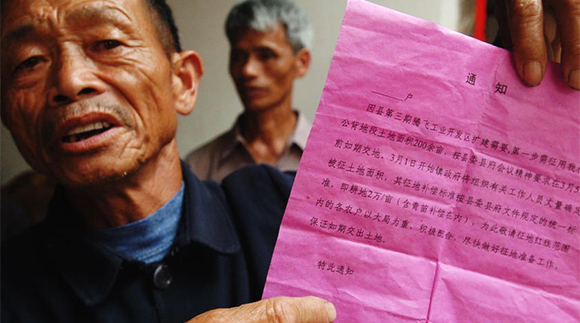
farmers hold up land seizure notice giving six days to vacate homes
state land, private house
According to the constitution, all urban land is state-owned. Local governments can lease out residential land usage rights for up to 70 years. The 2007 Property Law legislated ‘automatic renewal’ of these rights, but left out procedural details. Property owners fear high renewal fees or potential expropriation. The issue flared up in April 2016, when the local government in Wenzhou, which has anomalous 20-year leases, flagged charging users for renewals, stoking calls for national-level clarification.
The ‘Opinions’ seek to reassure on this issue, signaling the state is considering detailed regulations to clarify the procedures around renewal of rights. A recent directive from Ministry of Land and Resources (MLR) on the Wenzhou issue requires the local government to automatically renew land usage rights, and bars them from charging for the service. This indicates Beijing’s resolve to curb localities using renewals as a revenue-raising exercise.
'public interest' still hazy
Expropriating non-state property is constitutionally permitted if done in the ‘public interest’ and compensated for. But the term, and a compensatory mechanism, are left undefined, granting the state almost limitless legal power to seize collective and private property, often for little or nothing. Arbitrary seizures of land have become one of the main causes of tension in the countryside, as seizures of private housing have in cities.
The ‘Opinions’ touch upon the issue of expropriation in passing, calling for a clear definition of ‘public interest’, and a detailed legal framework and compensatory mechanism. But this passage is the most vague of the document and state media made little mention of the issue. While the Party is still committed to substantial land reform, progress will be incremental over a number of years, and will not come close to the privatisation proposals floated in 2014.
Comprehensive regulation of rural land expropriation will be based on national pilots already underway, in particular, the 33 pilots on 'three rural land reforms', due to conclude end 2017. Local governments have, however, been slow to pursue land requisition reforms in pilot areas, with Beijing recently stepping in to force their hand. A national overhaul, were one forthcoming, would need to push through severe local resistance, and requires a collective shareholding system to have teeth, not expected for at least five years.
substantive reform will have to wait
In a politically critical 2017, Xi will likely opt for symbolic moves to preserve the confidence of the private sector and urban middle class, avoiding missteps like the call to tear down urban compounds’ walls. He will defer any big push on property rights—a deep-water issue—until his second term. The PR element will be prominent, seen in instructions to the judiciary to produce headline cases promptly. The exception will be the SPC, which will be elevated at the expense of other branches of government in the shorter term.
There are other challenges awaiting a second-term push on the issue—defining which instances of business misconduct will be forgiven is legally difficult and contentious, and any proposal on land use caps may be open to accusations of privatisation. Though the legal system may better protect the private sector, business owners will still have to contend with an SOE reform plan aiming to make state firms ‘bigger and stronger’, and even more market-dominant.
profiles
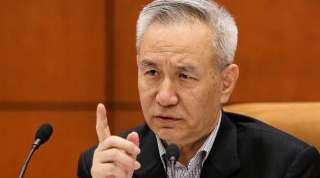
Liu He 刘鹤 | CCP Central Finance and Economy Leading Group chief of staff
Running the office of the Party’s most important economic policy agency, Liu is Xi’s most trusted economic adviser. With safeguarding private property among his top priorities, he launched research on the issue in September 2015 to ‘boost confidence of entrepreneurs’. Commenting ever more frequently on it, he often visits coastal strongholds of private firms. Announcements on the issue in 2016 end with state media identifying Liu as the mastermind behind the scenes, almost single-handedly responsible for policy details.
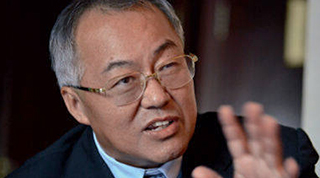
Gu Chujun 顾雏军
Trained as an engineer, Gu entered business in air conditioners and refrigerators in the 1990s. In the early 2000s, when management buyout was the default privatisation path for SOEs, he added several companies to his business empire, Greencool 格林柯尔. In 2004, however, the populist economist Larry Hsien Ping Lang 郎咸平 accused Gu of stealing state-owned assets. Portrayed in a lengthy media campaign as personifying business greed and corporate crime, Gu was arrested in 2005 and given a 12-year sentence in 2008. Released in 2012, he filed a series of lawsuits to clear his reputation, exploiting opinion shifts against Lang and populism at large. He was, he insisted, framed by corrupt officials. Though his lawsuits remain unsettled, Gu features as a prime example in current debates of the 'sins' of private businesses and the mistreatment they endure.
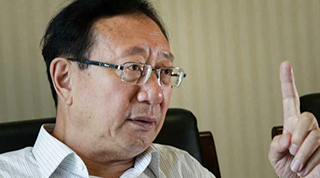
Tian Wenchang 田文昌 | All China Lawyers Association criminal defence chief
Early to practice law privately in China, and founder of major Beijing law firm King and Capital, Tian has defended entrepreneurs implicated in a series of high-profile cases. He calls for rethinking the role played in the nation by private businesses, and ending institutional bias against them. The SPC acknowledges Tian’s influence over its two new guidelines on private property law. He calls for overturning miscarriages of justice against entrepreneurs, and ending use of criminal measures to settle SOEs’ civil disputes with private firms.
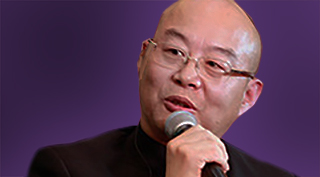
Zhisland 正和岛
Zhisland is an exclusive online community platform for entrepreneurs, scholars and journalists, set up in 2012 by Liu Donghua 刘东华 (pictured). The community has lowered its political profile since prestigious venture fund investor and member Wang Gongquan 王功权 was arrested for ‘disturbing public order’ in 2013. But members have not ceased sharp policy commentary, their discussions a litmus test of the private sector’s economic and political confidence. Zhisland sparked the discussion over the private sector’s ‘sins’ with a piece on WeChat announcing a potential ‘pardon’, followed by a conciliatory Party response.
context
23 Dec 2016: MLR directive requires 20-year residential usage rights leases in Wenzhou to be extended without fees, as a transitional measure until legislative changes
30 Nov 2016: SPC chief reform planner He Xiaorong 贺小荣 announces an agenda to expand judicial sway in civil and commercial areas
28 Nov 2016: SPC pledge courts will take ‘historical circumstances’ into account in handling disputes involving private businesses
27 Nov 2016: Xinhua publish the ‘Opinions’, passed by the Deepening Reform Leading Group in August
18 Nov 2016: Tian Wenchang calls for overturning some notorious cases against private businesses to send a clear message
17 Oct 2016: Economic Observer confirm Liu He’s push for property rights protection
12 Oct 2016: Zhisland circulate an article claiming the soon-to-be published ‘Opinions’ would pardon private businesses of their ‘sins’
2 Sep 2016: SPC issue a document, making protecting and encouraging private investment a top priority
30 Aug 2016: Deepening Reform Leading Group pass the ‘Opinions’ on protecting property rights, described by Xinhua as signaling ‘equal protection’ for all forms of ownership
31 May 2016: Liu He convenes an NDRC meeting on property rights protection in response to shrinking private investment, admitting ‘feelings of insecurity’ is a major reason
21 Apr 2016: state media agree on the need for a swift legislative response to calm down the public over urban land usage rights extensions, but differ on the meaning of ‘automatic extension’
20 Apr 2016: pro-reform scholars argue extensions should be automatic, with no strings attached
April 2016: some property owners in Wenzhou, Zhejiang, are asked to pay 30 percent on their initial property prices to extend their 20-year land leases, sparking national debate
27 Feb 2016: activist lawyers record growing use of violence in house demolition in their 2015 ‘Annual China demolition and relocation report’
24 Feb 2016: Ministry of Housing and Urban-Rural Development assure urban property owners that their rights will not be abused, and that tearing down compound walls will be done in a legal manner, foreshadowing the proposal’s shelving
21 Feb 2016: Xi proposes ‘opening up’ walled urban housing compounds to ease traffic at a meeting on urban planning, provoking wide opposition from property owners
10-11 Nov 2015: Liu He emphasises protecting property rights and entrepreneurship during a tour of Zhejiang, reiterating his message from his 8-10 October tour of Guangdong
19 Sep 2015: Liu He convenes a seminar on protecting property rights