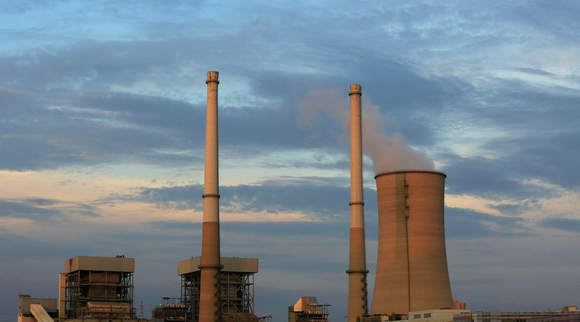
how is policy shifting?
- big-ticket carbon market reforms may be put on hold
- focus now on improving accuracy of emissions data
- pressure growing for stronger penalties for falsification
Cases of tampering with emissions data and sloppy checking multiplied in early 2022. Faking the data hurts the decarbonisation cause; the product being traded—CEAs (carbon emissions allowances)—must be trusted for the market to work. Indeed, 'data quality is the lifeline of the carbon market', declares the leading small group for Carbon Peaking and Carbon Neutrality (a cross-ministerial climate policy A-list).
Accuracy and data reliability will be scrutinised in the national carbon market, warn authorities. Likely to consume regulators in 2022, this may delay major reforms. Adding new industries to the market, or auctioning allowances et al, originally mooted for 2022, have been pushed back to 2023, according to Zhang Xiliang 张希良 (see profile). Beijing is talking up a zero-tolerance attitude to emissions fraud, but carbon market legislation needs teeth to deter would-be fraudsters.
fraud on the rise
Data forgery is committed by power plant operators and third-party consultants entrusted to monitor emissions. Such agencies were called out in March 2022 for rubber-stamping power plants’ sloppy reporting or, in many cases forging data for them outright. In one case, an Inner Mongolian power plant’s emissions were on paper reduced by some 2m tonnes, worth C¥100 million in CEAs. Found in breach, the plant had to pay for its allowances but avoided any extra penalties due to gaps in black-letter law.
As well as intentional fraud, flawed data may be due to cutting corners and inexperience. Capacity building fell by the wayside in the market’s first compliance cycle: a 2021 survey of participants found that a majority require more training in virtually every aspect of the market. Awareness of the legal framework, laments Liu Youbin 刘友宾 MEE (Ministry of Ecology and Environment), is superficial among third-party agencies.
But deliberate fraud is on the rise: data tampering services were hyped to prospective clients by one such agency. The regulatory ecosystem is lopsided: fines of C¥10 to 30K for power plants forging data pale in comparison to what they stand to gain by cheating, note lawyers from Zhejiang Jingheng Legal. As carbon prices rise, the incentive to cheat grows. Yet the upper limit of fines is, say the lawyers, constrained by the State Council’s reading of the Administrative Penalties Law. There are still no set penalties for fraud by third-party agencies. The novelty of the crime and lack of supporting black-letter law means that regulators can do no more than publicly shame wrongdoers, reports Zhejiang Jingheng Legal.
rescuing data quality
Data quality is hence an ever higher priority for policymakers in 2022. A crackdown on emissions data from April-July 2022 has been notified by the beefed-up SAMR (State Administration for Market Regulation). The leading small group for Carbon Peaking and Carbon Neutrality held a conference dedicated to the issue on 8 April 2022.
With political capital staked on the issue, regulatory shifts are imminent. MEE will update regulations, focusing on data quality, and issue new reporting guidelines later in 2022, reveals Zhang. It may explore avenues to treat data fraud as a criminal rather than an administrative offence. To this end, a joint campaign with the SPP (Supreme People’s Procuratorate) and MPS (Ministry of Public Security) was announced on 30 March 2022. This is likely to lower the boom on delinquents. MEE has also notified new transparency rules, requiring all emitters to disclose their data on a monthly basis from April 2022.
Looking further ahead, effective solutions must include top-level legislation and tech-based approaches, say experts. Introducing a dedicated Carbon Emissions Trading Law could be a solution, argues Lv Hongbing 吕红兵 All China Lawyers Association president. The Environmental Protection Law, urges Hu Chengzhong 胡成中 Delixi Group chair, should be amended to support the carbon market as well. Tech upgrades would also make data fudging much harder; carbon market players favour installing CEMS (continuous emissions monitoring systems) to measure emissions directly and eliminate fabrication. Blockchain tech could also help track emissions for more complex industrial processes, once added to the carbon market. Ant Group has already begun exploring pilot projects.
Progress on these long-term legal and tech solutions is all very well. Nonetheless, stronger penalties, oversight and capacity building are needed ASAP, say experts, to stamp out data issues before they become endemic.
who is shifting policy
SinoCarbon Innovation & Investment | 北京中创碳投科技有限公司
A leading firm in setting up PRC emissions trading, SinoCarbon was one of four bodies chastised by MEE (Ministry of Ecology and Environment) in March 2022 for 'turning a blind eye' to dodgy emissions reporting. Incorporated in 2011, the thinktank-cum-consultancy advises state and private bodies on emissions matters, including carbon data and market-based policy tools. Assisting MEE in designing national and provincial carbon markets, it is a household name among stakeholders. Yet its verification lapses have drawn slaps from MEE, who charge it with rubber-stamping fraudulent emissions reports. Managing this stigma, SinoCarbon pledges to right its wrongs by refining its internal procedures.
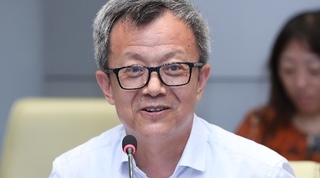
Zhang Xiliang 张希良 | Technical Expert Committee for the Design of the National Carbon Emissions Trading Scheme chief
Data quality issues are inevitable in the early stages of any emissions trading scheme, argues Zhang; just look at Europe and California. Over time, lapses will be ironed out. At the moment, explains Zhang, many data issues are due to firms’ inexperience with the market rather than deliberate ploys to cheat the system. Probes in 2019 found this to be the case in Beijing’s local pilot carbon market. Some firms seek to use loopholes regarding coal parameters, but this is strictly speaking legal and cannot be called 'fraud', opines Zhang. Yet strengthening penalties, law enforcement and corporate responsibility are, he reckons, crucial to improving data quality.
The chief architect of the national carbon market, Zhang is a professor at Tsinghua University, his alma mater, and concurrently director of its Institute of Energy, Environment and Economics. A heavyweight of PRC climate policy, Prof. Zhang’s research papers and policy input often carry the day.