geopolitics: asserting the alternative
In September, PRC global diplomacy was marked by an assertive push to build alternative global governance structures while cautiously managing Sino-US relations.
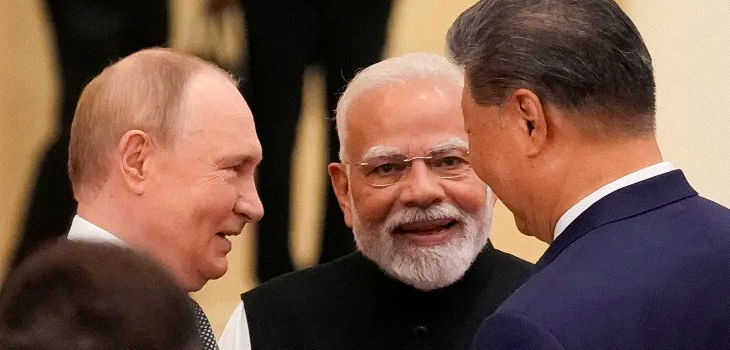
Beijing hosted the bigger and bolder 25th SCO (Shanghai Cooperation Organisation) summit in Tianjin in early September. Xi launched his Global Governance Initiative at the summit, adding to his suite of ‘Global Initiatives’.
Moving ever closer to UN-style aims, it promotes fairer and more equitable global governance, and will, according to Beijing, strengthen inclusivity, equality, and cooperation. A concept paper was issued at the same time; early reactions from scholars are emerging. Russia, Belarus, Pakistan, Malaysia, Cuba, Venezuela, and Nicaragua have expressed support or shown interest in joining.
The SCO gained observer status with the Commonwealth of Independent States.
Indian Prime Minister Narendra Modi visited the PRC from 31 August to 1 September. Analysts see modest improvements in strained Sino–Indian ties, though many doubt they will last. The summit sparked debate about the SCO’s challenges and India’s role in the group—one PRC expert called it ‘an internal cancer.’
Marking the 80th anniversary of Japan’s World War II surrender, a military parade in Beijing on 3 September displayed PRC military capabilities, including hypersonic weapons and nuclear-capable missiles.
Attending the 80th UN General Assembly session in New York, Premier Li Qiang 李强 hosted a 130-country High-level Meeting on the Global Development Initiative on 23 September. President Xi opted not to attend UNGA, read as a preference for engaging in platforms Beijing controls.
Presidents Xi and Trump held phone talks on 19 September. They were deemed ‘pragmatic, positive and constructive’, yielding guidance for bilateral relations. A rare bipartisan US congressional delegation visited Beijing, meeting Premier Li and Vice Premier He Lifeng 何立峰 to discuss military-to-military dialogue and TikTok ownership. Progress was made on resolving the TikTok dispute.
macro: cultivate demand, but through supply and structure
Deflationary pressures persisted in August, with the CPI declining 0.4 percent year-on-year and PPI falling by some 3 percent. Despite this, industrial productivity continued to expand, driven by a 9 percent year-on-year increase in high-tech sectors, which outpaced manufacturing growth by about four percentage points.
Boosts to service consumption—one for sports, one for broader measures—emerged from the State Council.
- the sports plan calls for more supply via international events, the ice-and-snow economy and new equipment, as well as financing and innovation support
- the general plan covers culture, tourism, healthcare and childcare, urging local pilots, fresh investment and tighter statistics monitoring
Both plans display a demand-supply coordination model: raising supply quality while spurring demand by curbing transaction costs and access barriers. Fifty cities will test new service consumption business models and scenarios.
Meanwhile, regulatory structures are being refined to secure financing. Party Committees of the NAFR (National Administration of Financial Regulation), PBoC, CSRC (China Securities Regulatory Commission) and the Ministry of Finance reported progress in fixing systemic flaws flagged by central inspections.
The PBoC pledged to maintain a sound monetary environment for recovery. The CSRC promised reforms to the STAR Market, ChiNext and the Beijing Stock Exchange, easing funding for ‘New Productive Forces’. The NAFR, meanwhile, raised capital guarantee deposits for insurers, ensuring funds for investment and market stability.
trade: August trade muted
Below forecasts, exports rose 4.4 percent year-on-year and imports 1.3 percent in August. Frontloading effects eased, slowing outbound shipments, while domestic demand stayed weak.
managing trade friction: Trade talks between Beijing and Washington were held in Spain. Apart from a general 'framework consensus’ on TikTok, no major progress was made on trade or tariffs. The deal reportedly transfers TikTok’s US operations to US ownership and control, with Oracle managing data security; ByteDance retains ownership of the underlying tech and IP. Making progress on this top priority issue for both Washington and Beijing could open doors to concessions on other matters.
Several strategic and targeted countermeasures were meanwhile taken against the US for deterrence
- sanctioning six US tech and security firms
- an anti-discrimination probe (second of its kind) against US restrictive measures on PRC integrated circuits
- anti-circumvention duties levied on certain US optical fibre products
Sino-US economic rivalry is reaching a point that is testing each side’s resilience, warns Bai Ming 白明 MofCOM Research Institute: the PRC will keep diversifying trade, retaliating when necessary and deepening ties with other partners.
Beijing’s multi-dimensional approach applies beyond the US. Against reports of Mexico appeasing the US via tariffs potentially levied on the PRC, Beijing warns this would risk retaliation, by
- anti-dumping probe on US and Mexican pecans
- a trade and investment barrier probe
On the domestic front, Beijing is beefing up its legal toolkit to counter foreign trade headwinds. A new draft Foreign Trade Law underscores
- reforming legal support for greater opening and aligning with global standards
- assisting distressed firms
- bolstering retaliation measures
- including tighter rules against PRC parties helping foreign counterparts to evade countermeasures
PRC remains a Global South country: The PRC will not seek new WTO S&D (special and differential treatment) in current and future WTO negotiations, Premier Li Qiang 李强 told the 80th UN General Assembly. A position paper soon followed, stressing that the PRC’s rights under existing WTO S&D rules remain unchanged, and that it remains a developing country and a member of the Global South.
Doubling down on services: MofCOM unveiled new measures to promote exports of services. No new funding is pledged, but some export champions—e.g. high-end design, R&D, IP and geographic information services—will get more support.
Growing the services trade is made more urgent by tech shifts and geopolitical pressures, explains Zhang Qi 张琦, Development Research Centre of State Council. Regulatory gaps for services trade need to be closed, argues Peng Delei 彭德雷 East China University of Science and Technology Law School dean, via gradual merger of the three current negative lists governing services trade.
Other trade developments this month include
- more policy support is pledged for innovative digital economy firms
- new guidelines for PRC firms’ overseas sustainable infrastructure projects
energy: investing in storage
Power market reform presses ahead. Shandong reported results of its tariff pricing for new renewable projects, showing a downward price trend. A notice on promoting local use of renewable power requires at least 60 percent to be consumed near source, with tougher rules to come in 2030. An action plan on new energy storage seeks to double capacity by 2027, drawing billions of RMB in investment, while new pricing tools will be rolled out.
‘Five highs’ feature in a power system highlighted by experts ahead of the 15th 5-year plan: more renewables, innovation, new market players, reliance on electronic devices and rising risk of extreme weather events, reports Ouyang Changyu 欧阳昌裕 State Grid Energy Research Institute.
Ending four decades of debate, a landmark Atomic Energy Law has been passed, effective January 2026.
A Sino-Saudi joint petrochemical and refining venture was launched, building phase II of Fujian’s Gulei petrochemical hub
agriculture: deposits, deadlines and disgrace
Anti-dumping deposits of some 16–62 percent were imposed by MofCOM on EU pork, covering fresh, frozen and offal. Higher quayside costs favour big distributors and squeeze offal importers ahead of the peak season for hotpot and preserved-meat sales. The measures run in two stages: taxing EU variety meats now and fixing traceability and hygiene when new standards for by-products and prepared meat take effect in March 2026.
An anti-dumping case on Canadian rapeseed was extended to March 2026, keeping the ~76 percent deposit set in August. Imports remain loss-making, forcing crushers to use costly substitutes. This shows that with EU dairy and pork probes nearing final rulings, extensions can be used to apply pressure in agri-trade disputes.
Former agriculture minister Tang Renjian 唐仁健 received a suspended death sentence on 29 September for allegedly receiving some C¥270 million in bribes. His fall seems to follow a now well-worn pattern, where anti-corruption and political recalibration move in tandem.
scitech: exit TikTok, enter new tech
Xi Jinping gave his nod to the sale of TikTok’s US arm. A deal in Madrid gives US investors a majority in a new US joint venture; ByteDance stays below 20 percent. US partners will control or retrain code, algorithms and content rules, with US data kept on US servers. Seeing TikTok as a non‑core tech, Beijing may trade it for tariff relief.
Brain-computer interfacing, the metaverse and quantum are to become three new pillars in the next 5‑year plan. The state may take the lead by seeding orders in such new tech, modelled on bus electrification pilots in Shenzhen that helped the rise of BYD.
Data is now backing loans in a trial. Guizhou Pinpinxian Biotechnology used two years of power‑use data to secure C¥100 million from a local bank. State Grid supplied data; Guiyang Big Data Exchange priced and set terms.
environment: underpromising and overdelivering on climate
Xi unveiled new climate targets through 2035. According to experts, the targets are unambitious, but they nonetheless amount to a step change in controlling CO2. All greenhouse gas emissions are covered, from relative to absolute emission reductions and high-emitting sectors to society as a whole. Underpromising and overdelivering has been common in areas like installing renewables and rolling out electric vehicles; previous targets were met several years in advance.
The Ministry of Ecology and Environment has reviewed the past five years' environmental achievements. For the next five, expect integrated air, water, soil and waste governance, full regional coverage, and a steady decline in PM2.5 concentrations, nitrogen oxides and volatile organic compounds.
Three more chapters of the Environmental Code dropped for public comment. Greater powers for local environmental bureaus and clearer rules on carbon market allowances will top the legislative agenda in 2026, to be discussed by the National People’s Congress.
governance: roadmap for the 15th 5-year plan
Market exit mechanisms are being refined. A draft amendment of the Enterprise Bankruptcy Law streamlines enterprise restructuring protocols. It launches personal bankruptcy measures—a first in the PRC and demanded since the 1980s—for natural-person shareholders in indebted firms.
Regulatory shifts chime with broader policy goals: the Party will present its desiderata for the 15th 5-year plan at the Fourth Plenum, 20–23 October 2025. From building a unified national market to fostering new productive forces, the Politburo promotes the plan as striving for a fairer distribution of development outcomes.