macro: steady rates, tighter planning
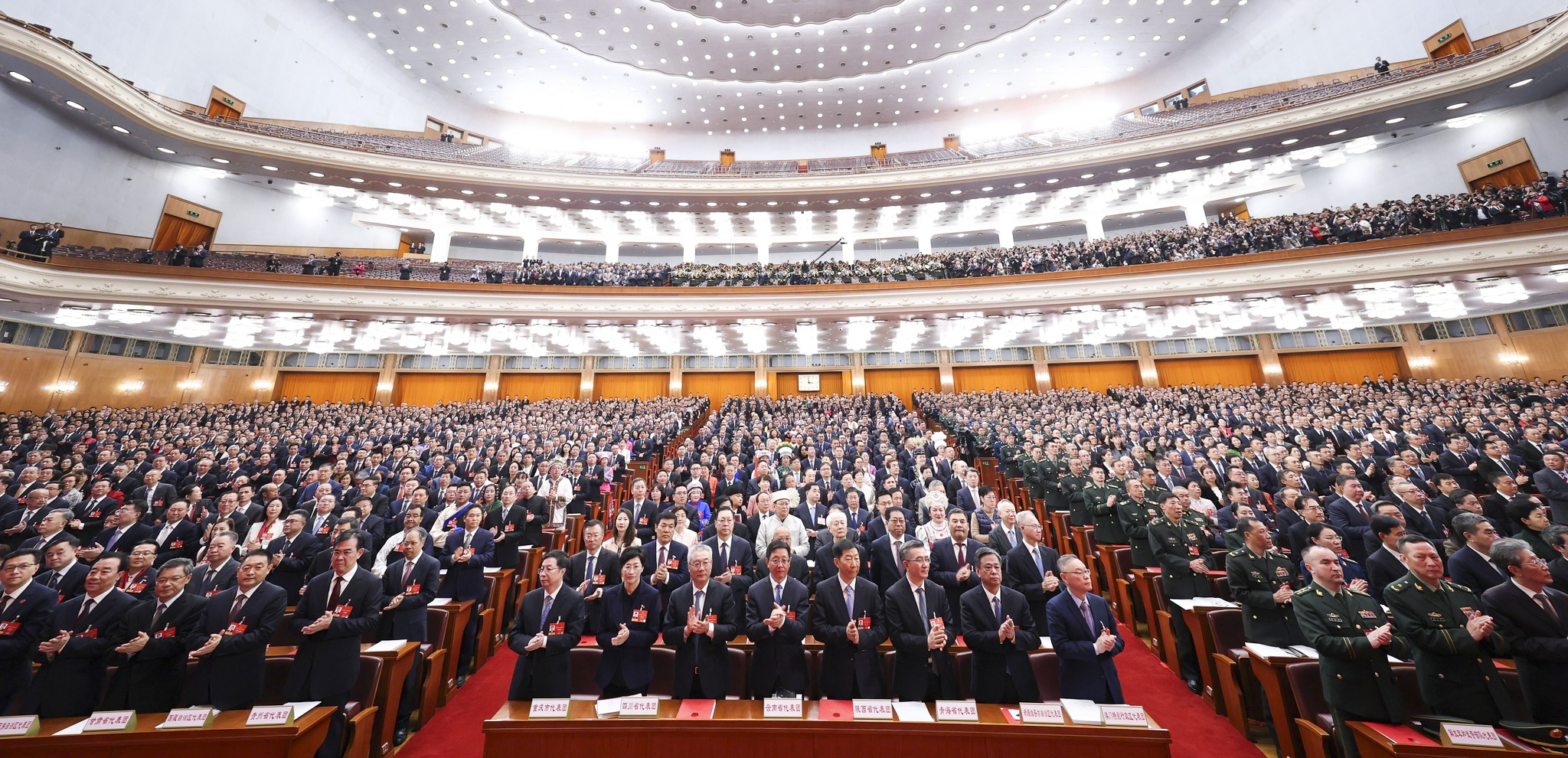
The March Two Sessions set the tone for 2026: a flexible GDP growth target of 4.5–5 percent, 'striving for higher results in actual work', leaving room for structural adjustment in weaker areas and stronger rebound in advanced regions. PBoC (People's Bank of China) held loan prime rates steady for an 11th month, signalling readiness to respond to external shocks while avoiding premature loosening amid oil price volatility. Retail sales grew around 3 percent year-on-year; fixed-asset investment rebounded to around 2 percent.
Fiscal policy remained supportive but more selective. A deficit ratio of 4 percent, C¥4.4tn of local special bonds and C¥1.3tn in ultra-long special treasury bonds maintain the high level of 2025. Project scope has narrowed, with the focus shifting to new productive forces and the 'six networks' connectivity framework.
The National Development Planning Law, adopted at the Two Sessions, places planning under more unified central control with clearer legal hierarchy and tighter enactment review. Drafting, execution and supervision form a single chain, leaving less room for local deviation. The broader implication is a reorientation of PRC economic governance away from the bottom-up experimentation that drove growth for four decades, toward centralised direction.
NAFR (National Administration of Financial Regulation) is consulting on a draft Financial Law, the first attempt at a unified top-level legal framework for the whole financial system. The draft bolsters central bank authority, formalises macro-prudential management and clarifies responsibilities between regulators. Experts welcome its ambition in integrating rules across financial innovation and cross-sector activity while calling for stronger investor protection and clearer rapid-response protocols.
trade: the services turn
January–February exports surged around 22 percent year-on-year, driven by high-tech demand and steady global orders. Imports rose around 17 percent on holiday spending, commodity stockpiling and recovering domestic demand. US-bound shipments fell 11 percent, extending a slump since early 2025, though the pace of decline has slowed.
Trade tensions flared in March. Mexico's tariffs and curbs on the PRC were deemed 'trade and investment barriers' by Beijing, with retaliation flagged if bilateral talks fail. Beijing also launched two parallel probes in response to fresh Section 301 investigations by Washington.
On 'innovative trade development', the 15th 5-year plan calls for tighter coordination between goods and services trade. PRC goods exports could fall sharply amid external volatility, warns Huo Jianguo 霍建国 of China Society for WTO Studies, who urges expanding services exports to ease surplus pressure. The 2026 Government Work Report backed this, promoting a 'China Services' brand and explicitly treating inbound tourism as a services export.
Washington is holding its most aggressive moves in reserve ahead of the bilateral leaders' meeting, argues Zhang Yansheng 张燕生 of Chinese Academy of Macroeconomic Research. Beyond the tariff truce, PRC–US rivalry continues in security, AI and finance. The 15th 5-year plan's stress on 'great-power relations as a major factor shaping PRC domestic development' reflects this: Beijing should keep 'doing its own thing well' by bolstering tech resilience and advancing industrial upgrading.
geopol: war changes the calculus
At his annual press conference on 8 March, Wang Yi 王毅 outlined Beijing's position on the major foreign policy questions of the moment. 2026 is a 'big year' for PRC–US relations, he said, with high-level exchanges 'already on the table.' Donald Trump has since delayed a long-sought state visit to Beijing until mid-May, amid the war with Iran.
On the conflict itself, Wang called it 'a war that should not have happened,' of benefit to no one, in his telling. PRC analysts are less categorical: some foresee opportunities for Beijing, not least as a mediator. They note that the war could impose unexpected costs on the US and that its trajectory remains uncertain.
Zheng Yongnian 郑永年 Chinese University of Hong Kong Advanced Institute of Global and Contemporary China Studies argues the Gulf conflict amounts to a 'religious war 2.0'. PRC experts, as materialists, struggle to grasp the region's underlying dynamics; overall understanding remains limited, he finds.
On Europe, Wang urged Brussels to hold 'a correct perception of the PRC', signalling Beijing's expectations of its partners. On the Global South: 'the PRC's heart is with the Global South, and its roots as well', reaffirming Beijing's claim to natural membership there.
energy: building the new
The Two Sessions continued the 'build first before breaking' theme. The 15th 5-year plan targets non-fossil energy at 25 percent of total consumption by 2030, while retaining a role for cleaner coal power and increased oil and gas reserves. Hydrogen received an expanded pilot: up to five city-clusters will trial large-scale hydrogen application across fuel-cell vehicles, green ammonia and methanol, chemical substitution, metallurgy and heating. Terminal hydrogen prices are to fall below C¥25 per kilogram, with some regions targeting C¥15. During the 15th 5-year plan, the industry aims to move beyond transport into power generation and storage.
scitech: AI application over frontier tech
The 15th 5-year plan concentrates on AI application in the real economy and the financial sector rather than frontier technologies yet to produce economic returns. The Government Work Report gave first priority to traditional industries, second to emerging, and third to future industries, while adding brain-computer interfaces and future energy as new sectors to cultivate.
Plans for AI integration have multiplied at the national and local levels, with little emphasis on worker displacement. MIIT (Ministry of Industry and Information Technology) is focused on upgrading traditional industries by consolidating upstream and downstream data into accessible databases for AI training. Wuxi and Shenzhen are heavily subsidising OpenClaw adoption, with proponents citing one-person companies as a vehicle for AI-driven economic transformation.
governance: execution and incentives
The Two Sessions focused on how policies are carried out and officials held accountable. The National Development Planning Law reels authority back to the centre, setting a rigorous chain from Party guidance to approval and rollout, leaving less room for local deviation and targeting longstanding problems of policy inconsistency and debt-driven projects.
Running through mid-2026, a Party campaign to 'practise a correct view of political performance' targets senior officials, aiming to curb formalism, short-termism and data manipulation. GDP growth is no longer the primary metric: weight shifts to social outcomes, environmental safeguards and development quality. The law and the campaign work in tandem; one tightens planning control, the other reshapes incentives.
social policy: the ‘1-metre height perspective’
All levels of government are directed to embed child-friendly standards across public policy, urban planning and service delivery. On aged care, long-term care insurance is being rolled out nationally with a three-year enactment target, covering employed workers, retirees, flexible workers and non-employed urban and rural residents, administered at the city level with a pathway to provincial pooling.
Medical technology oversight is shifting to 'trigger-based' evaluation, with a structured pathway for reviewing technologies already in clinical use when safety, effectiveness or ethical risks emerge. Post-market compliance and data reporting become more central to continued clinical use.
environment: codifying green development
The Ecological and Environmental Code, passed at the close of the 14th NPC, is only the second PRC code since the Civil Code (2020). It seeks to standardise and integrate dozens of laws and hundreds of regulations, while providing a framework for future climate legislation. Legal scholars have questioned its status relative to existing standalone statutes. Softer language has been introduced on industry's use of recycled materials—once mandatory, now encouraged. Changes to Environmental Public Interest Litigation mean evidence of harm must now be provided upfront, weakening its value as a preventive tool.
The Two Sessions announced a 17 percent reduction in carbon intensity as the headline 15th 5-year plan climate target. An unambitious bar, it may be met despite rising emissions. Carbon peaking by 2030 is described as 'on schedule', yet a hard target is still lacking. Priorities include a dual-control system for carbon emissions, continued new energy infrastructure build-out and a national fund for low-carbon transition.