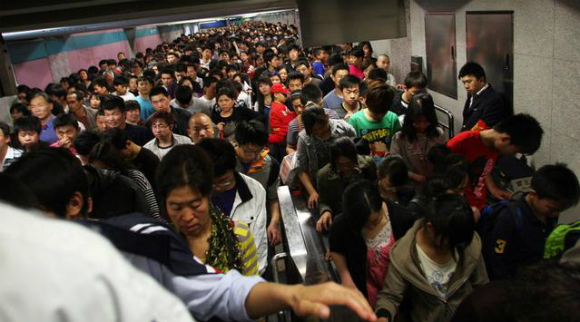
The state launched its ‘Settle in the city plan’ to give 100 million migrants urban hukou by 2020.
people-centred migration
Aiming to ‘deeply urbanise’ migrants, incentivising them to permanently settle in cities, the plan will
- ease urban hukou and residence permit restrictions, bringing migrants into urban social services
- incentivise cities to grant hukou through linking urban construction land quotas, affordable housing and infrastructure funding to number of migrants urbanised (linking land, people and money)
- encourage migrants to relinquish rural homestead land rights
- give those still ineligible for urban hukou residence permits
The plan would give access to urban social services to about half the migrants currently excluded. 'China Floating Population Development Report 2016' claims 247 million people do not reside where their hukou is registered, 18 percent of the population. This causes a swathe of problems, including left-behind young and elderly, lack of marriage partners, unused homes and land in the countryside, and social instability. Priority will go to
- long-term residents with stable employment and entire families moving from agriculture
- rural students moving to cities to further their studies or enlist in the military
- ‘new generation’ migrants, who generally have higher levels of education than previous generations and often move to urban areas straight from school
deeper urbanisation in smaller cities
Cities have benefited from pancake-like urban sprawl, exploiting rural migrant labour without having to pay for their social security. Despite long-term benefits in allowing people to properly settle in cities, localities are largely unwilling to pay for it: bringing a migrant fully into the urban fold costs around C¥120,000 per person, calculates Jinan Daily. Keeping people in cities is key to both agricultural modernisation plans, and transitioning into a consumption-driven economy. Currently, most migrants return to the countryside at around 40.
To help the struggling small-town urbanisation policy, the plan prioritises smaller cities in central and western provinces over more popular megacities. This could help soak up excess housing, a particular problem in tier-3 and -4 cities, and follows moves to limit population in megacities like Beijing and Shanghai, while promoting growth of satellite cities around them. According to the plan
- medium and large cities should not set barriers to hukou based on local housing ownership, investment or tax contributions
- cities with a downtown permanent population under three million should not implement a points-based hukou system like Beijing’s
- cities at the provincial level or below should allow university and vocational school graduates, skilled workers, and overseas returnees to settle freely
Linking land, people, and money incentivises cities to urbanise their migrant populations, helping them to overcome initial cost barriers. New construction land will be allotted to cities per person urbanised. This system favours cities with less construction land per person. Megacity downtown areas will be unable to add any new land. Cities will also be rewarded with subsidies for urbanising migrants, but central and western areas gain more than eastern ones.
trading homestead land rights
The plan encourages migrants to give up their rural homestead rights, so land left behind can be put to productive use. It calls for setting up a system for migrants to return rights to their collective economic organisations for compensation, or trade them to other peasants, stressing rural collectives cannot force migrants to give up their rights upon gaining urban hukou.
Reluctance to give up rights in return for nebulous urban benefits contributes to lagging rates of small town urbanisation. Han Changfu 韩长赋 agriculture minister argues ‘historical patience’ is needed to allow peasants to voluntarily give up what is essentially their rural safety net. Migrant workers often prefer to let family members keep their land back home at low cost rather than move the entire family to the city. Some are also concerned about missing out on profiting from increasing land value once it is transferred.
The compensation system tallies with other pilots to marketise rural land rights, allowing peasants to leave lands with enough money to urbanise. These include further opening of homestead transfers and construction land markets, turning collective members into shareholders, and allowing peasants to take out mortgages on various rights. Recent ‘Opinions’ also clarified the separation of contracting and operating rights, to further promote farmland’s marketisation.
roundtable
Chen Weimin 陈卫民 | Nankai University economics professor
Migrants distort demographic structures, imposing severe burdens on the health and aged care sectors. 90 percent are engaged in wage labour, creating a bulge of young people in prosperous coastal cities, and exacerbating the ageing trend in their provinces of origin. Policies should incentivise families to migrate as a unit, to allow working adults to take care of their parents. People’s Daily

Zhang Xiuzhi 张秀智 | Renmin University Land Management Department associate professor
Linking land to people will restrain growth of construction land, linking urban increases to rural decreases. Between 2000-11, urban construction area grew much faster than the urban population, at 76.4 and 50.5 percent respectively. Even rural villages added 30 million mu of construction land while their populations declined by 133 million. Policy should continue to continue to focus on small- and medium-sized cities in middle and western regions, where urbanisation rates are 10-20 percent. Government should also reserve space for medical and educational institutions. Liberalising land trade in villages will lead to economic and environmental losses. Unlike in the West, migration in China is one-directional, and the villages are not ready. Caixin

Tao Shun 陶舜 | Economic Observer
Opening up homestead land transfer markets is needed to encourage rural residents to urbanise. Although the plan allows transfers for compensation, this is largely symbolic, as transfers are limited to within rural collectives, and few rural residents are eligible to receive plots. Government should allow more freedom to transfer outside of collectives as this would: increase outgoing rural residents’ returns on transfers; allow more potential demand to be met; ease problems caused by separation of rural-urban real estate markets; and mitigate the social effects of abnormally high urban property prices. Economic Observer
context
14 Nov 2016: Central Economic Work Conference expected to prioritise reducing housing inventory in tier-3 and 4 cities and counties, directing peasants and university students to these areas
13 Nov 2016: Ministry of Land and Resources (MLR) announces it will allocate 12 million mu of urban construction land as part of the ‘Settle in the city’ plan, which will account for one third of the total urban construction land to be added nationally between 2015 and 2020
31 Oct 2016: NDRC issues ‘Guiding opinions on developing beautiful towns with special characteristics’, calling for completely opening up hukou and resident permit systems in tier-3 cities
27 Oct 2016: transferring 100 million rural residents to urban registration key to 5-year plan for agricultural modernisation
11 Oct 2016: State Council issues ‘Settle in the city plan’ aiming to grant 100 million urban hukou by 2020
10 Oct 2016: MLR issues ‘Implementation Opinions’ on calculating cities’ construction land quotas
5 Aug 2016: State Council issues ‘Notice on fiscal policy to support rural migrant urbanisation’, rewarding localities for granting migrants access to social services
17 Mar 2016: ‘linking people, land and money’ is listed as a central measure under the framework of new urbanisation in 2016, according to the 2016 Annual Government Work Report
15 Feb 2016: State Council ‘Opinions’ expand residence permit system for non-hukou holders nationwide
23 Jan 2016: MLR slates using its land allocation power to promote housing and urbanisation reform, ‘linking people and land’
21 Oct 2015: draft national residence permit system unveiled to equalise access to services
23 Sep 2015: State Council press conference shows provincial hukou reform is outgrowing national guidelines
30 Jul 2014: State Council issues ‘Opinions on further reforming hukou system’, calling for eliminating distinctions between urban and rural hukou and setting up residence permit systems
16 Mar 2014: ‘New urbanisation plan (2014-20)’ issued, the blueprint for China’s urbanisation strategy. Steering growth away from high-profile megacities toward smaller cities or regional clusters, the plan also pushes for ‘people-centred’ development. This would give people who have exited rural areas equal access to urban public services