the new Tariff Law promotes openness, while arming Beijing with ‘legal’ remedies to counter ‘unfriendly’ moves. Final decisions on tariffs moves up to NPC Standing Committee
Tariffs—taxes exclusively levied by the central government—accounted for some 2.6 percent of central general budget revenue in 2023. A Tariff Law was passed by the NPC (National People’s Congress) Standing Committee at its ninth session on 26 April 2024.
The new law, circulated in draft for public comment in late 2023, comes into effect 1 December 2024. Joining the Customs Law and laws on quarantine inspection, it will be a top-level enforcement reference for customs and at the core of subsequent expansion of the customs legal framework.
The Law is based on the 2023 ‘PRC export-import tariff regulations’, brought in following PRC accession to the WTO. Now putting tax into ‘law’ aligns with a ‘tax legislation’ campaign, harmonising and formalising taxation. Set up to deal with ‘new circumstances’ in international trade, not least rising protectionism and US decoupling, the law will focus as well on the strategic role of tariffs in diplomacy and trade policy.
‘taxation under the law’ vs policy needs
The new Tariff Law manifests the ‘taxation under the law’ principle for tariffs, targeting both global markets and domestic interests. Laws enacted by the NPC and its SC (Standing Committee) set out a 'fundamental framework of taxation'—as practised in advanced economies.
Yet the NPC has become an activist in tariff policy. Certain rate adjustments, formerly the preserve of the CTC (Customs Tariff Commission), must now be filed with the NPCSC or seek its approval.
At the same time, the new law retains, indeed reinforces, policy tools for the State Council and its CTC to respond swiftly to volatile global trade dynamics
- §9 adds a provision to clarify that the CTC may adjust tariffs and associated rules based on ‘actual needs’, subject to State Council approval
- §17 adds a provision under which the CTC may recommend a reciprocal response to any country or region that fails to provide MFN treatment or tariff concessions according to international agreements, subject to the State Council’s approval
- §18 adds that ‘other measures’ may be deployed along with retaliatory tariffs in responding to restrictions imposed on the PRC that contravene international agreements
Arming the State Council with more policy tools shows Beijing’s resolve to ensure that trade measures respond more promptly to macroeconomic and policy needs, argues Sun Kunpeng 孙鲲鹏 Central University of Finance and Economics. ‘Changing domestic and international situations’ entail regulating the role of tariffs in ‘dual circulation’, hence expanding the range of legal countermeasures, notes He Rong 贺荣 Minister of Justice, in an explainer of a draft law.
Beijing is not sitting back
A tougher external environment fraught with trade tension is expected to exert more pressure. Sensitive to national economic security, the PRC economy is ever more securitised.
Major trade risks, not least charges of wilful overcapacity by Western (and indeed Southern) states, place Beijing on guard to rebuff perceived unfair practices. This is seen in export controls tightening in response to semiconductor blockades. Beijing also ended tariff perks agreed with Taiwan under a bilateral agreement in retaliation for Taiwan's trade restrictions on PRC goods.
Deemed a vital partner of the PRC, Europe faces growing protectionism in its region, e.g. anti-subsidy probes. Beijing will not ‘simply sit back’. A ‘patriotic imperative’ to protect its economic and trade interests is not hard to read in the amended law.
import more
Expanding imports is another imperative, reiterated in the 2024 Government Work Report. As the PRC tariff regime further improves and matures, Sun Kunpeng notes that import tariffs may be reduced in sectors critical to PRC development, such as medical goods, raw materials, and essential equipment used in advanced manufacturing. The 2024 tariff adjustment plan released on 21 December 2023 largely echoes this, cutting rates in these areas and applying provisional rates below the MFN (most favoured nation) rate on over 1,000 items.
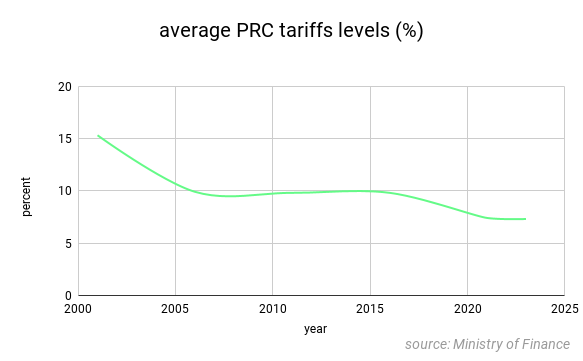
Huo Jianguo 霍建国 China Society for WTO Studies has made similar calls, urging ‘bold’ tariff cuts for environmental protection gear and high-end consumer goods. The average tariff level fell from 15.3 in 2001 to 7.3 percent in 2023.
Beijing asserts that boosting imports will remain a priority to shore up industry, improve consumer choice, reduce the trade surplus and ensure security.
aligning with global rules
Another aim of the Tariff Law is compliance with high-standard global trade rules, proclaims the Ministry of Justice. It transfers into law pilot trials and rules that echo the stringent customs and trade facilitation provisions of the CPTPP (Comprehensive (and Progressive Agreement for Trans-Pacific Partnership). Separating the release of import goods from duty determination, for instance, is acceptable (§41); confidentiality of information submitted to customs will be ensured (§8). This is a further step in the PRC aligning its regulations with the CPTPP—after ending the forced transfer of source code in Free Trade Zones—and amending the 2023 Trademark Law.
The Law stipulates that applicable tariff rates should follow relevant rules of origin, codifying the principle. To ease compliance, the relevance of rules of origin is clarified vis-a-vis WTO MFN tariff rates or those in free trade agreements. Rules of origin are further specified in two provisions of the law
- ‘originating’ status is conferred to the state or region
- where the goods are obtained exclusively
- where the last major transformation occurred
- rules of origin in treaties, etc., will be followed where applicable
This may provide a legal basis for following RCEP (Regional Comprehensive Economic Partnership) rules of origin, says King & Wood Mallesons Research Institute, averting clashes between domestic and global norms. The second provision above leaves room for rules of origin in other agreements and future negotiations.
changes to CBEC rules
The new Law deletes a self-standing chapter on tariffs for imported 'articles' (wùpǐn 物品) entering the PRC for 'personal-use', as opposed to 'goods' (huòwù 货物) for commercial purposes.
Together with cancelling import tax for ‘articles’ (combining customs duty, VAT and consumption tax on articles over a duty-free quota but in ‘reasonable’ quantity), this change implies a shift from regulating imports as ‘articles’ to ‘goods’. The trend will impact tax collection, CBEC (cross-border e-commerce), and smuggling penalties. A simplified levying protocol to replace the import tax is awaited.
The duty-free threshold for inbound articles will likely be raised, encouraging more PRC spending overseas. Many Hong Kong NPC delegates, including Xu Li 徐莉 Kowloon Federation of Associations chair, proposed at the 2024 Two Sessions that this threshold cut in at C¥30,000 rather than the current C¥5,000.
CBEC firms will need to adjust their business models in light of these changes. The Tariff Law specifies withholding tax obligations of CBEC platform operators, logistics firms and customs declaration firms. The fine for failure to withhold tax is further defined.
more to come
Taxpayers’ ‘legitimate’ rights and interests have gained more attention. They are, for example, enshrined in the Tariff Law‘s Legislative Purpose §1. Li Yao 李繇 Grandall Law Firm Customs and Tax Business Committee argues that this will have far-reaching impact on the exercise of customs power, improving levying of tariffs.
The term 'tax obligor' has also been replaced by 'taxpayer'. This is a concept enshrined in the Customs Law in 1987. Tax law has shifted from obligations alone to ‘rights’ regarding tax. Some cases in point
- extending time limits for applying for overpayment refunds from one to three years
- aligning with customs’ tariff recovery time limits
- payment of the tariff is no longer a prerequisite for administrative reconsideration
- payers to declare tariffs at the customs office of their choice
- tariffs able to be paid once a month
The Tariff Law has many innovative provisions, but some longstanding practical issues remain unresolved. For instance, the implications remain unclear of ‘commissions’ and ‘brokerage’ fees paid by the buyers in the taxable price of imported goods, notes Zhan Guohong 展国红 Dacheng (Shanghai) Law Firm.
codifying PRC taxes
Legislating PRC taxes will, it seems, continue under the broader ‘taxation by law’ campaign. As of May 2024, legislation is done and dusted for 13 of the 18 taxes in the PRC—10 adopted after 2012. Five are in the pipeline: VAT, consumption tax, land VAT, property and urban land use tax.
- VAT: underwent a second deliberation in August 2023
- consumption tax: listed as legislative projects in the 'first category' of legislative plans (13th and 14th NPCSC)
- land VAT: Ministry of Finance and State Administration of Taxation issued 'Land VAT Law (draft)' July 2019
- urban land use tax: legislation not receiving much attention
- property tax: many iterations of pilot property taxes, the latest decided by 13th NPCSC in 2021. It remains the thorniest of the taxes—just too many vested interests
tariff experts
Lin Qian 林倩 | Beijing DHH Law Firm senior partner
The Tariff Law stipulates that where taxpayers underpay or avoid duties, a late fine of 5/10,000 (0.0005 percent) of the duties will be charged per day. While preserving provisions of the 'PRC Export-Import Tariff Regulations', argues Lin, it lacks rationality or legality. Underpaying duty is less ‘criminal’ than intentional tax evasion. The law already imposes a tax ‘make-up+’ fine; adding a late fee would be vexatious.
Lin adds that products and their origins, as classified by customs authorities, bear no necessary relation to the levying of duties. Hence, the law should not deem disputes over them as tax collection disputes as this makes it impossible for taxpayers to initiate administrative litigation directly.
A customs lawyer, Lin has helped resolve tax disputes for MNCs and large enterprises, including CNPC, Japan’s Toshiba Corporation, South Korea’s Samsung, etc. Formerly a senior legal expert of GAC (General Administration of Customs), he is now an adjunct professor at China University of Political Science and Law and a decision-making consultant at the China Customs Brokers Association.

Tu Xinquan 屠新泉 | UIBE (University of International Business and Economics) WTO Research Institute director
The PRC is now implementing temporary import duty rates below its MFN rates on over 1000 items in its 2024 tariff adjustment plan, notes Tu. This demonstrates the country’s determination to expand its opening to the world and share its booming market with the world, says Tu. He adds that FTAs are also a key instrument for the PRC to lower tariffs, further its economic interdependence with other countries, and expand its ‘circle of friends’.
Tu received his doctorate in international trade at UIBE. His research focuses on PRC trade policy, WTO, government procurement and US-China trade relations. He is a 13th Beijing Municipal Political Consultative Conference member and a foreign trade expert for MofCOM’s Advisory Committee on Economic and Trade Policies. Tu has conducted research projects for the China Social Science Foundation and the Ministries of Commerce, Education and Finance.

Wang Xiaohong 王晓红 | China Centre for International Economic Exchanges (CCIEE) Information Department deputy director
Expanding imports is essential to the PRC from both international and domestic perspectives, proclaims Wang. On the one hand, they provide more opportunities for world economic growth and help maintain stability in PRC foreign relations. On the other hand, imports play an irreplaceable role in ‘dual circulation’–consuming more high-quality goods and services is critical in shaping the PRC as a ‘strong trading nation’.
In analysing import tariffs, Wang suggests to compare the PRC with CPTPP countries. She believes this can help generate valuable proposals to aid the PRC’s accession and compliance with the mega Pacific trade pact.
Wang, a CASS PhD in economics, focuses on international trade, investment, and service economics. Her reports have been submitted to PRC leaders such as President Xi Jinping and Premier Li Keqiang. A prolific commentator and author, she has led or taken part in over 50 national-level projects, including 15 as project leader for NDRC, MofCOM or MIIT.
context
26 Apr 2024: Tariff Law adopted, takes effect from 1 Dec 2024
10 Nov 2023: GAC releases revised ‘Customs Law (draft)’ for public consultation
1 Jan 2022: RCEP enters into force in China
29 Apr 2021: Customs Law most recent modified
1 Mar 2017: 'Export-import tariff regulations' revised for the last (fourth) time
1 Mar 2005: GAC released 'Management measures on tax collection of imported and exported goods by customs'
3 Sep 2004: State Council issued 'Regulations on origin of imported and exported goods'
23 Nov 2003: State Council issued 'Export-import tariff regulations'
22 Jan 1987: sixth NPC Standing Committee adopts Customs Law