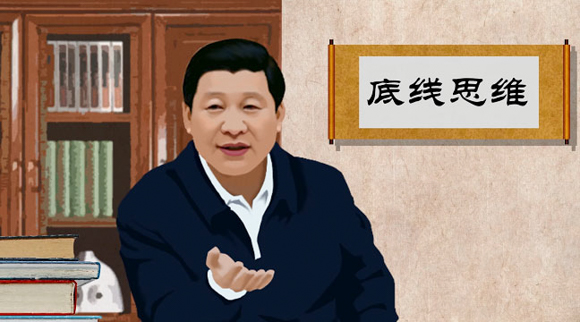
baseline thinking shores up outcomes, but will it propel Xi Jinping Thought into the company of Mao and Deng?
Launched 2017, ‘Xi Jinping new era thought on socialism with Chinese characteristics’ was a bid for Xi’s aura and agenda to displace his predecessors’, surmounting even those of Mao and Deng. The July inauguration of a Centre for Research of Xi Jinping Thought on Diplomacy is the latest extension of this bid.
Much of the content of Xi Thought however is commonplace: the dramatic hooks and catchcries of Mao and Deng Thought are lacking. Enter ‘baseline thinking’ 底线思维, a compact buzz-term recently invoked in regard to the Party’s tough measures against COVID-19.
A common expression in current ethical debates, ‘baseline’ indicates the absolute limit of some value, but new connotations are being added. The use and implied meaning of baseline thinking in many domestic spheres, and on the global stage where it is quite a bit narrower in meaning, will demonstrate its versatility.
the national baseline
Domestically, baseline thinking is called on in field after policy field to invoke worst-case scenarios. Some examples
Cybersecurity: A set of ‘seven baselines’ for a ‘healthy online environment’ was foreshadowed in 2013.
Poverty alleviation: A high priority for the Xi administration, it must deal in outcomes, not intentions. Epidemics and floods provide no pretexts for failing. Baseline thinking in Party and state agencies keeps officials focused on realising top-down directives; it connects to the Party loyalty/sincerity complex.
Macroeconomy: Zuo Xiaolei 左小蕾 independent economist explains the dramatic new paradigm of ‘dual circulation’ in terms of baseline thinking. Framing it as essentially defensive, defined by worst-case scenarios, she cites nameless ‘inalterable reasons’ for China’s loss of development prospects in the advanced Western economies.
Rural governance: This week, Zhou Zhihong 周志红 Party secretary of Xiantao, Hubei, cited the imperative to strengthen baseline thinking in response to a deadly flash explosion in a chemical factory. Hygiene must be rigorous, safety requirements better understood, and both enforced in a ‘harder style’. Thus, the Beijing refrain structures admonishment in a rural centre.
Top-down calls can run into trouble when they reach the grassroots. Warnings to avoid formalism and bureaucratism are instructions for officials to ‘do something’, but not simply for the sake of appearances: local cadres must be on the front foot when toeing the Party line. Shortcomings, such as inadequate adherence to safety standards, are easy to chastise, but experiments that depart from the baseline bear severe political risk, and are viewed as disloyal (and ‘insincere’). Sounding the alarm over a new and unknown virus spreading through Wuhan was a case in point: public-spirited as it might seem, the Party baseline was divorced from that of the public.
global impact: zero sum vs ‘least worst’
A different ideological setting operates in foreign relations. In a recent op-ed, Xi apostle Zhang Weiwei 张维为 builds a narrative aiming squarely at Western criticism of Beijing’s Hong Kong policy: baseline thinking is precious Party IP, expressed by Chairman Xi in a strict line of descent from strongman-intellectuals Mao and Deng. Zhang claims a single lineage that runs from Mao and Deng and extends to Xi.
at the end of the day
Baseline thinking functions as a master control, taking on more or less benign implications for lower-order policy measures, e.g. in COVID-19 response, Hong Kong policy, the South China Sea and the India–China border, depending on upper-level needs. On the domestic side, the result is variable. Deng’s reforms started by ending the vicious, overwhelmingly zero-sum doctrinal struggles of the late Mao era. Many, though not all, state–society tensions could then be eased using least-worst strategies.
It is when baseline thinking is transposed to the global arena that deep troubles emerge. ‘Least-worst’ strategies are read by counterparts as ‘zero sum’—ironic given Beijing’s huge propaganda attack on ‘Cold War’ thinking. Thus implicitly for Zhang Weiwei and palpably for Western observers, Beijing’s national security law in Hong Kong is zero sum. For one side to gain, the other must lose.
‘Dual circulation’, less explosive politically yet powerful in its economic implications, has not yet, according to Zuo Xiaolei, been equipped with all the baseline thinking it requires. Its essentially defensive motivation, she tells us, arises from ‘inalterable reasons’ separate from mere trade frictions.
Leaving aside the effects of Trump and COVID-19, it is hard to think what these reasons could be apart from blowback arising from the ‘going global’ policy of 20 years ago and its extensions. At the very least, ‘dual circulation’ will be hard to sell as a win-win outside of the PRC.
profiles
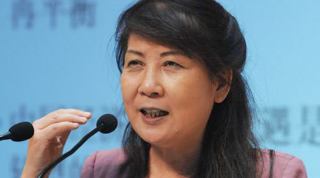
Zuo Xiaolei 左小蕾 | independent economist
Zuo has been State Council counsellor and Galaxy Securities chief economist. She co-wrote confidently in the past (with Lin Yifu 林毅夫, Peking University National Development Research Institute professor, at that time also a State Council counsellor) about the prospects of BRI building industrial parks in Africa. She had attracted notice earlier: ‘“The government has to move before the bubble bursts and destroys the overall economy,” said private-sector economist Zuo Xiaolei in unusually frank comments to state-run China Daily newspaper’ (cited in Foreign Affairs, 2010).
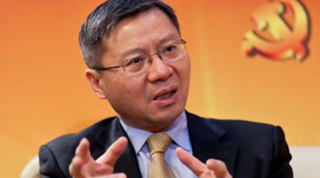
Zhang Weiwei 张维为 | Fudan University China Model Research Centre director
‘One of China's leading and best-known thinkers’, Fudan University graduate Zhang has long been convinced of Western decline due to civilisational decadence combined with arrogance about its political system. He is known as a Xi surrogate, invoking ‘baseline thinking’ to frame Xi Jinping Thought as early as 2017. Selling over a million copies globally, Zhang’s book The China Wave (2014) claimed it is ‘unimaginable that most Chinese would ever accept multiparty democracy.’ He is a former visiting fellow at Oxford University, was professor of international relations at the Geneva School of Diplomacy and International Relations and senior research fellow at the Centre for Asian Studies, University of Geneva.
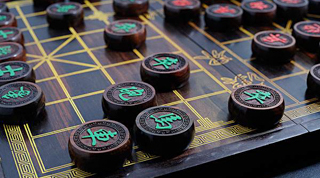
zero-sum strategy and least-worst strategies
By-products of game theory, the now-common terms ‘win-win’ and ‘zero sum’ are basically opposites. Zero-sum loosely describes winner-take-all contests, where failure to win means annihilation, hence drawing is as bad as losing. Games in chess tournaments (as opposed to stand-alone games) are ‘not zero sum’: a draw can be highly desirable, sometimes adding up to an overall tournament win. ‘Least-worst’ situations take stock of worst-case scenarios; a loss now may add up to a win in further rounds. While inferior to a win, a draw is on this score certainly better than a loss.