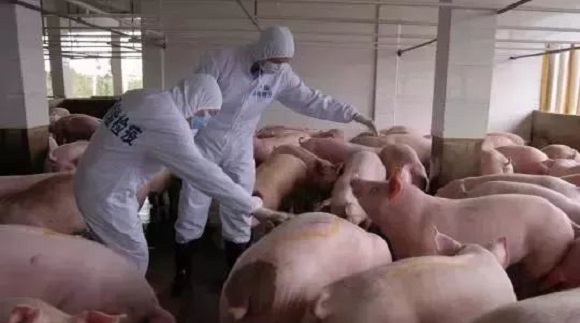
state efforts to control ASF too late to prevent impacts on domestic farming and global economy
In August 2018, China’s Ministry of Agriculture and Rural Affairs (MARA) reported the country’s first outbreak of African swine fever (ASF), a viral disease that spells disaster for any infected pig herd. China is the world’s largest producer and consumer of pork, and last year was home to some 400 million pigs—over half the world’s total. Despite driving China’s vast feed grain and oilseeds imports, the live pig population has fallen nearly 20 percent y-o-y, reported Tang Ke 唐珂 MARA market information department director on 17 April. Tang projects pork prices will increase by some 70 percent over the next six months. As the live pig population falls and prices hit historic highs, trade partners must prepare for a rapidly evolving market.
What is ASF?
African swine fever is a virus that infects pigs and wild boars, spreading through tick and fly bites, direct contact, and feeding of offal, table scraps and other protein sources derived from sick pigs. ASF is highly contagious, with no known vaccine or cure and nearly 100 percent mortality. Pigs that survive may become lifelong carriers who are often asymptomatic but continue to infect others. In less developed countries with new outbreaks, 30 to 50 percent of the total pig population may be lost to the disease and related culls.
Endemic in sub-Saharan Africa, the first isolated ASF outbreaks began in southern Europe in the 1960s and 70s and spread to France, Belgium, and the Netherlands in the 1980s before entering central and eastern Europe in the 2000s. In 2007, an outbreak in Georgia was linked to pork from southeast Africa. From there, the disease spread to Russia and Central Asia, where regular outbreaks have been reported since. China’s first reported case (August 2018) occurred roughly 600 km from the border with Russia. ASF management requires
- extremely strict control of pig feed to exclude any infected material
- eradication of wild boars as a route of transmission
- rapid diagnosis, slaughter and disposal of all animals where an outbreak is reported
- complete disinfection and de-insectisation of affected farms
China’s first outbreak was reported 3 Aug 2018 in Liaoning province. Less than 1,000 pigs were culled, and the outbreak was immediately declared ‘contained’ by local officials. Two weeks later, a second case was confirmed by MARA in Henan province, over 2,000 km south of the first. Just 30 pigs were culled there, but reports surfaced that some may have been sick as early as April 2018. MARA responded by blocking transportation of pigs and pork out of areas where the disease was reported, and publicly declared each outbreak ‘under control’. Privately, industry analysts speculated that underreporting was rampant and by December 2018, the disease was confirmed in most provinces. In February 2019, prices for broiler chicks spiked to record highs, suggesting companies expected a great deal of future demand for chicken.
China consumes over 30 kg of pork per capita every year—by comparison, the US consumes just over 23 kg. Pork makes up more than 60 percent of all meat consumption in China, and is such a staple that in many regions the word for meat refers only to pork. The national diet is slowly diversifying to include more poultry, fish, beef and sheepmeat, but pork will likely account for the majority of meat consumption through 2030. A vast population demanding plentiful, healthy pork at low prices: the vulnerability is built-in. Apart from biological and economic risks, we see the implicit risks of industrialising what was once a very local industry which rarely transcended county-scale marketing regions.
By late March 2019, rapid falls in live pig population were showing up in public reporting of province-level ag data. More worrisome, however, were rumours that ASF had struck piglet breeding bases that supply most large-scale farms. Publicly, Yu Kangzhen 于康震 MARA vice minister hailed efforts to slow the spread of ASF, noting blockades had been lifted in almost all reported outbreak areas. While he described the fight against ASF as a ‘long-term battle’, his upbeat comments were inconsistent with MARA’s own data, which show prices for pork, live pigs and piglets rising, amid a substantial drop in the pig population.
high fever
On 22 March, MARA finally moved to stabilise the sector, promising a targeted subsidies and other support including new approaches including
- extending temporary fiscal support to large-scale farms
- pushing financial institutions to provide bridge loans for pig producers
- ensuring breeding farms are monitored and guaranteed sterile transportation
- setting up inter-province disease control systems including delivery of feed to large-scale operations
Data published by MARA on 8 April shows breeding sow population has declined by 28 percent y-o-y in Jiangsu, 26 percent y-o-y in Henan and Guangdong, 23 percent y-o-y in Jilin, and over 16 percent in Chongqing. On some key breeding bases, pig population has indeed fallen to zero.
outlook
We have not yet seen the full scope and impact of ASF, but it is already clear the epidemic will reshape China’s pig farming sector. Small-scale farmers, already under extreme pressure from tighter environmental regulations, will likely be decimated by the disease. Larger players will only survive inasmuch as they are able to manage biosecurity to exacting standards. ASF has already spread to Vietnam and Cambodia, and feed demand will fall further across the region as the disease progresses.
There are some bright points. ASF’s spread has been accelerated by practices like widespread use of untreated kitchen waste as feed and long-distance transportation of live pigs, rather than transportation of frozen pork (see context, below). There will be more pressure than ever to formalise feeding practices on China’s pig farms, and explicit efforts to shift consumers’ preferences away from ‘fresh, never frozen’ pork supply. Both stand to improve food safety, and both benefit international suppliers of feed and pork. China’s poultry, beef, and aquaculture sectors will also grow as high prices and disease fears cause consumers to seek alternatives to pork. Traders will look abroad for meat as well, further benefiting countries that can supply animal protein to China.
The ASF crisis bears a family resemblance to a series of national-level problems—food safety, factory explosions and so on—regularly in the headlines. This family of problems has some powerful political (or governance) vectors, all of which share a key element of scale. When things go wrong, they seem to go wrong on multiple levels—national, provincial, regional, local—at once. African swine fever is no exception, rapidly developing from an isolated infection into a substantial macroeconomic threat through local mismanagement and central delay. Though domestic sources insist CPI growth will be controlled to within three percent this year, international analysts have called attention to 2007, when the spread of blue ear disease caused pig population to fall 20 percent, driving a 6.9 percent CPI rise and pushing inflation to nearly five percent. China’s economy has shown signs of revival from the 2018 slump in recent weeks, but risks remain, and food price increases are among the most visible and sensitive issues for domestic consumers.
roundtable

Yu Kangzhen 于康震 | MARA vice minister
Before he was promoted to vice minister of the former Ministry of Agriculture in 2013, Yu held leadership positions in National Livestock Station and China Feed Industry Association and was the state’s chief veterinary officer 2008-13. He is known for his contributions to bird flu virus identification and vaccine development. After the 2018 MARA consolidation, Yu was placed in charge of livestock, poultry, fisheries and veterinary work. Yu is on the front line of ASF prevention and control work. During ASF control training in January 2019, Yu argued the virus first entered China in June 2018 or even earlier.

Feng Yonghui 冯永辉 | Soozhu Net chief analyst
China’s leading pig farming analyst, Feng was the only third-party evaluator approved to provide feedback on pig and pork price regulation during price reforms in 2009. He helped develop monitoring and early warning software used by regulators to help ensure stable market conditions, and his ‘Who controls China’s pig price’ report series is authoritative. In the wake of ASF outbreaks, he has spoken with dozens of publications at home and abroad, describing conditions that may have spread the disease, risks to the industry in coming months, and why farmers and local officials are unlikely to cover it up. Feng started his career in market research roles at China Feed Industry Association Information Centre and China Animal Husbandry and Veterinary Medicine Association before founding Soozhu in 2007. His platform is China’s first (and foremost) commercial pig monitoring service.

Zhu Zengyong 朱增勇 | CAAS Ag Information Institute vice researcher, MARA livestock products trade chief analyst
Zhu’s research in livestock and poultry covers both the international market and trade patterns, as well as the domestic industry chain and pricing. He leads research on livestock products for China’s Ag Outlook, published annually in late April. He is not optimistic about the feasibility of slaughterhouses and farms launching ASF self-testing due to concerns that small-scale operators cannot afford the high cost. Amid increasing calls to relax transportation restrictions and facilitate pig circulation, Zeng insists on tight transportation regulation due to concern over poor inter-province ASF supervision and high risk of spreading ASF at a larger scale. He predicts pig prices will further rise in coming months as pig stocks fall through April.
context
16 Apr 2019: MARA released ‘Notice on strengthening African swine fever (ASF) investigations in farming process’, pushing farms to launch ASF self-testing
4 Apr 2019: Three central agencies released 'Notice on strengthening African Swine Fever (ASF) testing during processing and circulation', targeting pig downstream industries
8 Apr 2019: ASF spread to Xinjiang and Tibet, leaving Hainan province the single provincial administration without reported ASF cases 19 Mar 2019, Yu Kangzhen 于康震 MARA vice minister announced blockades had been lifted in 93 percent of all reported outbreak areas
15 Mar 2019: MARA released ‘Notice on strengthening African swine fever (ASF) testing during pig slaughter’, requiring all slaughterhouses to launch ASF self-testing by July 2019
February 2019: ASF detected in processed pork products
29 Jan 2019: MARA issued ‘ASF epidemic emergency plan (2019)’, offering guidelines for epidemic reporting, identification and emergency response
January 2019: MARA lifts ban on pig blood products in livestock feed
1 Jan 2019: State Council disciplines 223 local officials for ASF prevention and control failures
27 Dec 2018: MARA refines regulations on transportation of live pigs and pork products’, allowing pigs from outside infected counties to be transported across province lines after they test negative for ASF
14 Nov 2018: MARA and Ministry of Transportation strengthen supervision on live pig transportation, closing all green channels for livestock
24 Oct 2018: State Council General Office issued ‘Notice on further ASF prevention and control’, banning use of kitchen scraps as pig feed and requiring strict monitoring of long-distance live pig transport vehicles and shipments
30 Sep 2018: MARA and General Administration of Customs blocked pork imports from Belgium, Bulgaria and Japan on ASF fears
29 Sep 2018: MARA announces strict punishments for any illegal purchase, sales and transportation of infected pigs, and for local public officials who illegally issue certificates or perform poorly
11 Sep 2018: MARA banned pig blood products as an ingredient in livestock feed
1 Sep 2018: State Council General Office issued ‘Notice on prevention and control of African swine fever and other livestock epidemics’, restricting the transportation of pigs in all areas
16 to end Aug 2018: five new cases detected in Henan, Jiangsu, Zhejiang and Anhui, and 38,000 pigs have been culled during inspections
8 Aug 2018: MARA released a comprehensive plan on live pig movement supervision and ASF prevention and control
7 Aug 2018: MARA deploys works for ASF control, calling for broad inspection, early detection, quick response and strict disposal
3 Aug 2018: MARA reports China’s first ASF outbreak in Liaoning
Oct 2014: China launched first campaign on ASF prevention and control at Heihe port along China–Russia border
2 Dec 2012: Ministry of Agriculture (MoA) released China’s first ASF prevention plans, in response to ASF outbreak and spreading in Ukraine and Russia
20 May 2012: State Council released ‘national medium and long-term animal disease prevention and control plan (2012-20)’, ASF was listed as a level I exotic animal disease for special prevention measures