Beijing is pursuing financial great-power status while keeping its capital account closed
Offshore finance, widely understood as providing financial services to a jurisdiction's non-residents under a lighter regulatory regime, is becoming a buzzword in PRC policy circles. Beijing is now giving the concept its own twist: some offshore finance is urged to take place ‘onshore’ while ringfenced from the domestic system inside the Shanghai FTZ (free trade zone).
Policy is moving quickly on this front, unsurprising given several top priorities are served at once
- helping PRC firms expand abroad
- internationalising the RMB while keeping capital controls
- reducing reliance on US-dominated financial systems
A dedicated action plan is kickstarting a pilot in Pudong. The district’s latest 5-year plan calls offshore finance the ‘breakthrough point’ for moulding Shanghai into a global financial hub, with detailed targets following in three stages: groundwork by 2027, a more mature system by 2030 and a strategic hub coordinating onshore and offshore markets by 2035. The push, admit experts, remains premature. But Beijing's new policy vocabulary deserves attention.
‘offshore finance great power’
PRC doctrine has long insisted the country, already a great power in trade and industry, is not yet a great power in finance. Efforts are underway to close that gap, suggest Lian Ping 连平 China Chief Economists Forum chair and Deng Zhichao 邓志超 Shanghai Academy of Social Sciences Institute of World Economy. They assign a key role to offshore finance in that transition in their March 2026 article ‘A layered expansion of the definition of offshore finance from the perspective of national overall development’ (International Economic Review, 2026, No. 1, pp. 135-161).
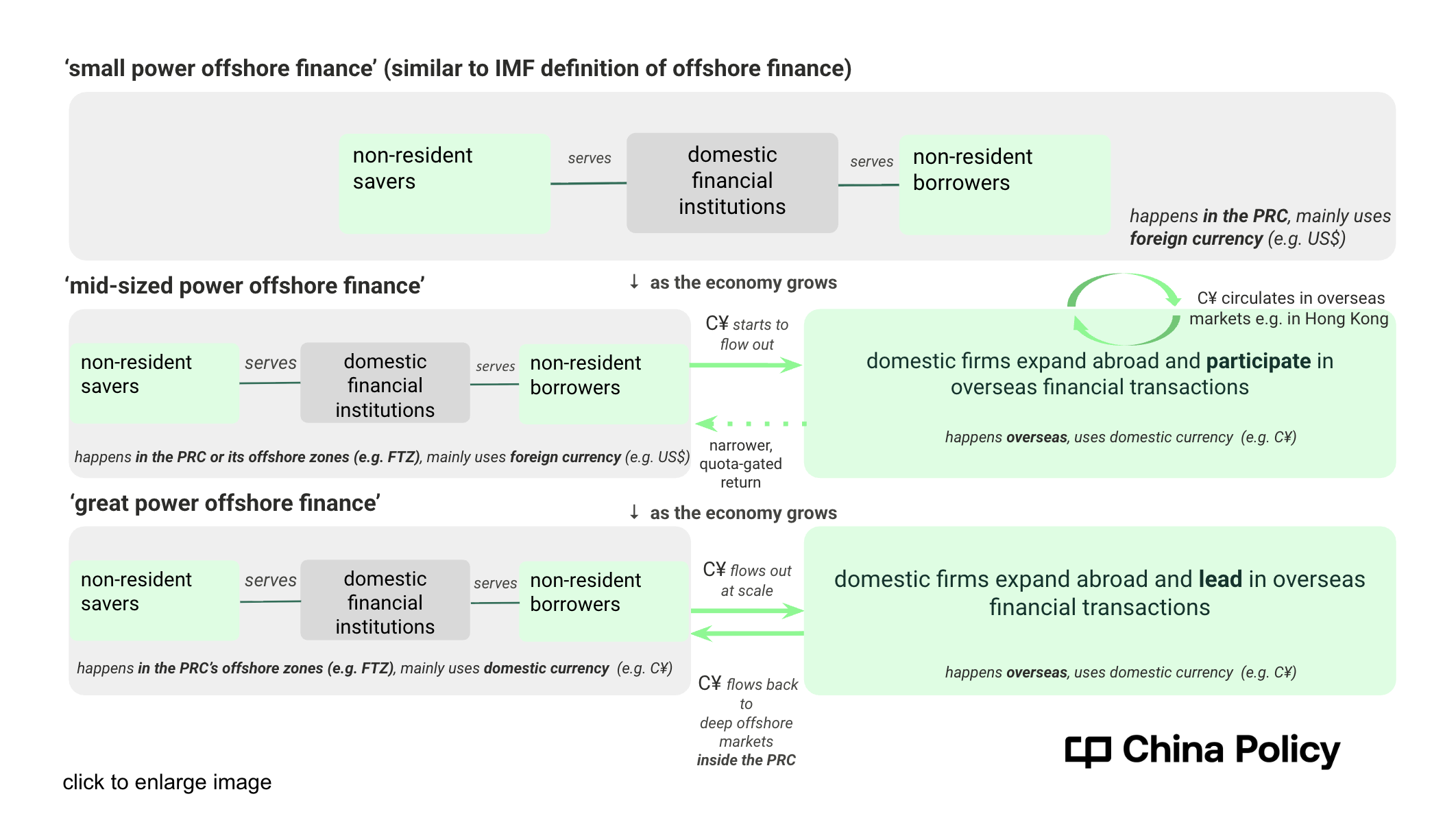
The IMF’s definition, ‘domestic financial firms serving non-residents in foreign currency’, only fits small economies, they argue. That is loosely where the PRC sat early in the reform era. In a mid-sized economy, the currency starts moving offshore, though the domestic offshore zone still trades mostly in foreign currency. A great power operates on another level: its own firms and institutions lead offshore trading in a home currency now in international demand.
Its financial markets, in turn, draw those funds back, forming the ‘two-way capital flows’ long envisioned in authoritative texts. The PRC is now pivoting from mid-power to great power, the two write, in an implicit parallel with the US’s own trajectory.
how offshore finance grows with the economy
serving overseas investment
Spurring offshore finance serves Beijing’s decades-long push for firms to ‘go global’. As supply chains restructure amid rising external headwinds, PRC firms’ overseas model shifts from discrete exports to full supply-chain relocation and direct investment abroad, driving up demand for such offshore financial services as cross-border cash management and FX hedging. Integrated circuits, biomedicine and other leading industries need ever more serious overseas services and financing as they go global; Shanghai’s offshore finance push can help meet these, observes Lin Ying 林莹 Agricultural Bank of China.
Under the action plan, Shanghai-based financial firms can offer offshore services to designated going-global firms via FT accounts (free trade accounts). Domestic capital, with its lower costs compared to dollar funding, now has a compliant channel to fund PRC firms’ overseas subsidiaries and Belt and Road partners’ investments, smoothing cross-border payments and speeding settlement, argues Dong Ximiao 董希淼 Merchants Union Consumer Finance.
There is a competitive stake too. PRC firms own and build much of the world's shipping, but Western institutions capture most of the fees for insuring and financing it, revenue PRC institutions should reclaim, notes Lian.
Policy rollout has been swift. Shanghai’s offshore trade finance pilot now enables real-time settlement for chip orders routed through Shanghai, with buyer and seller both outside the PRC. Such orders were once bogged down in paper and case-by-case bank review. Targets followed too: cross-border RMB settlement via Pudong is forecast to hit C¥15tn (~US$2.23tn) by 2030, up from C¥12.4tn (~US$1.84tn) in 2025. A separate city-wide plan sets a cumulative offshore-trade target of over US$500bn for 2026–30, up from US$383.5bn in the previous five years.
globalising a managed RMB
A key benchmark for currency internationalisation is its wide use by non-residents for trade, pricing and reserves. Pushing offshore finance targets this benchmark, Deng suggests. Offshore RMB trading, he notes, is currently the clearest shortfall behind the RMB’s lagging position in international payments relative to the PRC’s economic weight.
New measures target two practical bottlenecks: access to currency markets, and the ability to turn bond holdings into cash. Six mainland banks were authorised in June to trade offshore RMB against foreign currencies on a Shanghai FTZ platform open since December 2024; overseas arms of five mainland securities firms followed on 21 September as the first brokers, taking participants to 92.
A new repo facility lets foreign central banks and similar institutions borrow RMB against high-quality PRC bonds for up to three months, raising cash without selling, at rates tied to the PBoC (People’s Bank of China) policy rate. Neither measure widens convertibility, and the capital account stays tightly managed.
The PRC’s closed capital account largely explains Beijing’s enthusiasm for offshore finance. The onshore market cannot liberalise much in the short term. Beijing therefore needs a specific, lightly regulated channel that provides rising volumes of RMB-denominated capital abroad with a market for investment. Offshore finance in Shanghai serves this purpose, while its FT accounts ringfence offshore from onshore funds, sequestering unwanted risk.
This works on three fronts, explains Deng: offshore hubs act as ‘liquidity reservoirs’, letting RMB circulate abroad without pressuring onshore markets; as pricing testing grounds, letting onshore–offshore rate gaps narrow gradually rather than inviting arbitrage; and as investment conduits, drawing overseas capital towards RMB assets.
sheltering from sanctions and shocks
Leading PRC experts also frame offshore finance as a response to US trade and financial restrictions. Washington’s recourse to dollar sanctions forces firms and governments to diversify away from the dollar and look for safer places to park money, argues Lian. Offshore finance’s role is shifting accordingly, he says, from a focus on tax savings to safety and backup, an opening Shanghai now aspires to fill.
Offshore finance shields the PRC from outside shocks, just as the world grows riskier. Fully opening the capital account invites contagion, notes Deng, as the 1997 and 2008 crashes and other recent blow-ups showed. An offshore buffer works differently: seepage between onshore and offshore is limited, while offshore stays fully open to international finance, making it a transition zone that contains contagion and allows Beijing to pace capital outflows.
Since offshore markets remain within the PRC financial system, regulators can still apply macroprudential tools (rules that guard the financial system as a whole) through them, adds Lian. Beijing thus gains a direct transmission channel into the offshore market that Hong Kong cannot offer.
closing the loop
One theme drives Beijing’s ambitions for offshore finance: fostering two-way capital flows, to which the 15th 5-year plan’s call to ‘expand international circulation’ alludes. As the diagram shows, that flow never took shape under the ‘mid-power’ paradigm, but sits at the heart of the great-power paradigm. Washington has long been deemed to draw outsized financial reach from a two-way system that recycles dollars via current account deficits (importing more than it exports) and Treasury purchases.
The lesson extends into trade. PRC experts converge on a mirror version: a manufacturing-driven current account surplus paired with a financial account deficit (more capital flowing out than in), exporting RMB through outward investment. Offshore finance is the vector for that loop, sequestered and tightly managed. Whether this directed version can earn the depth and trust the dollar’s open system built remains the question hanging over the project.
Tax is the wildcard. The action plan attaches tax due diligence and reporting duties to pilot businesses but offers no preferential treatment for offshore finance. The only offshore-specific relief so far is a stamp duty exemption on offshore merchanting contracts (goods bought and resold abroad without entering the PRC) in selected free trade zones, running to end-2027. On the resident side, policy has moved the other way: rules issued on 24 July levy tax on PRC residents’ offshore trusts annually, whether or not income is distributed.
Pundits are aware of some of these frictions. The landscape of ‘offshore-facing’ accounts remains fragmented, with transactions scattered across different account types. Onshore regulatory logic may be imposed on offshore accounts, through overly tight supervision or domestic rules that threaten their competitiveness. The overlapping roles of Beijing’s dual financial hubs, Shanghai and Hong Kong, raise another question. While noting some competition is unavoidable, experts frame the two as complementary, each developing distinct niches. Hong Kong remains the more mature offshore market for now, but as geopolitical tensions rise, Beijing is hedging its bets—one hub, it seems, is not enough.
architects of the ringfence

The PRC's offshore finance push, Lian argues, should now focus less on volume and more on building a reliable, full-service hub where global capital feels safe to park and grow. He sees offshore finance as infrastructure for the PRC's economic reach. It should finance PRC firms going global while also providing cheaper, more reliable services to developing-country partners trading and investing with the PRC.
For Shanghai, the next step is to turn scattered pilots into a coherent system. He proposes converting successful sandbox arrangements into rules, shifting the offshore RMB market from settlement towards asset trading, risk management and price discovery, issuing offshore RMB sovereign bonds regularly to create a risk-free yield curve, and introducing more offshore RMB assets with a fuller range of maturities and better hedging tools for investors. He also wants FT accounts (free trade accounts) to function more like genuine offshore accounts, with clearer coordination across FT, OSA (offshore) and NRA (non-resident) account systems and transparent, adjustable limits on flows into the onshore market. Shanghai should supply institutions and products, while Hong Kong contributes market depth and global distribution. This would make the offshore layer both a testing ground for controlled opening and a platform for RMB pricing.
A former chief economist at Bank of Communications, Lian now chairs the China Chief Economists Forum and heads the Guangkai Chief Industry Research Institute as chief economist. His research has long centred on offshore finance, exchange rates and international financial centres, and he has been a regular voice in expert consultations convened by the State Council. He oversees the drafting of the 'China Offshore Finance Index Report', published at the China International Finance Forum. He studied economics at East China Normal University, where he taught until joining the bank in 1998, and holds a PhD in international finance.

Jing assigns distinct roles to the PRC's offshore centres. Shanghai should be the source of institutional innovation and RMB liquidity, Hong Kong the global hub for pricing and clearing, and Hainan a test bed for frontier activity such as offshore data-asset trading. He places offshore securities at the centre of this system, with bonds as the main instrument for moving the RMB from a settlement currency towards an investment and reserve currency. Shanghai would anchor the network, while Shenzhen focuses on cross-border financing for technology firms and Hainan on cross-border asset management and green finance.
Progress depends less on market demand than on institutional readiness, he argues. Priorities include coordinating regulators, consolidating fragmented account systems, developing ratings capacity and improving cross-border dispute resolution. His model is therefore regional and specialised: each centre should build around its comparative strengths, then replicate successful arrangements gradually.
Jing directs the offshore finance research institute of the Shanghai Chief Economists Financial Development Centre and serves as an expert with the Shanghai Financial Industry Association. He leads the team compiling the 'China Offshore Finance Index Report', first released in April 2024, which tracks the development of PRC offshore finance and recommends closer coordination between Shanghai, Hong Kong and Hainan.

Zhang places offshore finance within a broader strategy for RMB internationalisation. He sees a window created by strains in the dollar-centred system, but argues that durable progress requires genuine demand and investable assets. His strategy combines wider RMB pricing in commodities, more high-quality RMB assets for foreign investors, stronger CIPS (Cross-border Interbank Payment System) links and deeper use of the currency across Asian supply chains and Belt and Road economies. Hong Kong remains central because it provides international investors, market infrastructure and scope to test new products, including offshore RMB bonds, derivatives and digital-currency applications.
Shanghai should complement Hong Kong through capital-market opening and a domestic offshore market connected to the onshore system. He also stresses sequencing: exchange-rate flexibility and capital-account opening are necessary over time, but opening should remain gradual and matched by stronger hedging tools, deeper asset pools and safeguards against volatile cross-border flows.
Zhang's research covers exchange rates, RMB internationalisation, cross-border capital flows and the international monetary system. Before joining CASS in 2007, he worked as an auditor at KPMG and as a private equity fund manager, and he later served as chief economist at Ping An Securities. He has held visiting positions at the Hong Kong Monetary Authority and Harvard Kennedy School. He holds a PhD in economics from the CASS Graduate School and bachelor's and master's degrees from Beijing Normal University.
context
11 Sep 2026: Pudong 15th 5-year plan for the core area of Shanghai’s international financial centre names offshore finance as a ‘breakthrough point’ pulling other efforts together
14 Aug 2026: PBoC and SAFE extend integrated RMB and foreign currency cash pooling to smaller multinationals nationwide
10 Aug 2026: PBoC’s 15th 5-year reform and development plan commit to advancing the offshore RMB market, speeding up Shanghai’s international financial centre and consolidating Hong Kong’s
3 Aug 2026: HKEX launch five-year offshore RMB treasury bond futures, with CSRC chair Wu Qing calling for deeper mainland–Hong Kong capital market cooperation
24 Jul 2026: MoF and SAT set out individual income tax rules for offshore trusts, attributing trust income to PRC tax-resident contributors annually
7 Jul 2026: HKMA expands its RMB business facility from C¥200bn (~US$29.7bn) to C¥500bn (~US$74.2bn) and announced further measures to support Hong Kong’s offshore RMB market
7 Jul 2026: NAFR and the Shanghai government issue measures to speed up the Shanghai international reinsurance centre
17 Jun 2026: PBoC, NDRC, NFRA, CSRC, SAFE and the Shanghai government issue an action plan on developing offshore finance for Shanghai’s international financial centre, with targets for 2027, 2030 and 2035; NAFR sets rules for commercial banks’ FTZ offshore bond business in Pudong
17 Jun 2026: PBoC governor Pan Gongsheng authorises six mainland banks to trade offshore RMB on the Shanghai FTZ platform, alongside a new repo facility for overseas central bank-type institutions
25 Aug 2026: Shanghai’s 15th 5-year plan for international trade centre development sets a cumulative offshore trade target of over US$500bn for 2026–30
9 Dec 2025: Hainan FTP begins separate customs operations from the mainland
28 Oct 2025: Recommendations for the 15th 5-year plan call for advancing RMB internationalisation, raising the level of capital account opening and building an autonomous RMB cross-border payment system
18 Jun 2025: Shanghai relaunches FTZ offshore bonds, restricted to non-resident issuers and investors