International commentators call China’s trade surplus a problem; PRC economists call it a feature, and disagree only on how far to manage it
A consensus unites PRC pundits on the country’s trade surplus: it stems from manufacturing upgrades and deeper integration into global supply chains, is broadly legitimate, and should be fine-tuned rather than suppressed. Where they diverge is on how.
That argument has run hot since Beijing’s headline position paper this July, rebuffing foreign claims that overcapacity caused the imbalance. The PRC’s goods trade surplus reached US$1.2tn in 2025, above 6 percent of GDP by some estimates and beyond what some prominent PRC experts consider reasonable.
exports mandated to stay strong
Experts like Liu Yuanchun 刘元春 Shanghai University of Finance and Economics, and Xu Mingqi 徐明棋 Shanghai Academy of Social Sciences, echo the official line that the problem is overstated. Goods trade may run at 6 percent of GDP, they note, but the current account, a broader measure that also weighs the PRC’s deficits in services trade and investment income against its goods surplus, sits at a more reasonable 3.5 to 4 percent, still within the G7 and G20 benchmark ceilings.
Many argue that the drivers behind the surplus are not all wrongdoing on Beijing’s part. PRC strength in advanced manufacturing, multinationals’ strategies of ‘In China, for China’, strong global demand and Western export restrictions have all fed the surplus, notes Ding Chun 丁纯 of Fudan University’s Centre for European Studies. Trade imbalances need not necessarily signal trouble, he adds, since they naturally arise across different trading partners, sectors and value chains.
There is also a hard-nosed geoeconomic argument for maintaining manufacturing dominance and export capacity. Great power rivalry is turning more zero-sum, where economic scale serves as both a national security safeguard and a source of economic competitiveness, explains Peng Wensheng 彭文生 China International Capital Co. The PRC’s edge lies in scale rather than resource endowments; strengthening manufacturing is thus the better path, Peng says. Under tech blockades, he notes, a large economy can still marshal ample resources to fund parallel technical paths and make breakthroughs.
Beijing’s own plans point the same way: central directives to push manufacturing further up the value chain show no sign of easing, and that same drive is what has been pushing exports higher. Beijing has little reason to reverse it.
Bringing exports down sharply is not feasible, Liu Yuanchun asserts, noting that this risks raising firms’ costs and harming their competitiveness. That drive up the value chain shows in the numbers: electromechanical products now make up some 60 percent of PRC exports, high-tech products over 20 percent. This continued drive into ‘advanced capacity’ will likely bring sharper friction with Western countries specialising in these same segments.
trade policy remedies
But this does not mean Beijing will do nothing to tweak the surplus. Reliance on export-driven growth carries its own risks, leaving the economy more exposed to external shocks, warns Huo Jianguo 霍建国 China Society for WTO Studies, pointing to how the 1998 and 2008 global financial crises each hit PRC exports hard and dented growth. There is a slower-moving risk too: as the export base grows larger each year, the same dollar increase in export produces an ever-smaller percentage gain, so growth rates decelerate mechanically over time, a base effect that drags down nominal GDP growth for as long as it still depends partly on the surplus’s contribution.
The top candidate for adjustment, and one PRC experts largely agree on, is the export tax rebate. The idea is to trim rebates for sectors marked by rapid growth, overcapacity and cutthroat competition, e.g. some specialised equipment and machinery. This is already underway: aluminium and copper rebates were cancelled in 2024, and since the first quarter of 2026 Beijing has cut or eliminated export VAT rebates on processed aluminium and photovoltaic products.
The savings, notes Huang Qifan 黄奇帆 China Institute for Innovation and Development Strategy, could fund household support such as raising rural incomes. The sums are not trivial: export tax rebates totalled C¥2.1tn in 2025 (~US$290bn), some 12 percent of annual tax revenue. Even so, experts caution against sweeping cuts: rebate policy should stay stable and predictable for firms.
Another trade policy remedy involves recalibrating imports. Two categories are noted as ripe for expanded market access and future tariff cuts: advanced equipment, tied to the industrial-upgrade drive, and ag products, where the PRC holds a comparatively weak natural-resource endowment. This strategy, according to Xu Mingqi, is the ‘most effective policy choice with minimal side effects’ since it costs little to employment or growth while lifting consumption and welfare. Going further, Huang Qifan suggests import tariffs could fall two to three percent toward the global average.
Policy already leans this way: GAC (General Administration of Customs) data show imports up 22 percent y-on-y in the first seven months of 2026, with mechanical and electrical products leading at 29.7 percent and ag imports up 7.4 percent. Tech imports are surging in line with Beijing’s manufacturing and export drive, while other import categories still lag, reflecting soft domestic demand. This points to an ongoing structural asymmetry where Beijing can nudge imports upward at the margins but many of them feed almost directly into exports, which will likely continue to outpace inbound shipments.
bigger investment picture
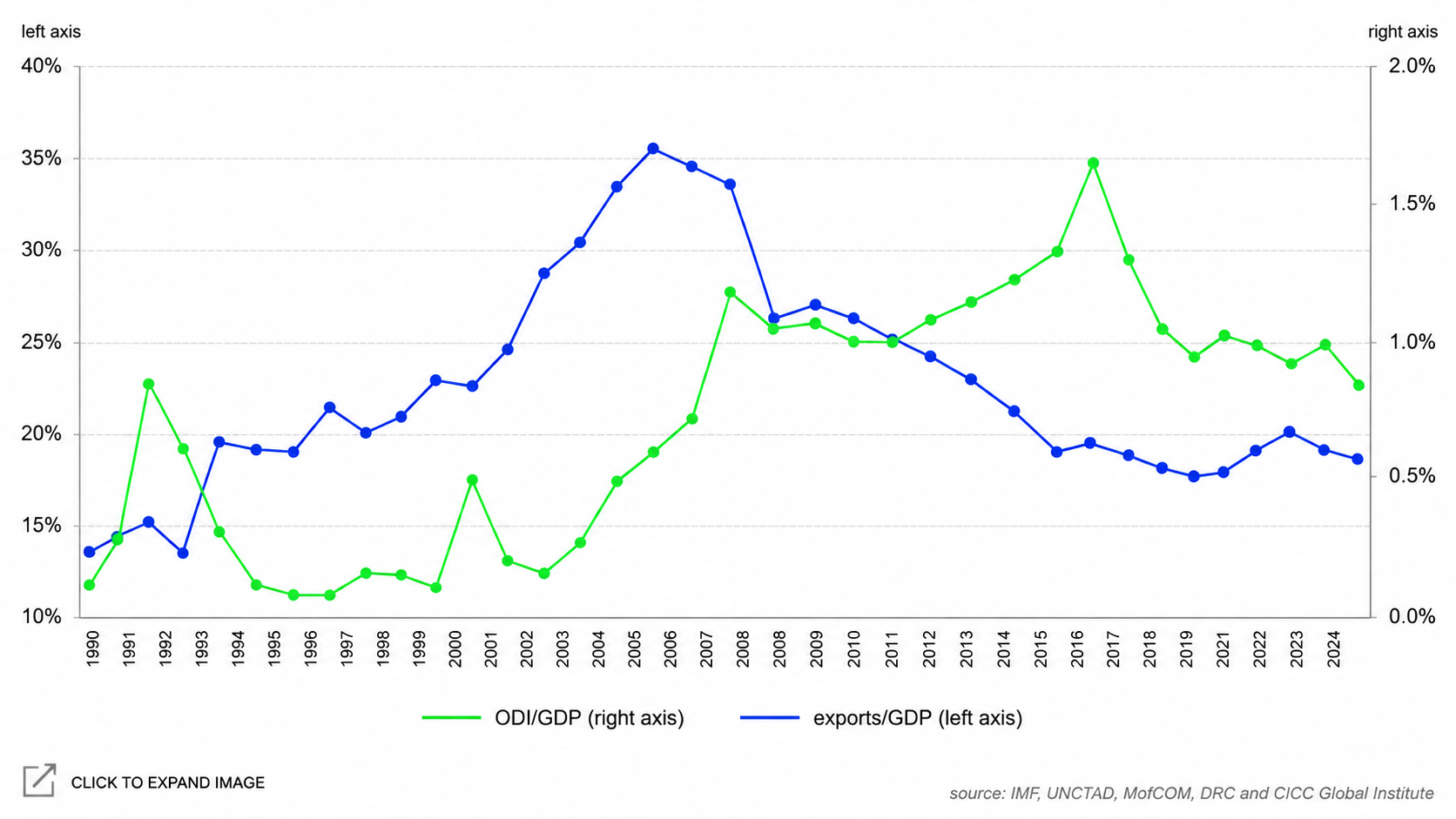
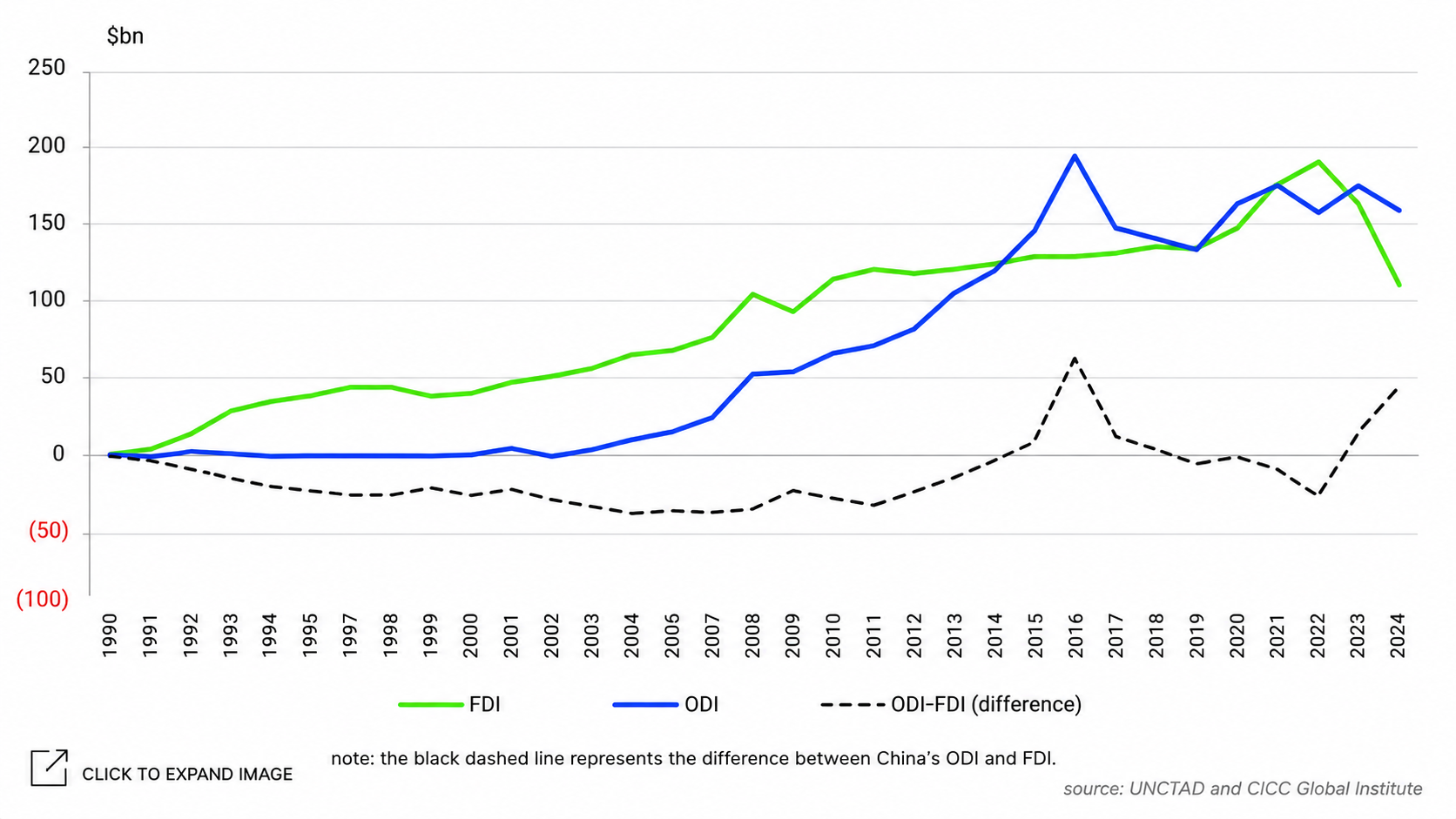
Rather than compress the current account surplus, experts argue Beijing can lean on the capital account instead and step up outward investment. This helps balance international payments by squaring some inward flows with outward ones, while enabling firms to hedge against trade headwinds and leverage global resources, argues Liu Yuanchun. This shift shows up in the data: non-financial ODI (outbound direct investment) to BRI (Belt and Road) countries, accounting for half of the PRC’s goods trade surplus, rose 18 percent in 2025, extending a steady climb over the past several years. Over the past decade, ODI has risen faster than exports as a share of GDP, with the PRC becoming a net capital exporter as ODI overtakes inbound FDI (foreign direct investment).
ODI has risen faster than exports as a share of GDP
PRC is becoming a net capital exporter
Wang Yongli 王永利 China International Futures Co., pushes back on the idea that internationalisation requires running a massive deficit: Washington only began running deficits after, not before, achieving global dominance, building the most competitive economy, attracting capital and productive capacity, and accumulating reserves. The PRC should study that trajectory rather than skip ahead, he argues; RMB internationalisation is better served by expanding outward liquidity, including swap lines, aid, investment and credit, while keeping the industrial base intact.
beyond trade and investment
The surplus runs deeper than a trade-and-investment story, and PRC economists are split over the RMB’s role in addressing it. Zhang Yansheng 张燕生 Chinese Academy of Macroeconomic Research, sees RMB appreciation as a natural, welcome trend following a strong trade surplus. It boosts the wealth effect behind RMB holdings, he argues, and pushes firms up the value chain as rising domestic costs force them to upgrade or expand overseas. But Zhang’s real target is broader than the currency: a persistent goods surplus, he argues, depresses ordinary people’s consumption and welfare by sending real resources abroad that should stay at home.
Xu is warier still: meaningfully denting the surplus would require sharp appreciation, risky enough to shock asset prices, hit export sectors and trigger capital flight. Huang Qifan sketches a middle path: gradual appreciation, roughly ten cents a year, a yuan every five to six years, 15 to 20 percent over a decade, which he argues would lift imports and per capita GDP growth while trimming the surplus ‘reasonably’, without the shock Xu Mingqi warns against.
Liu Yuanchun pushes this further: the surplus may look like an import-export mismatch tied to prices, costs, exchange rates and interest rates, he notes, but its roots lie in the country’s imbalanced savings-investment-consumption relationship. Correcting it, on this view, means reforming that structure, e.g. upgrading consumption, improving investment efficiency, and strengthening fiscal discipline and macro coordination.
There is an external dimension too. Robust PRC exports are rooted as much in the US side of the ledger, argues Zhang Monan 张茉楠 China Centre for International Economic Exchanges, noting that they are enabled by a US economy built on dollar-underwritten consumption. Narrowing the imbalance needs international coordination to diversify reserve currencies, not PRC adjustment alone, she suggests. Yao Yang 姚洋 Shanghai University of Finance and Economics, concedes that this imbalance may be hard to resolve at all, since fixing it needs a currency capable of rivalling the dollar, and none has yet emerged.
key role for the state
Two priorities now sit on Beijing’s agenda, both written into the 15th 5-year plan: shaping a ‘two-way economic flow’ like the one the US built, and stepping up RMB internationalisation to hedge against potential US restrictions. The PRC’s trade surplus, or rather its economic relationship with the world, sits at the centre of getting to both priorities.
Two paths present themselves. Bringing down exports while boosting imports would likely dent PRC industrial and geoeconomic clout, sending capital into buyers’ hands, beyond Beijing’s control. Supporting exports while stepping up ODI, by contrast, reinforces Beijing’s position across key supply chains and gives the state a larger hand in allocating domestic and global capital. Recent trade and ODI data, alongside campaigns pushing an ‘overseas service system’ and a new GNI (gross national income) accounting framework to gauge the PRC’s ODI footprint, suggest policy is leaning this way, a reading top pundits seem to share. For multinationals and countries outside the PRC, robust PRC exports may be here to stay.
managing the surplus
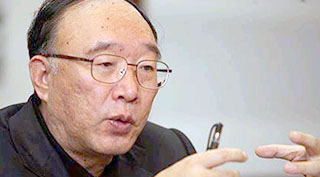
Huang argues a gradual RMB appreciation would boost imports and per capita GDP growth, reducing the PRC’s trade surplus ‘reasonably’ in the process. He also calls for easing ‘involution’ among exporters by tightening labour discipline, improving wages and trimming excessive overtime to raise frontline workers’ incomes. On top of that, he suggests extending paid leave for a total increase of five to ten days a year to convert accumulated export strength into real income gains rather than budget transfers alone.
Huang stresses these measures are not meant to blunt PRC manufacturing’s competitiveness, but to convert its accumulated industrial strength into real income gains and ‘shared prosperity’.
Huang was one of the founding officials posted to Shanghai’s Pudong Development Office in the early 1990s, and later mayor of Chongqing from 2010 to 2016, where his land and financial reforms drove double-digit growth and earned him the nickname’ finance mayor’. He is the author of 结构性改革:中国经济的问题与对策 (Structural Reform: China’s Economic Problems and Solutions), with a foreword by Yu Yongding 余永定. From 2017 to 2018 he was vice-chairman of the National People’s Congress Financial and Economic Affairs Committee. He holds an MBA from the China Europe International Business School, completed in 1999.
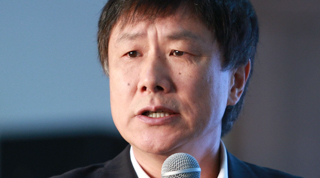
Among PRC experts, Zhang sits on the more critical side of the debate over the trade surplus, pushing for greater policy action to narrow it. A persistent goods surplus, he argues, depresses the general public’s consumption and economic welfare, reflecting sustained net outflows of real resources that should instead be retained domestically. He has repeatedly pitched a coordination mechanism between exports and firms’ overseas expansion to ease trade frictions and imbalances. The PRC should pivot away from its export-oriented ‘East Asian-style’ model toward what he calls a ‘normalised model,’ which entails more balanced domestic and external trade incentives alongside reform of exchange rates, forex controls, export tax rebates and monetary policy. That earlier export-led strategy suited the PRC’s early reform era as a smaller economy, he notes, but is unsuited to a major power—one that now needs a global, balanced outlook to manage its relationship with the world.
Zhang is one of the PRC’s most prominent voices on international trade and globalisation policy. He lectured the Communist Party’s Politburo directly at its collective study session early in his career, and is a laureate of the Sun Yefang Economic Science Award, one of the PRC’s top honours in economics. He earned a master’s degree in economics in 1984, taught at the Central University of Finance and Economics from 1984 to 1996, and undertook advanced study at the University of Colorado, the University of Toronto and the World Bank’s Economic Development Institute from 1986 to 1988.
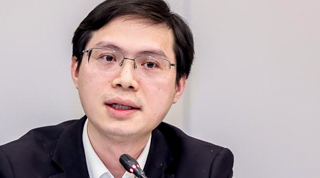
While the PRC’s exports remain robust overall, their composition is fracturing, notes Luo. High-end sectors like AI are growing fast even as labour-intensive ones such as clothing, footwear and luggage decline, threatening employment in regions that specialise in the latter and warranting fiscal policy to backstop affected areas and workers. Some county-level economies remain heavily dependent on labour-intensive exports, he notes, and face a double bind: an unstable property market, combined with a lack of the talent and capital needed to pivot toward AI-driven growth. Transfer payments should account for this, he argues, and provide greater support to regions reliant on labour-intensive exports.
Luo has built a reputation for sharp, closely watched commentary on fiscal policy, local government debt and the transformation of urban investment platforms. He is the author of 城投转型向何处去:基于财政可持续和国资国企高质量发展的视角 (Where Should Urban Investment Platforms’ Transformation Go? A Perspective on Fiscal Sustainability and High-Quality State-Asset Development), published in 2024. He has briefed Premier Li Qiang’s own economic sessions and had research reports draw direct instructions from central leadership. He also directs Yuekai Securities’ Research Institute and was promoted to president’s assistant there in November 2025. Luo holds a doctorate in economics from the MoF-affiliated Chinese Academy of Fiscal Sciences.