
tariffs and counter-tariffs dominate global headlines, but Beijing is eyeing another growth driver: digital trade
Digitally ordered trade from the PRC is already successful. This is thanks to a thriving CBEC (cross-border e-commerce) sector (e.g. B2B: Alibaba.com, DHgate.com, Made-in-China.com and B2C Shein, Temu, Aliexpress). Now accounting for some six percent of total PRC trade, the sector has doubled in value since 2019, according to customs data.
Sights are now set on digitally delivered trade–digital services in various forms. Quadrupling since 2005, digital services are rising in global trade. The WTO estimates the sector makes up half of global service exports and some one-eighth of global exports. Noted examples of PRC digital services, as featured by Beijing, include
- digital tech–telecommunications, computers and other information services like cloud computing and AI
- digital products–cultural and entertainment goods such as video games
- digital services
- digitised professional services in finance, insurance, and international payments
- offshore outsourcing services in research, development and other business and knowledge processes
- cross-border data trade
Given a post-pandemic surge in offshoring and service automation, Beijing senses a chance to thrive in this space, thanks to its AI strengths and manufacturing, market and CBEC clout. This matches longed-for moves up value chains while preserving globalisation against its adversaries.
digital trade becomes a new trade pillar
‘Digital trade’ is ever more to the fore in PRC policymaking. Featured mostly under ‘CBEC and other new trade formats’ in policy documents before 2021, since then it has surfaced as a discrete item in sectoral 14th 5-year plans, albeit less than prominently.
The 2022 20th Party Congress promoted it as one of three ’pillars of a strong trading nation’ (along with goods and services). It now shares pride of place in official conclaves and read-outs, e.g. the 2024 Third Plenum Resolution and the 2025 Government Work Report. Recent moves confirm digital trade as a strategic focus, notes Zhang Monan 张茉楠 China Centre for International Economic Exchanges.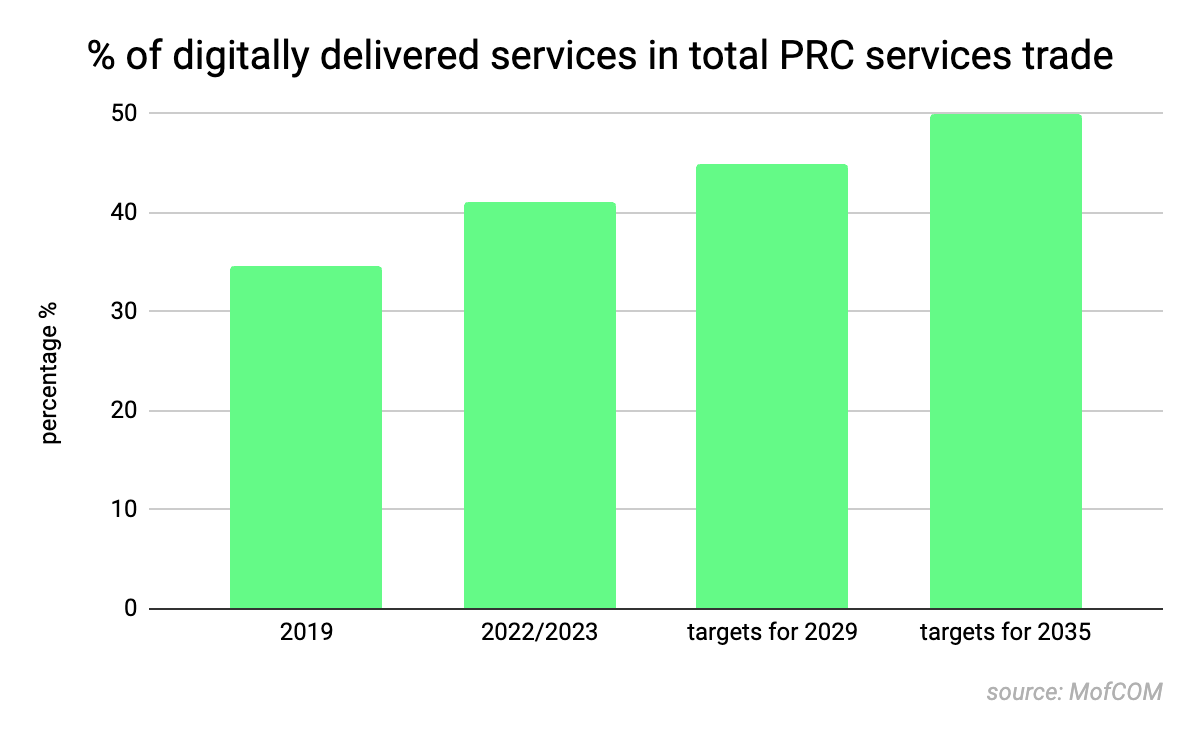
Key targets were set for 2029 and 2035 in a 2024 ‘Opinion’ issued by the CCP Central Committee and the State Council. By those dates, digital services will take up about 45, then some 50 percent of the PRC's total services trade, up from current levels of about 35 percent.
In supporting firms and selected sectors in digital services, the ‘Opinion’ urges ‘institutional opening’ and improving rules, systems and regulations related to the trade. Expected by trade pundits to provide top-level guidance for digital trade, more policy moves are expected to follow its cue.
multiplying channels and leapfrogging
Despite undeniable headwinds, the Xi administration seeks to upgrade its industries under the rubric of ‘high-quality development’. As trade evolves, it is deemed more important than ever to make advanced manufacturing goods, develop CBEC and now venture into digital services.
Such moves up the value chain are, however, not one-directional: each link must support and work with others in the chain. The aim is to deploy digital trade to consolidate advantages in other trade areas, including conventional ones.
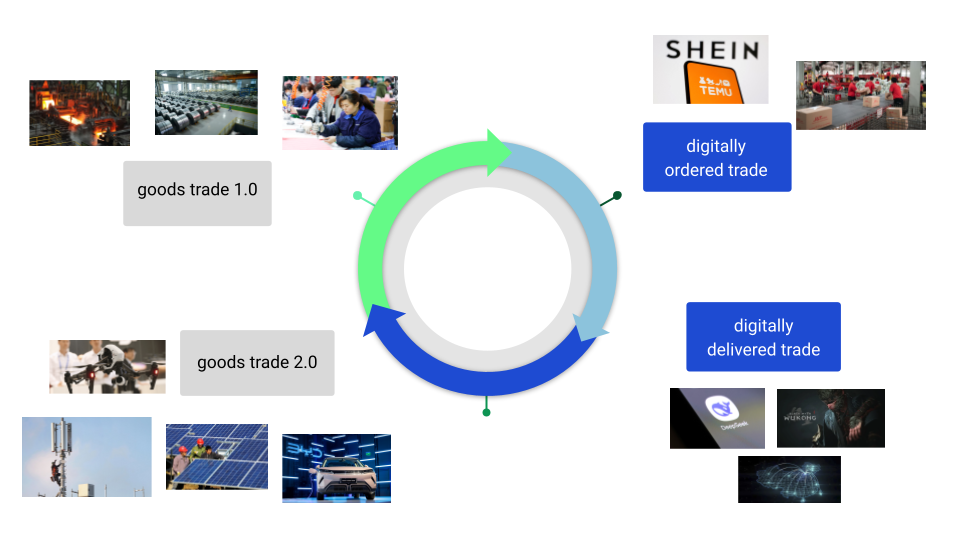
To spur digital trade, argues Shen Yuliang 沈玉良 Shanghai Academy of Social Sciences, the PRC should leverage its strengths in conventional goods, digital platforms, infrastructure and tech.
Thriving CBEC could enliven the lagging PRC services trade, adds Long Yongtu 龙永图 Global Cross-Border E-commerce Conference. It has a range of satellite industries, likely to blossom should the industry make strides abroad.
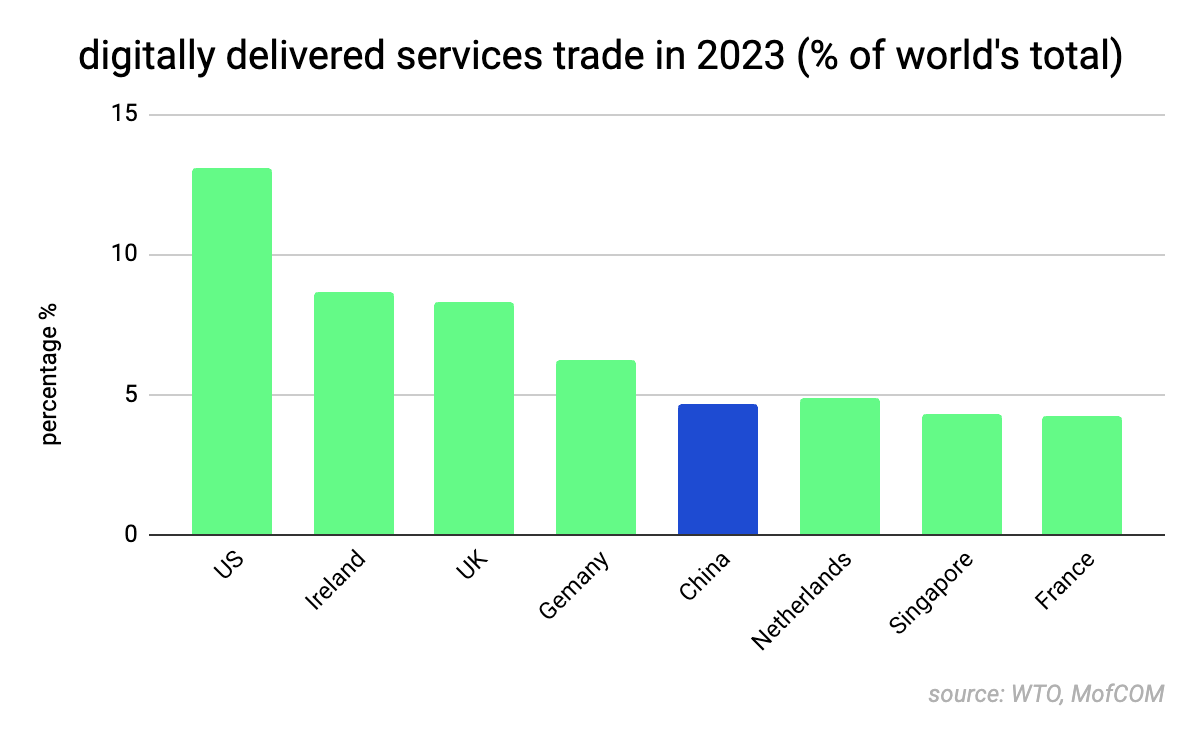
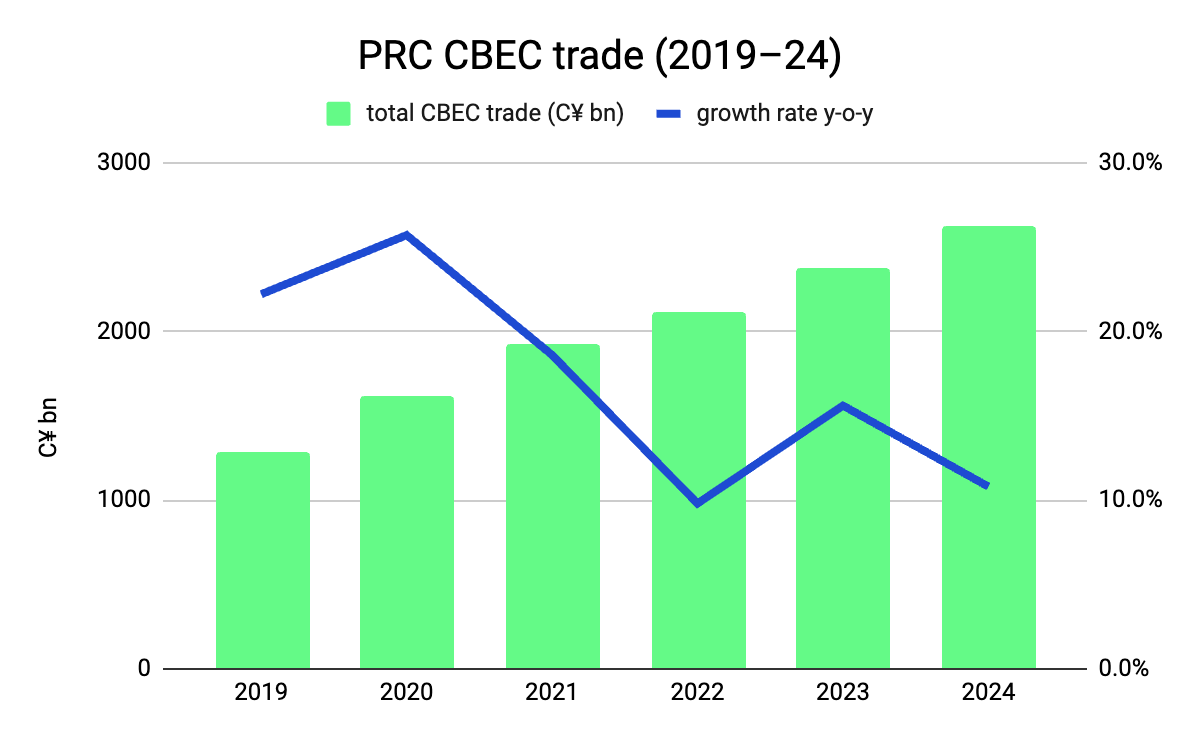
Leading the world in manufacturing gross output, the PRC, for all its recent advances, still trails the US, UK, Germany, et al. in the digital dimension. There is much room to expand, indeed, to leapfrog others. As the digital economy creates more demand for services, argues Bai Ming 白明 Ministry of Commerce Research Institute, the PRC needs to ‘occupy the high ground’: leveraging its manufacturing edge to develop support services.
more support coming
A range of Beijing-sponsored policy support strives to foster digital trade. Given rising trade tensions with partners in conventional trade areas globally, more is likely in the pipeline. Recent highlights include
- financial help
- pledging more aid for digital trade, the central-level guidance fund on services trade, and export credit insurance
- customs facilitation
- support for CBEC return services and storage warehouses in customs zones
- pilot zones
- 130+ CBEC pilot zones and a Silk Road e-commerce pilot zone in Shanghai
- the 2024 opinions called for building ‘digital services export platforms and cluster zones’
- a trade pundit has made some recommendations on how to implement this
- logistics and warehousing
- support for CBEC warehouses, relaxing some customs reporting requirements and more tax rebates
- over 33 e-commerce agreements with BRI members
- data centres
- support for building them at home and abroad (overseas CBEC warehouse clusters with multiple functions)
data as a factor of production
The unencumbered flow of data across borders, a fundamental prerequisite, is indeed termed a ‘key production factor’ by MofCOM. The more data is used, the more it grows in value, generating insight and wealth, summarises Yan Xuetong 阎学通 Tsinghua University Institute of International Relations.
Yet the national security agenda, intrinsic to the Party-state, remains in place. A corpus of key data must stay inviolate within the PRC, safeguarding vital interests and bolstering home-grown giants. To boost digital trade in the face of this imperative, a form of ‘selective openness’ has been adopted, whereby relatively relaxed data protocols are piloted in special FTZs (free trade zones). Lingang Area, in the Shanghai FTZ, is one, supporting cross-border data flows and launching a negative list and detailed guidelines.
The aim is to attract foreign expertise to set up branches in FTZs to work with PRC firms, sharing know-how and boosting domestic digital services exports. Incentives are added for advanced IT firms in cloud computing, AI, semiconductors and 5G, along with streamlined relief for cybersecurity and compliance.
Testing data protocols domestically shapes compliance with those encountered in advanced global trade pacts such as CPTPP (Comprehensive and Progressive Agreement for Trans-Pacific Partnership), undergirding ‘free’ cross-border business data flows and curbing data localisation. Negotiation is ongoing; Beijing will likely press for cut-outs for itself and other developing countries on grounds of defending ‘data sovereignty’ and ‘development space’.
It is, nonetheless, happy to take charge in less contentious areas, as in a recent WTO Joint Initiative laying out ground rules for e-commerce standards, and efforts to foster greater digital connectivity with Belt and Road Initiative partners. Beijing also pitches a global cross-border data flow cooperation initiative to counter US-led 'digital decoupling', deploring discriminatory data policies and the ‘overstretching of national security’ on data issues.
frictions and openings
PRC firms need to focus on quality and tech innovation, argues Song Yuru 宋玉茹 Chinese Academy of Social Sciences Finance Strategy Institute. Recent examples include record-breaking global successes of the video game Black Myth: Wukong and the digitally animated film Ne Zha 2. Sales revenue of independently PRC-developed games in overseas markets hit US$ 18.6 bn in 2024, rising by 13.4 percent over 2023–according to MofCOM.
The 2025 Two Sessions pledged funding for disruptive tech. The success and rapid adoption of domestic champion DeepSeek is more than likely to spur the takeup of AI and other leading-edge tech in digital trade. AI is already integrated in many fields: e.g. Alibaba’s powerful consumer algorithms are powered by AI, big data analysis and cloud computing; PingPong Payments leverages AI in cross-border small transaction decision-making. These will gain further traction in the future.
While the PRC has made strides in the digital economy, it remains domestically anchored. The top ten internet and software firms, reports the State Council Development Research Centre, derive only seven percent of their revenue from offshore sales. The WTO reports that the PRC makes up only five percent of the world’s digital services trade.
This may well change. A well-educated and AI-empowered PRC workforce with more competitive wages than Western counterparts is entering the global market. This may well be spurred by Sino–US strategic and tech rivalry.
Tariff and other barriers are readily imposed on manufactures and even CBEC goods, but digitally transmitted services, instant and virtual, have greater promise for offshoring and real-time collaboration. Ensuing productivity gains could seriously alter the global division of labour. Yet disruptive effects—substituting service workers in higher-wage countries—threaten to come with them.
Aside from following news on the tariff wars on goods and commodities, policymakers and firms overseas would benefit from also keeping an eye on PRC digital trade development.
digitally savvy commentators

Wei Jianguo 魏建国 | China Centre for International Economic Exchanges vice chair
Digital trade will be the fastest growing area for the PRC in the next five years, says Wei, noting that the country’s strengths in goods, services, consumption and CBEC put it in a unique position to seize this opportunity. PRC digital trade firms can access overseas markets via the country’s CBEC platform giants, he adds.
Working his way up in commerce teams at China’s Moroccan (1973), Tunisian (1980), and Gabonese (1988) embassies, Wei became MofCOM vice minister in 2003. He has been affiliated with the CCIEE since 2009. Wei frequently comments on economic and trade issues, unpacking the implications of policy documents from official conclaves.

Yan Xuetong 阎学通 | Tsinghua University Institute of International Relations honorary dean
The most significant difference between a non-digital economic system and a digital system lies in the use of data, explains Yan, noting that its collection, analysis and usage creates vast wealth and capital. Arguing that the US seeks to prevent its technological lead with the PRC from narrowing, Yan adds that the outcome of PRC-US rivalry will be determined by digital tech superiority–not least which side can better harness the power of the circulation of data.