
behind-the-border rules respond to changing trade dynamics, as Beijing bids to amplify its voice and that of the Global South
Emerging in 2018, ‘institutional opening’ zhìdùxíng kāifàng 制度型开放 has risen as a trade and development priority.
Now a constant at high-level conclaves such as the annual Two Sessions and the 2024 Third Plenum, the framework has more layers than meet the eye. Given mounting geopolitical and trade friction, it has become core to a reset of Beijing’s trade contract with the world.
why ‘institutional’?
Opening is termed ‘institutional’, as it goes beyond simply opening markets and levelling the playing field, to very ‘institutions’ of domestic arrangements and international trade rules. Presaging a shift in PRC trade strategy it entails
- recasting laws and regulations
- improving governance structures
- building policy transparency and predictability
- aligning domestic with international standards
Upcoming measures are to address behind-the-border non-tariff barriers and raise standards and policies beyond WTO commitments. This means proactively modernising domestic institutions to prepare for renegotiations of trade and investment rules with partners.
high on the agenda
Upgraded opening was hailed in the July 2024 Third Plenum Resolution.. Under the ‘opening’ rubric, it reiterated concrete measures that
- align with high-standard trade agreements, e.g. CPTPP
- in IP protection, industry subsidies, green standards, labour protection, finance
- improve the business environment and attract foreign investment
- unilaterally open to least-developed countries
- uphold WTO trade multilateralism
- expand PRC FTZ (free trade zone) networks
For the first time, the plenum hailed building a 'high-level' open PRC economy, with institutional opening at the forefront. A range of policy shifts embodied the Plenum’s call to action: FTZ measures that, for instance, exempt duties on specific goods and welcome imports of specific products. Further measures are in store after the Central Committee for Comprehensively Deepening Reform passed an ‘Opinion’ in late August.
State Council ‘Opinions’ on market access and services trade dropped, pledging more liberalisation, deregulation and state support. Institutional opening can be expected to pick up tempo with this top-level reinforcement.
current vs new trade order
The institutional opening is tied to action to reshape the PRC's global trade role; the task is made more urgent by rising trade tensions.
Failing to resolve these, the ‘free trade paradigm’—hitherto cornerstone of the WTO—is under mounting strain. Beijing responds by redoubling its ‘self-reliance’ mantra, essentially stepping up security: its dual circulation paradigm.
The WTO remains Beijing's best place to settle disputes; it still runs in its interests. Beijing proclaims trade multilateralism, seeking greater cooperation, not least with Global South states, with whom it has common cause in countering protectionism.
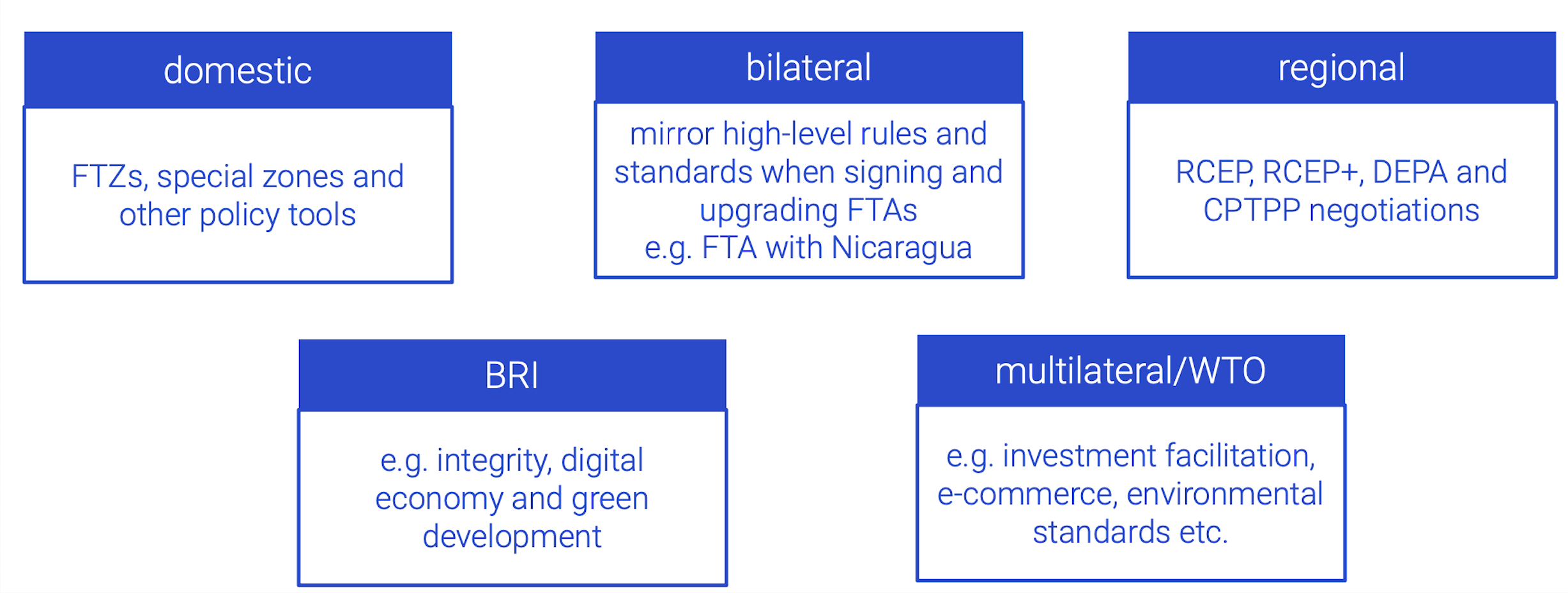
Meanwhile, 'institutional opening’ is becoming the core instrument to rework trade rules via domestic, bilateral, regional, and multilateral avenues. Beijing needs to figure out what works and what fails with its partners. Much ‘exploration’ will go into working out rules and protocols that align with its interests. Such conflicts as the EV subsidy controversy with the US and EU demand more exploration and negotiation, echoes Zhang Xiangchen 张向晨 a WTO deputy director-general.
Further opening is deemed imperative to offset derisking/decoupling. Opening needs to be more ‘institutional’ to defend both fronts. De-risking and de-coupling also demand re-coupling and improved cooperation, declares Zhang Yansheng 张燕生 China International Economic Exchange Centre.
Curbing subsidies and local preferences, institutional opening mitigates distortions that create PRC trade imbalances with the world, enthuses Zhang Bin 张斌 Chinese Academy of Social Sciences Institute of World Economics and Politics.
PRC 'institutional opening' action across levels of engagement
rival institutions
BRI and Global South cooperation, grounded in a shared interest in alternatives to prevailing free trade paradigms, will be ever more central. A trial-and-error is underway.
Cases in point
- BRI frameworks in
- PRC production standards
- carbon footprint platform for photovoltaic products
- adoption of PRC tech standards as used in the Jakarta-Bandung high-speed railway
- bilateral FTAs
Exploration is displayed in the 22 special FTZs, now some fifth of PRC foreign trade and investment. On notice to show 'institutional innovation’ reflecting their unique strengths, they are on notice to explore beyond them.
‘Institutional opening’ enables Beijing to avoid conformity with advanced global trade conventions such as CPTPP. Beijing proclaims that it must chart its own path at whatever cost.
It will be a lengthy process. The ‘steady’, ‘rational’ opening foreshadowed by the Third Plenum implies protecting domestic industry and remains imperative, admits Wei Jianguo 魏建国 China Centre for International Economic Exchanges. Its economic system, the CPC’s ‘Two Unwaverings’ are fixed bases of rationality, echo Li Dawei 李大伟 and Yin Jiayin 尹佳音 NDRC Academy of Macroeconomics.
allocating resources
'Opening' ultimately boils down to efficient resource allocation, PRC pundits know. It is essential to curb regression, e.g., subsidies and preferences launched at local levels, such as tax breaks, equity investment, export, investment, or R&D incentives that distort allocation, says Zhang Bin. This may gradually shift resources from manufacturing to services, where they are needed.
Localities should, suggests Zhang, be
- barred from disguising benefits offered to firms
- assessed on success in improving state-business relations
Institutional opening is envisaged enabling the market to play a ‘decisive’ role in allocating resources. Unlike previous 'policy openings' that only opened some sectors strategically for policy goals, success hinges on
- a stable, transparent and predictable legal enforcement
- functioning institutions and markets
- equitable treatment of both overseas and domestic firms
- alignment with high-standard global trade norms
areas to watch
Complex and politically risky, institutional opening is not for the faint-hearted. Negotiations go to complex issues such as
- trade rivalry both within the BRI and with advanced economies
- e.g. their greater trade surplus with the PRC
- protecting PRC overseas interests
- overhauling insurance and risk management
- finding more to import from BRI member states
Greater opening in telecoms, internet, education, culture and medical care are foreshadowed. The medical sector has already seen overseas firms now set up wholly foreign-owned hospitals in eight cities and engage in stem-cell and gene biotech R&D in FTZs.
Warranting a watching brief, the Plenum broke new ground, mentioning
- aligning ‘compliance’ with global rules
- reforming both FDI and ODI
beyond opening
Greater PRC opening could unlock domestic markets, address trade imbalance and foster global partnership in desirable sectors. Less commonly explored, the inverse of the equation holds good. A more internationally aligned domestic system also helps to train PRC firms, allowing them to compete more effectively abroad. Expect the PRC to raise its voice in global trade rules-making.
Minor tweaks of rules and institutions by Beijing may have great impact globally. Hyperactive exports and investments prompt other economies to review their corresponding policies. The era of ‘institutional rivalry’ may already be upon us.
trade pundits

Tu Xinquan 屠新泉 | UIBE (University of International Business and Economics) WTO Research Institute director
To be self-initiated, ‘Institutional opening’ needs, says Tu, to focus on ‘post-market access’. The PRC should actively align with high-standard trade agreements like the CPTPP: the process is of value in itself, he argues, despite possible failure to meet some qualifying criteria. It should learn from friendly states’ consumer interest protection, fair competition rules and limits to state discretion.
Holding a PhD in international trade from UIBE, Tu works on trade policy, WTO, state procurement and Sino-US trade relations. A 13th Beijing Political Consultative Conference member, he is on MofCOM’s Economic and Trade Policy Advisory Committee and has conducted research for the China Social Science Foundation, and the Commerce, Education and Finance Ministries.
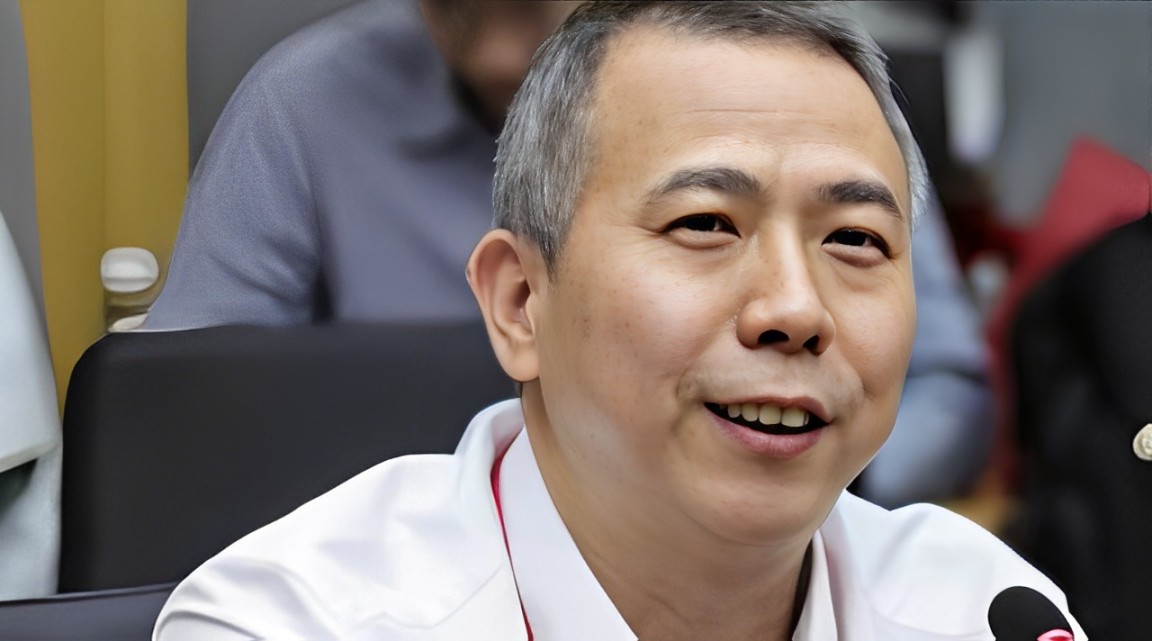
Qian Zhongyan 钱仲焱 | COMAC Systems Engineering Vice Director
Institutional opening facilitates both FDI and ODI, notes Huang. Future reform in these should, he argues, limit monetary policy uncertainty, enhance finance markets, ensure stable investment and mitigate cross-border capital flow risk. Beijing needs, he adds, to protect its growing overseas investment interests by working with LDC partners to upgrade institutions and rules.
An global, national finance and regional economist, Huang is dean of the Sun Yat-Sen University International School of Business and Finance. Concurrently a vice dean of the Institute of Free Trade Zones, he helps advise the Guangdong People’s Congress Standing Committee.
Li Dawei 李大伟 | NDRC (National Development and Reform Commission) Academy of Macroeconomics Emerging Economic Research Department director
" image="https://policycn.com/storage/peoples/Li-Dawei-%E6%9D%8E%E5%A4%A7%E4%BC%9F-320px-Z5OJud.png"]
Given rising protectionism and global rivalry, ‘institutional opening’ is strategic for the PRC, says Li: it helps build competitiveness, attracting quality resources. Spearheading reform and opening at home, he adds, helps reach consensus on emerging global issues with partners.
Li works in the Academy of Macroeconomics, a research institute directly under the NDRC, the nationally leading superagency. Holding a management PhD from the Institute of Mathematics and System Sciences, Chinese Academy of Sciences. Li works on international economics and trade, ODI and regional economic cooperation.