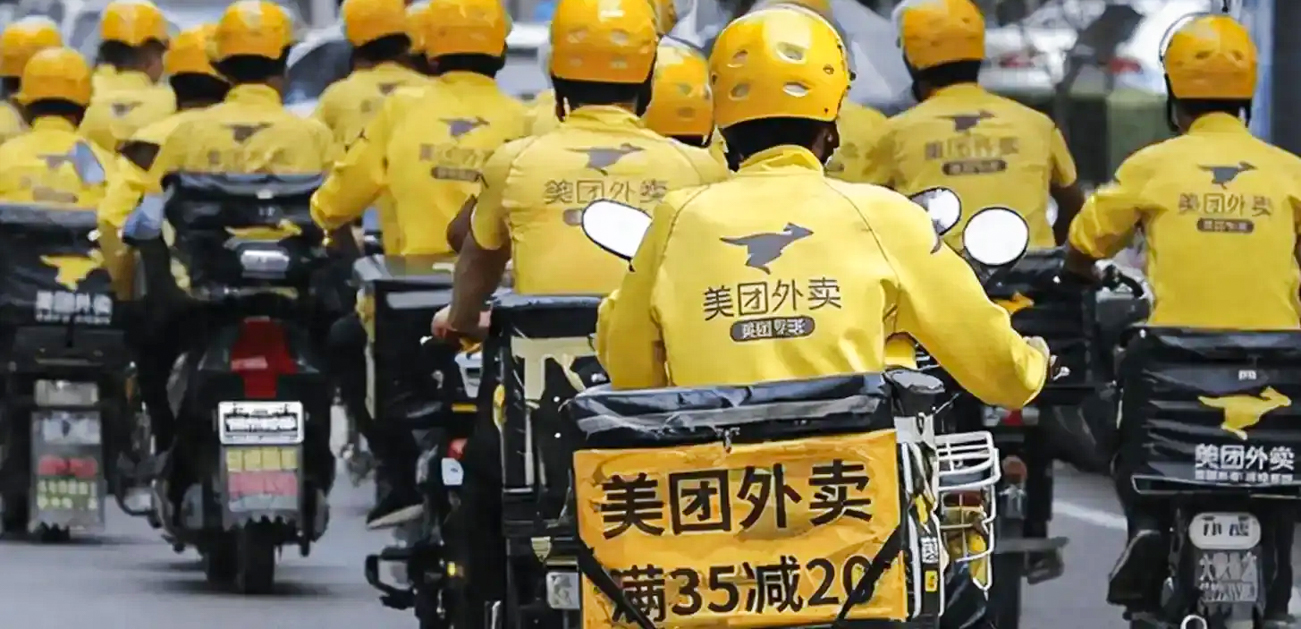
social security for delivery riders—how is this shifting policy?
- maintaining ‘social stability’ a main target from 2025 Two Sessions
- cross-regional pension contributions now possible
- expanding coverage for injury and unemployment security
- platforms taking on responsibility to support the pension fund
With advancing job casualisation, late 2024 saw a spike in protests manifest, most distressingly, in random attacks. Keeping a lid on this tension was underscored in the 2025 Government Work Report. Indeed, gig workers are now a ‘target group’, Wang Xiaoping 王晓萍, Minister of Human Resources and Social Security, told the Two Sessions.
A June 2024 ‘Guiding opinion’ had called for more Party work among delivery riders, providing training and support while monitoring them more closely. The Work Report followed up with a new mechanism whereby local governments and party committees will be directly accountable for public order (social stability).
Despite economic slowdown, JD.com caught the nation’s attention after announcing its entrance to the food delivery business by pledging to gradually cover social security for its delivery riders from 1 March. Others, e.g. Meituan and Ele.me, soon followed suit with similar plans.
Expanding social security coverage from traditional to flexible jobs challenges conventional labour practice, triggering debate on whether this is a ‘win-win’ or a ‘lose-lose’ situation for platforms and their gig workers.
growing gig economy
Driven by platforms, the gig economy has mushroomed since 2019. Total national gig workers (灵活就业) have, according to 2023 data, passed 200 million, some 23 percent of the workforce. Covering eight sectors (e-commerce, delivery services, lifestyle services, WeChat business, knowledge services, social media, live streaming, and ridesharing) it offers flexible hours, a low skills bar, and ready cash.
As recent downturns see more stable jobs disappear, some 46 percent of new gig workers have a college degree, reports Jinan University’s Institute for Economic and Social Research and Zhaopin.com. Gig jobs are no longer a short-term survival option for those with less education but a feature of the labour market.
gap in social security coverage
PRC social security consists of three pillars
- Basic Pension Insurance
- enterprise and occupational annuities
- commercial insurance
In addition to individual contributions, employers must pay ‘five insurances (eldercare, medical, unemployment, injuries, childbirth) and housing funds’ that constitute the Basic Pension Insurance for their employees. Enterprise and occupational annuities are voluntary contributions over and above the basic contribution. Commercial insurance is a new sector that is paid by individuals to supplement the existing pension system.
Gig workers, lacking formally recognised labour relations with their platforms, have been excluded. They can pay for their own social security, but enrolment rates remain low. Given unstable incomes, few workers can afford continuous payments.
Gig workers face high injury rates in accidents for which neither government insurance nor platforms are obliged to compensate. Over 40 percent of respondents in a 2024 National New Flexible Employment Report were concerned about insufficient social security coverage.
Platforms tactically hand responsibility over to subcontractors. Isolated at the end of the labour supply chain, the drivers are almost always worse off, reveals a study by Zhicheng Public Interest Lawyers' Xu Miao 徐淼 and Chen Xinyi 陈欣怡. With the growth of ‘flexible employment,’ they found, platforms gradually ceased employing delivery riders directly. This cut labour costs and minimised their risk of being sued in employment disputes. Despite the risk delivery riders face from work pressure imposed by AI algorithms, in most cases courts have deemed platforms 'not responsible' for infringing labour rights.
The economy is slowing down, and the population ageing. Xu and Chen warn that if the social security gap remains unaddressed, gig workers (mostly on lower incomes and often unable to save either for job loss or retirement) would, over the long term, become a massive threat to social stability.
structural challenges
High turnover in the gig economy is a major structural challenge to extending social security. Since pensions and other social security benefits often have a minimum requirement for years of contributions, long-term contributions are difficult for delivery riders who work in short stints, typically less than 10 months. Besides, existing pension schemes remain provincially managed: riders who switch cities often face delay or loss in their accumulated contributions. Without national coordination, gig workers remain inconsistently covered. Labour laws, rooted in industrial era mass production and based on static employment relations, struggle to fully adapt to new types of jobs, notes Li Wenjing 李文静 Chinese Academy of Labour and Social Security Department of Legal Research.
evolving policy
In 2021, as Beijing began fretting over labour rights issues for those ‘flexibly’ employed, responsible agencies issued ‘Guiding opinions’ urging improved social security policies and work injury protection. Guidelines targeting several specific sectors, such as delivery and ride-hailing, were issued later that year, requiring platform firms to offer reasonable wages, insurance, and transparent work conditions. In 2023, local pilot programs began to test new social security models tailored to gig workers, such as Beijing’s registration system for gig workers and Zhejiang’s gig worker injury insurance trials. In 2024, the Third Plenum highlighted the need to reform social security for workers in flexible jobs and migrant workers via
- expanding the coverage of unemployment, work-related injury and maternity insurance
- abolishing the requirement for local household registration status when enrolling in social security programs
- improving the bureaucracy for transferring social security records to other cities
next steps
Following the MoHRSS (Ministry of Human Resources and Social Security) minister highlighting the plight of gig workers at the Two Sessions, to boost gig worker enrolment in social security, MoHRSS pledged to expedite ending hukou (household registration) restrictions for gig workers seeking social security. To maintain flexibility, they can select a contribution rate between 60 and 300 percent of the provincial average wage for urban employees. They may make contributions monthly, quarterly or annually, and their social security can be transferred across provinces if they relocate.
Yet not all issues yield to solution by social security. Once a labour relationship is legally confirmed, workers forego the option to ‘voluntarily participate’ in social security schemes, notes Zhang Chenggang 张成刚 China New Employment Forms Research Centre. Food delivery riders, his research shows, rank ‘social security contribution needs’ as their third priority, after ‘income’ and ‘work autonomy’. It's uncertain, laments Li Gan 李干 a Shanghai Labour and Social Security Society Young Scholars Committee, whether delivery riders, especially highly mobile migrant workers, are willing to take part in urban employee social security schemes given higher contribution rates.
social policy experts

Nie Huihua 聂辉华 | Renmin University Economics Professor
The discussion on delivery riders’ social security should be approached as a market, rather than a moral issue. Food delivery demand fluctuates with peak hours, requiring a highly flexible workforce. Covering all riders under social security would not be financially feasible, forcing platforms to prioritise full-time riders. Defining who qualifies as a full-time rider remains a challenge.
As a low-skilled group with limited job openings, many gig workers seek full-time status to secure social protection, but this increases their workload and intensity. In turn, part-time drivers face reduced working hours and employment opportunities.
If the gig economy capacity shrinks, its role as an employment buffer and fallback option will also diminish. Nie recommended lowering eligibility thresholds and providing subsidies to enroll gig workers in social security as a low-income vulnerable group.
Renmin University economic professor, Nie Huihua, was a Harvard University Economics Department postdoc, specialising in political-business relations, firm theory, and institutional economics. His policy reports on anti-corruption, Public-Private Partnerships, zombie enterprises, and official incentives have received key endorsements from national leaders and provide references for policymaking in the PRC.

Lu Ming 陆铭 | CPPCC National Committee member, Shanghai Jiao Tong University Antai College of Economics and Management professor
Lu urges proactive reform in social security for delivery riders and other gig workers. He notes the need for a unified national social security system, particularly for pensions, ensuring that individuals retain their contributions when moving from city to city.
He also calls for faster urban integration of migrant workers, as long-term residency increases willingness to contribute. Additionally, he supports flexible participation, allowing those who prefer cash payments over social security contributions to have that choice. Each person makes choices that best serve their own interests. Hence, the system should enable individuals to maximise their benefits rather than imposing mandatory participation that may not be their optimal choice, said Lu.
Lu serves as an expert for the 15th 5-year plan. A former Fulbright Scholar at Harvard and the US National Bureau of Economic Research. He specialises in urban, regional, and labour economics. He works on evaluating urban policies and promoting PRC market integration and sustainable economic growth. Lu is a distinguished professor at Shanghai Jiaotong University Antai College of Economics and Management, a CPPCC member, and also the executive director of the China Development Institute.