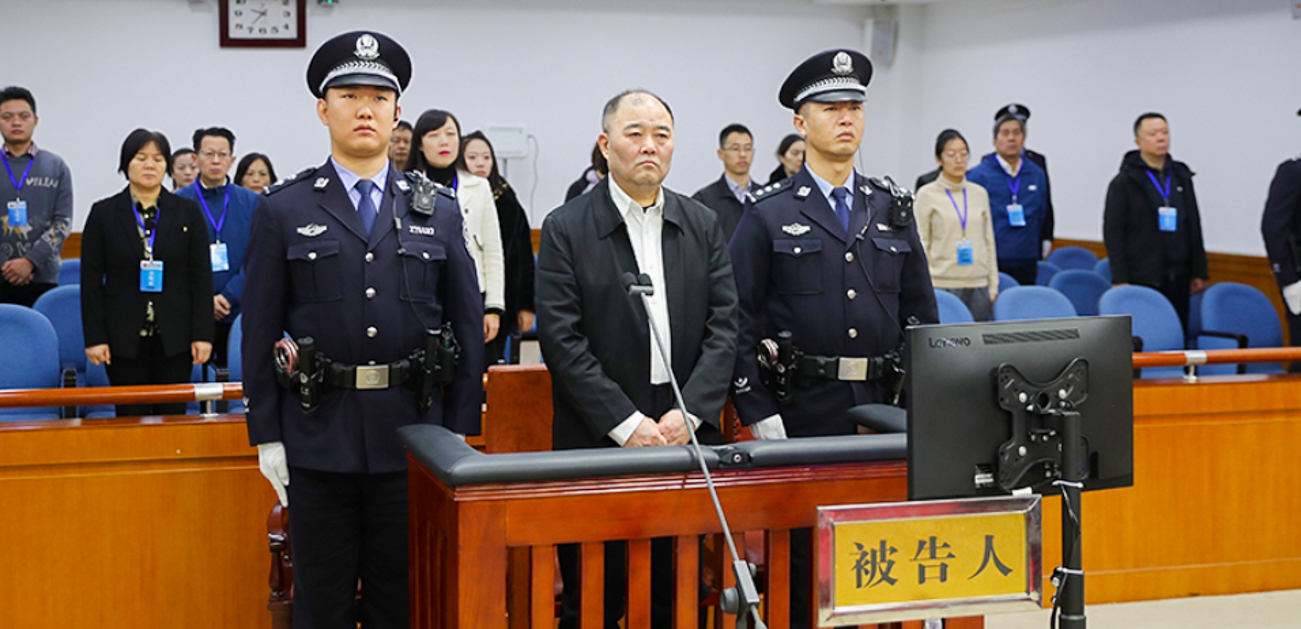
with financial stability now a political imperative, the Party Centre is deploying its discipline whip, the CCDI, to monitor financial operations
Financial security has become ever more prominent on the policy agenda since the 2023 CFWC (Central Financial Work Conference). The Party seeks to raise its ability to resolve financial risk and offset systemic destabilisers. Realising 'China-style' financial development entails a return to the Marxist principles promoted by Xi: asserting Party leadership over finance.
Financial oversight units and state agencies are on notice to partner up and strictly curb financial malfeasance. Stability and loyalty are prioritised in enacting central decisions.
State agencies are not the only apparatus expected to roll out financial stability. The Party’s disciplinary whip, the CCDI (Central Commission for Discipline Inspection), is now tasked with this as well. CCDI’s mission is to purify the Party spirit and eradicate Party corruption, proclaims Li Xi 李希, its 'czar'. It is, he boasts, the ‘disciplinary bedrock’ of national rejuvenation. Yet, in an ever more politicised economy, the whip has been repurposed into a lens, monitoring as much as chastising.
politicising finance
Li told a mid-2023 Party study session that the CCDI would take the initiative to back socio-economic high-quality development. It will oversee the rollout of major Party socio-economic initiatives, ensuring adherence to central directives. Loyalty to Xi Jinping’s leadership core is uppermost as it advances high-quality development.
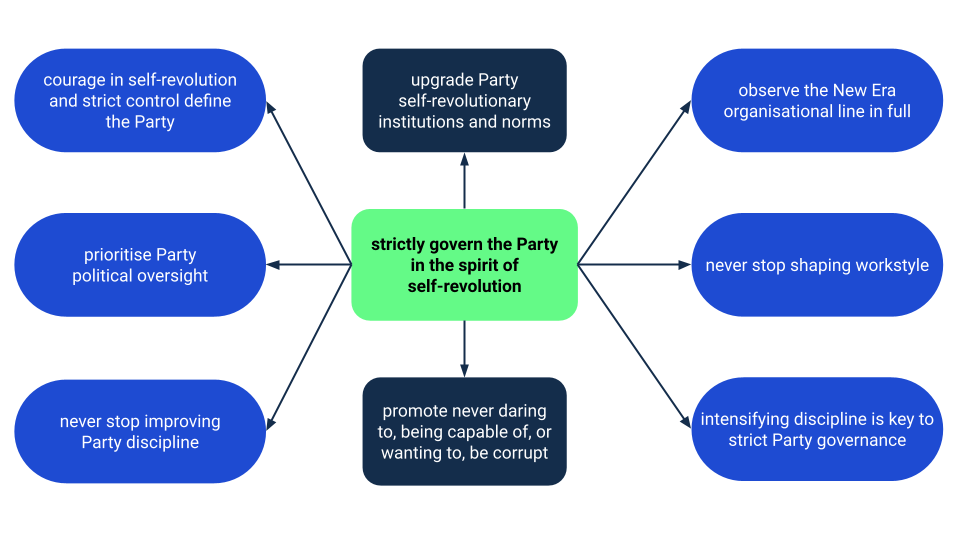
The CCDI is, above all, meant to step up its presence in the sector. Disciplinary cadres must grasp that financial work is political and enforce Xi’s ‘self-revolution’ doctrine (New Era self-criticism) when monitoring corporate operations, reminded Zhu Kepeng 朱克鹏, the CCDI branch group leader at China Construction Bank. Local CDIs (Commissions for Discipline Inspection) must attune financial SOEs to central policy, not least the ‘five articles’ of financial work. The key targets are refining financial service quality and efficiency, supporting scitech innovation, green initiatives, social inclusion, and the silver and digital economies.
the many facets of 'self-revolution'
out inspecting the inspectors
The latest round of inspections, launched on 8 April, focuses on the MoF (Ministry of Finance), Shanghai and Shenzhen stock exchanges, major state-owned banks, etc. The probe is to last three months. Inspection group leaders pledge to scrutinise financial-related Party committees per Party discipline standards and ensure economic build-up meets top-down demands.
Such annual CCDI inspection campaigns are the Party's tool of choice in enforcing financial oversight. At higher levels, under central direction, CDIs, Party Organisation Departments and Party committees form inspection groups to evaluate the policy performances of lower-level bodies. Other Party departments will provide support, demanding that units under inspection cooperate and correct their mistakes.
Inspectors must, above all, closely monitor Party Secretaries, gauging their loyalty and ability. China Discipline Inspection Press thunders that those who pay mere lip service to central doctrine and cadres who fake policy performances face severe penalties.
Responding, financial agency heads vowed to rectify issues on the spot. Wu Qing 吴清 CSRC (China Securities Regulatory Commission) director portrayed an agency impatient to deploy the Party ‘knife’ within the regulatory system. Wu promised to tighten oversight over the capital market, shoring up risk prevention.
Similarly, the NAFR (National Administration on Financial Regulation) Party Theory Study Group swore loyalty to Xi, proclaiming his mission of deterring systemic financial risk. The NAFR proposed structural reforms in mid- and small-scale financial agencies, forbidding insider trading. Meanwhile, centre-local collaboration in monitoring needs to be bolstered, expanding oversight to every aspect of financial work.
pruning corruption
Besides ensuring policy rollout, the CCDI takes on curbing corruption. As economic pressure gathers, corruption becomes an ever-greater threat to stability and security. Hence, the upgraded Party-directed monitoring, argues Peng Xinlin 彭新林 Beijing Normal University International Anti-Corruption Education and Research Centre.
Rectifying damage to the Party’s legitimacy is another aim of the intensified CCDI oversight. Zhang Rongchen 张荣臣 CPC Central Party School (National Academy of Governance) links tolerance of corruption to the collapse of feudal dynasties and the Soviet Bloc. Bent on escaping historical cycles, the CPC cannot afford to repeat such mistakes. There is a need for the Party to carry out ‘self-revolution’, eradicating malfeasance to win hearts and minds. Based on this rationale, Wang Yongjun 王拥军 CCDI committee member claims the CPC will counter capitalist infiltration in political arenas, ending collusion between political and commercial personnel, above all in the finance sector and SOE operations.
In 2023, 103 state financial cadres were probed by the CCDI; 77 had been convicted in 2022. Some 72 percent of 2023 cases are centred on banks, with 40 officials from major state-owned banks examined. Three senior staff were convicted, including Liu Lianke 刘连舸 BoC (Bank of China), former Party secretary and chair. He was alleged to have illegally issued loans and accepted bribes. Similarly, Sun Deshun 孙德顺 former China CITIC Bank president was give a two-year suspended death sentence following serious bribery charges.
Meanwhile, the Party is cracking down on corruption in asset management, securities, and insurance firms. In particular, the SSE (Shanghai Stock Exchange) was under close scrutiny. Zhu Congjiu 朱从玖, former SSE CEO, and Liu Di 刘逖, former SSE vice CEO, are charged with receiving bribes, mainly in return for easing IPO procedures. Liu acquired listed company stock via shadow shareholders, dodging declaration requirements.
no end to the fight
Anti-corruption in the financial sector will be kept up through 2024. As of mid-March, 17 financial cadres have been found corrupt. Retired personnel appear to be new CCDI targets. Li Jiping 李吉平 CDB (China Development Bank), former Party Committee member and vice-governor, was detained in March. Li was already eight years into retirement. He was charged over a corruption scandal that saw four CDB managers removed, including former Party secretary and CEO Hu Huaibang 胡怀邦.
Party clout over finance is bound to keep spreading. Party unitary leadership distinguishes its financial model from the West's, claims Zhang Xiaojing 张晓晶 Chinese Academy of Social Science, Institute of Finance and Banking. After the 2023 Party-state restructuring, the Party’s CFC (Central Financial Commission) was tasked with setting major strategic direction and synchronising operations across agencies. The Party thus oversees all finance sector personnel arrangements and recruitment.
While intent on security, Beijing claims to be opening up the financial sector and welcoming foreign capital into its domestic market. Qiushi, an influential Party journal, urges officials to facilitate cross-territorial investment. Committees ought to eradicate all thinking and practices that hinder high-quality development.
Committed to a Sino-Marxist growth model, the CPC now proffers a repurposed and weaponised version of a planned era model. To the Party, guaranteeing financial stability promises new vitality. Whether this holds good requires yet another level of strict inspection.
self-revolutionaries
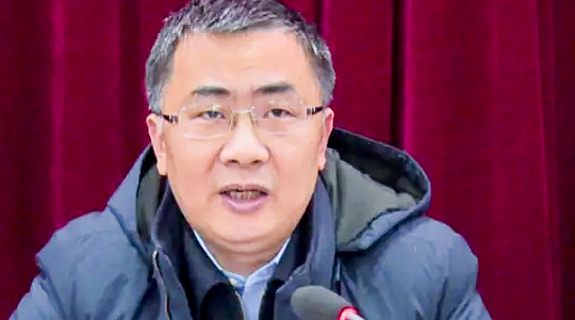
Wang Lujin 王陆进 | CCDI and NSC (National Supervision Commission) NAFR Branch group leader
Sound financial oversight is a core ability upheld by major financial powers, asserts Wang. He deems it imperative to induce ‘self-revolution’ as the spirit of PRC supervision. State agencies should view financial coordination in national strategy terms, where sub-agencies are chess pieces under a central command. The CCDI is charged with better merging financial oversight with anti-corruption probes, aligning resources and measures to tackle overlapping challenges. CDI branches are to project the Party’s political leadership, guiding financial practice with patriotism. Party committees in all sectors are to liaise with CDIs, sharing intel regarding legal violations in financial bodies. Discipline inspectors should, notably, monitor high-risk sectors, deterring turbulence.
Veteran bureaucrat Wang has an economics background, holding a D. Econ. and teaching at the Zhongnan University of Economics and Law 1990—95. Working in the State Taxation Administration from mid-1995, he became a vice director. In 2020, he ascended to the National Audit Office’s Party Committee. He was promoted to the CCDI in 2022, first serving in its China Banking and Insurance Regulatory Commission branch and later in the NAFR.
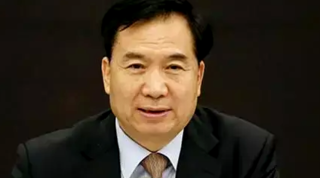
Li Xi 李希 | CCDI secretary
Anti-corruption is the basis of the CPC’s self-revolution campaign, contends Li. The CCDI must ensure that the Party’s ‘initial mission’ is cadres’ own. Embodying the people’s interest, the Party must ward off the lure of private gain. Disciplinary agencies must prevent external interests from impugning the Party’s political purity, excising corruption where power, resources and funding intersect. Malfeasance has to be pruned, above all, where social interests are threatened. At the summit, the state must seriously reform, better regulate the market, and bolster the supervision of emerging industries. Ensuring cadres embrace the message, the CCDI will boost internal ideological education, standardising it on Xi Jinping Thought and relevant Party theories.
Former Party Secretary of Guangdong, Li now directs the Central Commission for Discipline Inspection, enforcing Party discipline. An assistant to Li Ziqi (李子奇 1913-2014), a comrade of Xi Jinping’s father Xi Zhongxun (习仲勋 1913-2002), he climbed his first Party rungs in ‘backward’ Gansu and Shaanxi, enacting Xi’s anti-corruption initiatives. Liaoning Party Secretary by 2015, he transferred to Guangdong in 2017, signalling a likely rise to the Politburo Standing Committee.

Zhang Xiaojing 张晓晶 | CASS Institute of Finance and Banking director
The PRC has taken a financial policy path, insists Zhang, quite unlike the West’s. Its financial build-up is based on Xi’s ‘1+6’ model, starting with a firm foundation, honing world-leading economic and scitech capability. To this base it adds six elements: a robust currency, central bank management, financial agencies, IFC growth, financial oversight and professional recruitment. Social equity is the goal, with the market allocating resources. CPC leadership is indispensable to this. Guided by Xi, the CFC will decide on strategies, with the CFWC enforcing them. The NAFR, along with other state regulators, will oversee operations. Zhang, like the PRC, proclaims people-centred financial governance.
As both the CASS (Chinese Academy of Social Sciences) Finance Strategy Institute director and the leader of the Balance Sheet Research Centre, finance guru Zhang belongs to prestigious circles like the CF40 and Economists 50 Forum. He helped research and evaluate the 14th 5-year plan.