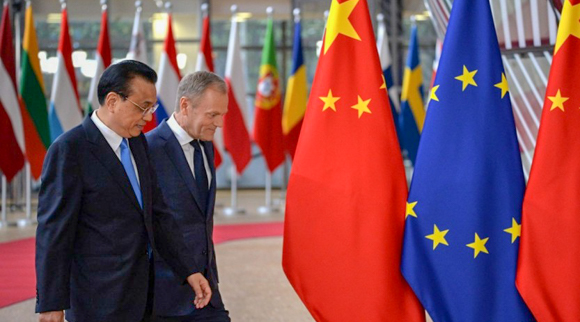
recent trends in Europe prompt deeper reflection
As the Sino-US trade war grinds on, relations with the European Union have become a focus of foreign policy interest. The European Parliament elections, with their mixed results, have prompted much discussion, challenging over-confident predictions of easy gains by Beijing.
Boosting EU ties to counter US pressure has been implicitly stated as official policy. Commenting on the Sino-US trade war, Zhang Ming 张明 Chinese ambassador to the EU said on 20 May that China, faced with worsening unilateralism and protectionism, needs to ‘use stable Sino-EU cooperation to cope with international uncertainty’. During his visit to Germany, 30 May–2 June, vice president Wang Qishan 王岐山 told Chancellor Merkel their countries should work to make the global governance system more just and reasonable, and ‘cope with uncertainty together’.
Sino-EU relations certainly face challenges. In March, the European Commission described China as ‘an economic competitor in pursuit of technological leadership, and a systemic rival promoting alternative models of governance’. Wang Yiwei 王义桅 Renmin University Centre for EU Studies observes that, during the recent European Parliament elections, China was indeed prominently mentioned, but mostly in a negative, if not threatening, light. The EU may change its decision-making mechanism regarding China, adds Wang, from requiring unanimity to qualified majority voting; this could trigger a ‘relatively big reversal’ in Sino-EU relations.
Sino-US-EU triangle
Tensions between the EU and the Trump administration, however, tip things the other way, according to China’s policy community. Sun Haichao 孙海潮 China Foundation for International Studies Centre for European Studies says, ‘Since Trump came to power, the EU–USA strategic alliance has experienced a new shock, and Sino-EU relations have seen new growth’. Xia Guohan 夏国涵 Charhar Institute says Europe will become a ‘global strategic balancer’ of Sino-US competition.
multilateral management
Sino-EU relations should be considered part of a trilateral relationship between China, the US and the EU, proposes Cui Hongjian 崔洪建 China Institute of International Studies Department of European Studies, rather than just a bilateral relationship. China needs, he says, to improve its management of multilateral relations: issues such as climate change and WTO reform present opportunities for cooperation with the EU to counter the United States.
While the US is a traditional ally of the EU and will keep putting pressure on Europe's China policy, it will not have its way on every issue, advises Zhou Hong 周弘 Chinese Academy of Social Sciences International Studies division. This presents opportunities for China, but it must manage relations with the EU and its member states carefully to avoid creating an impression that it is trying to divide Europe.
Both China and the EU care about global governance, a multipolar world, multilateralism, free trade and climate change, and have been coming close on some of these issues, feels Ding Chun 丁纯 Fudan University Centre for European Studies; so China can ‘expect more from Sino-EU relations’. ‘China’ he says, ‘can satisfy some of the EU side’s requests’.
populist party dividend
On the potential consequences of the rise of populist parties in the recent elections, Tian Dewen 田德文 CASS Institute of European Studies argues that European populists have caused much misunderstanding by labelling China a ‘beneficiary of economic globalisation’. But, he says, the populists can be good for China too. When elected, these parties will be eager to fulfil campaign promises, pleasing their electorates by improving the economy. This provides impetus for better relations with EU member states. For example, Italy’s participation in the Belt and Road Initiative was a result of efforts made by the populist Five Star Movement.
Sino-UK prospects
Sino-UK relations post-Brexit are another critical aspect of China’s relationship with Europe. On this, there are again both pessimistic and optimistic views.
Qu Bing 曲兵 China Institutes of Contemporary International Relations is pessimistic: the Brexit process has, he argues, been a drain, leaving little energy for the government to develop its relations with China. Brexit and the growing importance of Anglo-American relations may plunge the UK into a diplomatic dilemma, forcing it to pick sides between China and the United States.
On the contrary, suggests Zhao Huaipu 赵怀普 China Foreign Affairs University European Studies Centre: Brexit increases the independence of British foreign policy and will therefore inject more dynamism into Sino-British relations. This development, he hopes, will increase the UK's international influence and further balance trilateral relations between China, the United States and the UK.
self-confidence and uncertainty
Images of Beijing’s leaders confidently establishing beachheads to general acclaim in Europe, dominate China's media. A glance around the policy community yields a more nuanced picture, revealing concerns with managing the uncertainty generated largely by the US. Insistence on self-confidence, a mantra of Xi Jinping, is rarely questioned. But local commentators are aware that this is often an irritant overseas.
The triangular relationship between the EU, China and the US is reported as finely balanced, with many factors liable to qualify China's confidence in its relations with the EU.
profiles
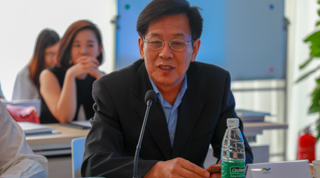
Sun Haichao 孙海潮 | China Foundation for International Studies Centre for European Studies director
A former diplomat in France, Switzerland, Morocco and the Central African Republic, Sun is an expert on China-Europe and Europe-US relations. The US, he claims, is to blame for current difficulties experienced by the EU: Trump has delivered a ‘new shock’ to the transatlantic relationship that will benefit Sino-EU relations.
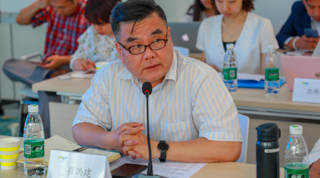
Cui Hongjian 崔洪建 | China Institute of International Studies Department of European Studies director
A Sino-EU relations expert and former diplomat, Cui argues Sino-EU relations should no longer be viewed just as a bilateral relationship, but as part of Sino-EU-USA and Sino-EU-Russia trilateral relations. He proposes that China should do a better job in managing multilateral relations, and should exploit the disagreements between the EU and the US on climate and WTO reform to China’s advantage.
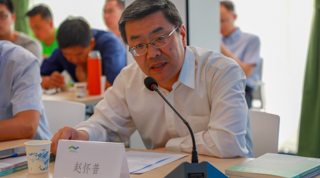
Zhao Huaipu 赵怀普 | China Foreign Affairs University European Studies Centre director
An expert in EU politics and EU-US relations, he has also studied Anglo-American relations and Euroscepticism in Britain. Zhao is optimistic about the future of Sino-British relations post-Brexit, because he thinks Brexit has made British foreign policy more independent. He argues that the ‘golden era’ of Sino-UK relations has boosted Britain’s international influence and will therefore ‘further balance’ the Sino-UK-US trilateral relations.