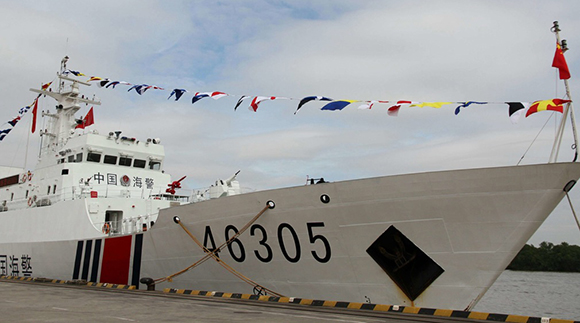
Global strategy in local waters: March 2018 reforms empower the China Coast Guard.
CCG's new structure
China’s naval forces have long suffered from fragmented administration, limiting their capacity to combat crime at sea and defend China’s sovereignty. Until 2013, marine police work was split between
- Ministry of Agriculture (focused on fisheries)
- Ministry of Transport (maritime safety)
- Customs (anti-smuggling)
- State Oceanic Administration (marine surveillance)
These were consolidated into a China Coast Guard (CCG) in 2013, but the move failed to address remaining ministerial overlap between the SOA, Ministry of Land and Resources and Ministry of Public Security.
To remedy all this mismatch and inefficiency, the March 2018 Two Sessions revamped the structure and hierarchy of law enforcement at sea and at the border. Coast guard forces were transferred from the civilian State Oceanic Administration to a military agency, the People’s Armed Police (PAP). Expanding its responsibilities and extending its mandate, the China Coast Guard (CCG) is now positioned as an elite, marine force, capable of combating threats to marine resources and beefing up China’s strategic maritime presence.
China's maritime power strategy
CCG reforms are core building blocks in China’s transformation into a maritime power on par with the US and Japan. To that end, the National People’s Congress Standing Committee empowered the CCG with law enforcement authority in June 2018. Its marine police operations appear to be structured around three regional bases in Beihai and the East and South China Seas (ECS and SCS), supplementing provincial marine corps along the coast.
Other efforts complement the CCG reforms, with a focus on maritime power. For example, the previously independent Centre for Maritime Rights and Strategy is now integrated with the Central Foreign Affairs Commission. The CCG, unofficial reports suggest, will be directly supervised by China’s Central Military Commission, allowing it to take part in military exercises conducted by the Chinese Navy (PLAN). Current estimates suggest the CCG has some 20,000 active personnel and nearly 200 ships of various types. While that indicates significant growth, the CCG is still only half the size of the US Coast Guard in terms of active personnel.
protecting marine resources
Administrative restructuring streamlines deployment of maritime resources in areas ranging from patrolling maritime territories to cracking down on fisheries violations. With its transfer to the PAP, CCG also gained power onshore, giving it greater leverage to coordinate with local officials in its policing role.
Flexing its new muscles, CCG is undertaking two rounds of special inspections on illegal activities through end 2018, focused on practices ranging from misuse of maritime resources to waste dumping. CCG’s increased authority also helps it crack down on fishing violations. Since the launch of a summer fishing moratorium on 1 May, fishery bureaus, fishing port authorities and vessel inspection agencies at all levels have moved to uniform standards to combat illegal fishing. Fishery bureaus have also begun coordinating with the procuratorate, border defence force, and CCG, enabling crackdowns on illegal practices followed by coordinated criminal prosecution.
impact: geopolitical complications in maritime disputes
Beyond its impact in domestic waters, the CCG’s expanded authority and capacity sends geopolitical messages. Policy makers and analysts do not agree on their meaning. Officially, ‘reforms have not changed the basic tasks of sea police, nor have they changed China’s principled position on relevant sea-related issues’, says Wu Qian 吴谦 Ministry of National Defence spokesperson. Instead, claims Xinhua, they are intended to combat illegal maritime practices, including fishery disputes and illegal vessels.
For others, however, these changes unambiguously enhance Beijing’s power and influence at sea. Large scale administrative integration of CCG, reports Daily Defense Observer, improves China’s capacity to protect its ‘sacred’ South China Sea. Equipped with considerable ‘combat power’, the CCG is part and parcel of SCS militarisation. Given a history of maritime aggression by foreign powers, writes Hu Bo 胡波 Peking University Marine Strategy Research Centre director, China has good reason to build a strong navy and sea defence system. An effective military presence at sea is required, argues Hu, to deter violation of China’s maritime sovereignty. Most domestic analysts regard CCG’s transfer to PAP as a warning to Western countries, not least the US, not to challenge China's control of disputed SCS territories.
Maritime disputes will likely grow, however, as Beijing better implements its maritime objectives via the CCG. Militarising it has already intensified friction in the ECS, above all with Japan. From early 2018 to mid-October, the CCG carried out 18 cruises, with more planned soon. On 20 April, the Japanese Coast Guard reported an unauthorised survey ship sailing near the Diaoyu islands, which Japan claims as part of its exclusive economic zone. Japanese authorities also reported air surveillance over the ECS on 27 July. In a meeting shortly afterwards on 31 July, Japanese Foreign Minister Taro Kono expressed concern over the ECS to his counterpart Wang Yi 王毅, despite improvements in overall ties.
China's next moves
As it grows more involved in global ocean governance, Beijing will seek to consolidate its image and practices at home, further scaling up the CCG. Now equipped with policing powers, it will continue to grow, its new resources enabling it to take on heavier tasks. A new offshore radar system is coming soon, sources suggest, together with patrol ships and other hardware. This investment has already begun at the provincial level: Liaoning is bidding for a project to upgrade its maritime police base; in Guangdong, the marine police detachment has already undertaken special combat dive training.
Day-to-day marine policing is unlikely to change, although China's presence in the SCS and around territorial borders with Korea in the ECS will increase. We expect to see CCG sub-departments take on greater responsibility, and increasingly frequent anti-smuggling operations have already demonstrated efficiency gains for internal CCG departments. Expect to see the same in other areas, particularly on issues like illegal fishing and environmental protection.
who is moving the agenda?

Hu Bo 胡波 Peking University Marine Strategy Research Centre director
Recent reforms, writes Hu, to the China Coast Guard were driven by historic strategic anxieties. The history of Western aggression makes it imperative for China to have to a strong navy and sea defence system. This program faces numerous challenges, including geopolitical competition from the US and Japan, geographic limitations, and a basic lack of familiarity with naval traditions.

Wang Hongguang 王洪光 | Marine Police deputy director
China Marine Police Bureau deputy director since 2016, having served as chief of command 2013-16, Wang delivered the annual report on the performance of the China Marine Police at the National Marine Police Work Conference. As one of two deputy directors, he is a key figure in communicating the needs of the Marine Police to the Marine Police political commissar and PAP deputy commander.
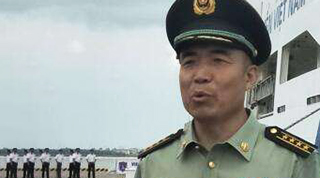
Zhang Chunru 张春儒 | Marine Police chief of staff
Zhang was promoted to Marine Police chief of staff after directing the Ministry of Public Security’s Border Protection Administration Marine Police Department. Since the March reform, Zhang has personally led operations against maritime drug trafficking and smuggling, setting up cooperation between the Ministry of Public Security Anti-Drug Bureau and the China National Marine Police Bureau. He also plays a key role leading official meetings with maritime police authorities of neighbouring countries, including Vietnam.
context
16 Oct 2018: latest cruises conducted around the Diaoyu Islands
17 Sep 2018: Hangzhou hosts the 19th North Pacific Coast Guard Agencies Forum, discussing a range of issues in marine governance among participant countries
1 Jul 2018: China Coast Guard Law enforcement powers enshrined
22 Jun 2018: NPC decision authorises China Coast Guard to carry out law enforcement activities, issuing the ‘Decision of the China Sea Police Service to Exercise the Power of Maritime Rights Protection’
mid-Apr to May 2018: various provinces issue fishing moratoriums under CCG’s new structure, working to implement integrated enforcement models
11 Apr 2018: CCG announces plans to launch two rounds of inspections on illegal activities that damage marine ecosystems
4 Apr 2018: the Central Political and Legal Affairs Commission hosts meeting on implementing legal institutional reform measures, further detailing plans for the CCG
20 Mar 2018: China Coast Guard is moved under the People’s Armed Police Force
17 Dec 2017: Meng Hongwei 孟宏伟 steps down as CCG director
4 Dec 2015: CPC Central Committee announces a two stage plan to realise China’s ‘maritime power strategy’
early 2013: China Coast Guard moved under the State Oceanic Administration, having had its duties previously dispersed among multiple departments