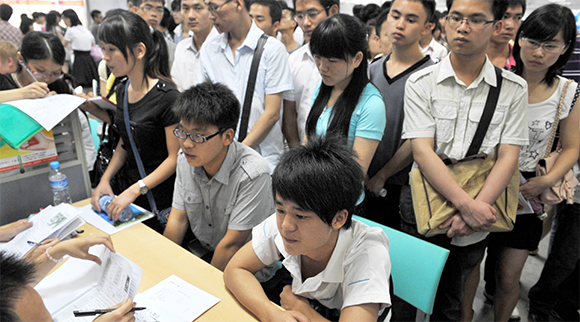
Facing demographic pressures, cities are in a bidding war for college graduates.
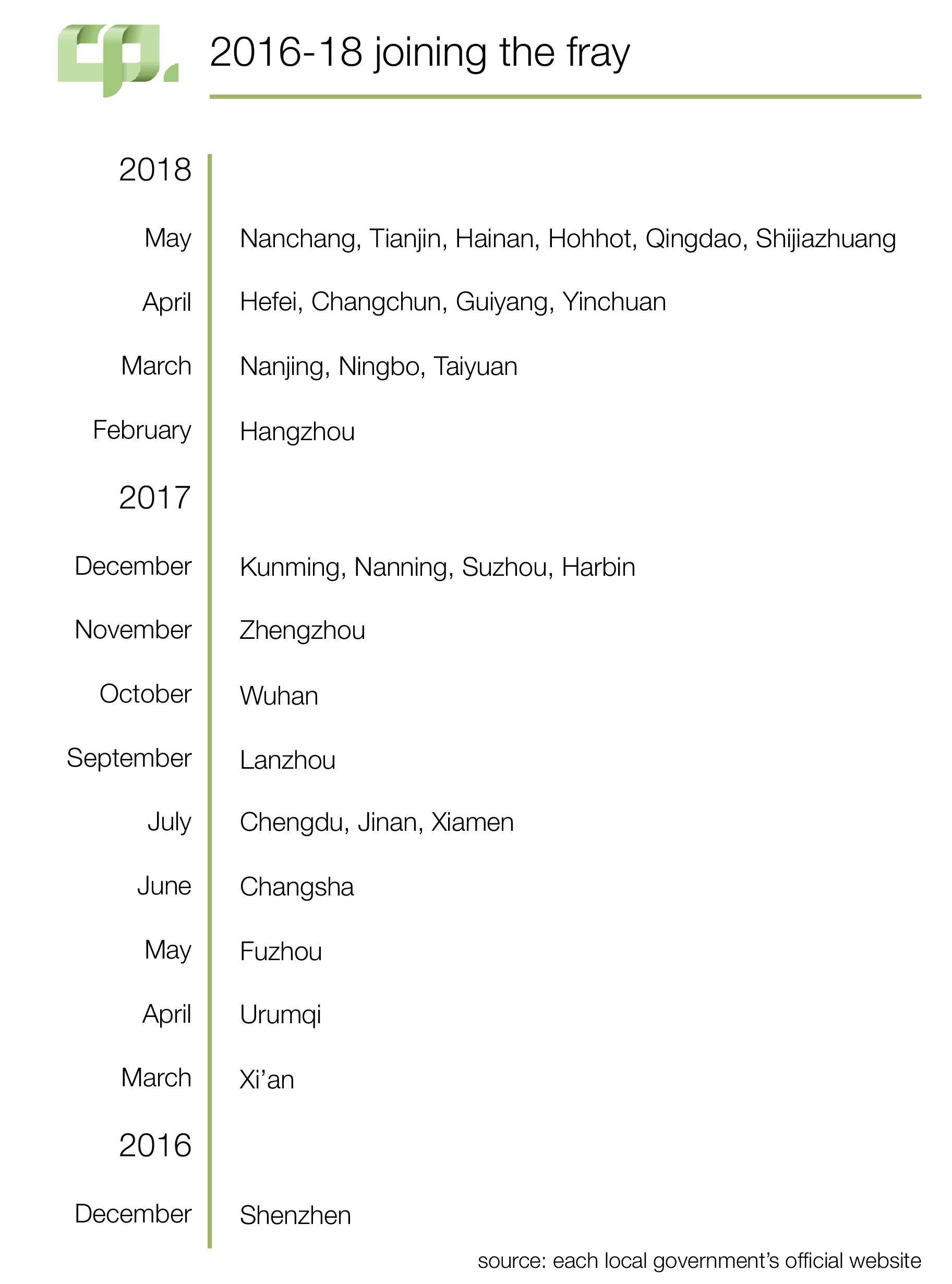
Cities need more college graduates. That appears to be the view of local decision-makers: over the last two years, measures to attract and retain college graduates have proliferated. The first salvo was fired December 2016 when Shenzhen allowed all graduates under the age of 35 from technical colleges and above to apply for hukou. The wealthy megacities of Beijing and Shanghai are not competing very strenuously, but smaller cities seek to win the so-called ‘talent war’. Since March 2017, nearly every month one or more cities issue talent policies, sparking a bidding war that central policy-makers are now trying to tame.
New Era, new development model
Describing talent as a ‘gold mine’, People’s Daily says that tapping human resources is vital to achieving the two centenary goals—achieving a moderately prosperous society and becoming a strong, democratic, civilised, harmonious and modern socialist nation. At the 19th Party Congress, Xi Jinping 习近平 called for an end to reliance on cheap labour, high infrastructure investment and low-end manufacturing. His new economic model built on high value-added manufacturing and innovation needs more educated workers. Manufacturing is to employ 62 million trained workers by 2025, but faces a predicted shortfall of almost 30 million. While the state has made plans to address shortages in skilled labour, local governments resorted to zero-sum policies to poach graduates from each other.
The central government has long wanted to divert people away from over-crowded megacities to smaller towns and cities. The 2014-20 urbanisation plan envisages more people working in modern industries, more urban residents boosting domestic consumption, and more coordinated regional development narrowing disparities between cities. Pilot programs have explored lower hukou requirements and assisting rural migrants move to urban areas. While dependent on migrant labour, to limit strain on their welfare systems and control population flows, second-tier cities had previously restricted access to hukou.
the policies
Talent-hungry localities are now using hukou to lure educated residents and keep the working but unregistered populations they have already from moving away. Fear of falling behind is gripping local governments: ads promising a bright future in Chengdu appeared in Hangzhou’s metro stations as the two cities established preferential policies for highly-skilled technical talent, with particularly generous incentives for those coming from abroad.
This competition will decide each city’s position on the economic map, argues Li Xia 李侠 Shanghai Jiaotong University. In the Information Era, leapfrogging stages of development is possible; every local government worries that if they miss out on this round of young graduates, finding an opportunity to bounce back within the next decade will be very difficult, says Li. With a greying population, says Bo Daofu 博导傅 Tianjin University Economics and Management Department, new graduates have become the new source of demographic dividend. Moreover, in the current ‘houses are for living in, not speculation’ policy environment, graduates have become new guarantors for housing markets and payers into social security funds. City officials sense that given the demographic shift, young talent is to be grabbed now before it is too late. The full effect of talent policies released mid and late 2017 is yet to be revealed. However, some cities have released figures that show striking increases
- Xi’an: 240,000 people gained hukou in Q1 2018, almost the same as the previous year’s total
- Wuhan: 142,000 university students gained hukou, six times the previous year’s total
bids on the table
Between March 2017 and May 2018, 28 second-tier and new first-tier cities released talent policies. Wuhan, capital of centrally located Hubei province, with a large university student population, seeks to transition from traditional to smart manufacturing.
- 20 percent discount on government-designated housing for graduates
- first to release minimum annual salary grades for graduates at different levels
Xi’an, capital of Shaanxi, could be a development motor for the less developed northwest but lags behind in innovation and international trade.
- relaxed hukou requirements five times within one year
- fast processing procedures; hukou registration within half an hour with ID and diploma
Shenyang, capital of Liaoning in northeast China, seeks to rejuvenate an economy reliant on traditional heavy industry.
- housing subsidies, giving PhD, masters and undergraduates, C¥60,000, 30,000 and 10,000 respectively
Nanjing, capital of Jiangsu in developed East China, has a vibrant economy and well-educated population but is facing demographic challenges.
- preferential prices on shared ownership housing; after five years, the 50 percent government share will be given to the homeowner
- C¥1,000 subsidies for graduate job-seekers
First-tier cities Beijing and Shanghai also released policies to attract talent, but their thresholds remain high. This March, with average local public sector salaries at C¥11,000 and private sector salaries C¥6,000, Beijing offered hukou to programmers earning over C¥70,000 per month.
policy adjustments
The response has been huge, with many cities seeing hukou applications spike to several times the levels of previous years. It is not clear how many people have moved in response to incentives—many would previously have lived in the same cities without official registration.
A few cities have, however, been overwhelmed by the response, especially in jurisdictions with preferable odds of university admission under the gaokao (college entrance exam) provincial quota system. Xi’an’s Education Bureau sought to deter educational migrants, announcing 8 May that people settling after 21 November 2017 must return to their former residence to take college entrance examinations. Tianjin adjusted its initial zero threshold for graduates four times within 96 hours of policy release on 16 May after 300,000 people registered in the first 24 hours. Some commentators seized the opening these adjustments created to argue for gaokao reform, noting that disparities in access to education distort market allocation of talent, leading to stampedes on areas like Tianjin.
Talent policies challenge Beijing’s efforts to keep housing markets under control as newly registered people buy houses, driving up prices.
2017 National Bureau of Statistics data on residential housing prices show steep rises
- housing prices in Xi’an up by 11.2 percent y-o-y
- prices of second-hand housing in Chengdu up by over 70 percent (sharpest rise nationwide)
- housing trading volume up by 17.6 percent in Nanjing, with prices rising (after being sluggish or declining in the past year and a half)
In early May, the Ministry of Housing and Urban-Rural Development (MoHURD) spoke to a dozen cities that had seen housing prices spike, including Xi’an, Chengdu, Taiyuan, and others. On 19 May, the ministry issued six specific goals for stabilising the market, including increasing mid- and low-priced housing, preventing land prices pushing up house prices and ensuring the proportion of residential land in ‘hot spot’ cities not fall below 25 percent. 16 cities were required to diversify land supply with action plans due by end June. Several localities, heeding MoHURD’s order to rein in housing prices, issued policies that added criteria for purchasing housing or no-sale periods to deter flipping houses.
central government criticism
In a full page editorial published 27 May, People’s Daily chastises local officials for crude approaches to attracting talent. The commentary suggests high-level consensus that broad-stroke local policies targeting university graduates will not attract the types of skilled labour that localities need. The editorial castigates localities for defining talent wholly by educational background, papers, titles and qualifications.
The commentary also took a swipe at cities for poor implementation of talent training policies. It criticises sluggish responses to the Central Committee’s ‘Opinions on deepening reform on institutional mechanisms for developing talent’ document, which emphasise improving worker training schemes and education. The editorial advises improving public services and development environment, winding-down talent management departments; and rapid reform of current mechanisms for promoting home-grown talent.
ongoing debate
The ‘talent war’ has, commentators agree, produced messy, uncoordinated policy and undermined migration controls. Reactive and homogenised policy ‘swarming’ ignores localities’ geographic advantages and future direction, says Hu Jianhua 胡建华 CCG Organisation Department Talent Bureau deputy inspector, who advises taking a long-term perspective to building more precise talent banks. Frowning on local experimentation and subsequent rollbacks, Chen Weimin 陈卫民 Nankai University warns that policy volatility incites popular anxiety.
But some voices welcome the chaos as a step toward a market system: competition for talent is a source of bottom-up reform that breaks monopoly of resources and optimises allocation, argued Guo Sheng 郭盛 Zhaopin CEO. He echoes other voices deep within the Party system that have publicly called for eliminating the hukou system.
outlook
Beijing hopes localities will not only focus on attracting skilled labour, but cultivate it. Expect cities to experiment with incentives and development policies geared to increasing their own local capacity to attract and keep talent. Policy-makers anticipate that long-term talent retention will require substantial investment in public services and improving urban environments, as well as subsidies. As local governments come under increasing pressure to balance their budgets, they may not be able to sustain these policies for the long term.
what are the experts saying?

Ma Kangmei 马抗美 | China University of Politics and Law vice president
Competing for talent campaign-style, seeing it as a target, mission or even vanity project, says Ma, is not conducive to healthy and sustained development. Rapid introduction of talent will likely lead to insufficient quality control. Local governments should continue improving talent policies, guiding cultivation of talent, and creating scientific and precise incentives and evaluation. Long-term mechanisms should be set up to ensure policy consistency as local leadership changes. Offering housing alone cannot retain talent; more important is a good environment for innovation and career development.
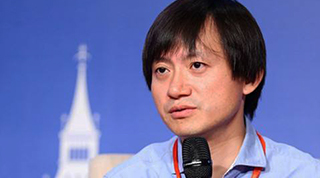
Guo Sheng 郭盛 | Zhaopin Ltd CEO
Talent rushing to first-tier cities is the greatest waste of human resources, says Guo. Zhaopin’s recruitment data shows the largest increase in jobs is not in Beijing, Shanghai and other megacities, but in new first-, second-, third- and even fourth-tier cities, which have talent shortages. To achieve balanced development, local governments should lower thresholds for hukou and subsidise housing purchases. In the long term, Guo hopes there will be no hukou restrictions on talent.

Li Tie 李铁 | National Development and Reform Commission China Centre for Urban Development director
Pointing to megacity kindergartens, which have seen a series of toddler abuse cases, Li argues that large cities have rapidly developing but low-quality service industries because migrants’ temporary urban status discourages them from investing in self-training. Considering academic qualifications alone ignores the real needs of cities; localities should give hukou to long-term migrant residents and break down boundaries between downtown and administrative regions of megacities. Relaxing hukou thresholds should not be done without careful planning; policy should be tailored to industry requirements, creating a low-cost service environment beneficial to innovation.
timeline
29 May 2018: NDRC convened scholars and experts to discuss the competition for talent
19 May 2018: MoHURD issued ‘Notice on further regulating the real estate market’
19 May 2018: Tianjin requires applicants to have proof of current employment in Tianjin
16 May 2018: Tianjin released ‘Haihe Talent’ program, relaxing threshold for hukou application
1 May 2018: MoHURD talked to ten cities that saw housing prices spike
23 Jun 2017: Wuhan releases plan to settle 1 million university graduates within five years
December 2016: Shenzhen allowed all graduates under the age of 35 from technical colleges and above to apply for hukou
11 Oct 2016: State Council released goal to extend urban hukou to 100 million migrants by 2020