update to animal husbandry law—how is this shifting policy?
- R&D to boost breeding
- grasslands to be more productive
- animal waste treatment to be highlighted
The PRC meat market is coming back after struggling for three years. The ASF (African swine fever) epidemic has prompted a policy makeover—from biosafety to designated transport routes and market monitoring and more. Pork is now better supported as the top factor in the CPI basket.
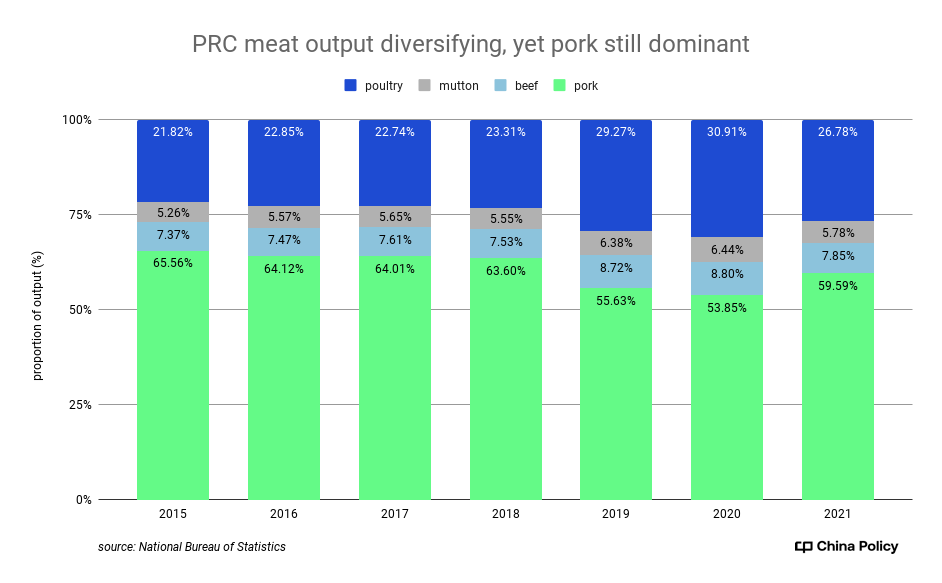
Eager for more meat, consumers are also looking for greater choice (see cp signal: China’s animal protein appetite). Declining in recent years, pork's share in total meat output was made worse by ASF. Pig farming recovered, rebounding in 2021, but will remain below the pre-ASF level, forecasts Zhu Zengyong 朱增勇 MARA (Ministry of Agriculture and Rural Affairs) pork industry chief analyst. The resulting three million tonne supply gap is to be filled by beef, mutton and poultry (see chart). Less regulated than pork, these three have room to expand; the total market share, for example, of the ten largest cattle suppliers is less than 0.5 percent of the gap.
A new Animal Husbandry Law comes into effect on 1 Mar 2023. As in the crop sector, safeguarding and making good use of genetic resources is imperative. Firms are urged to go in for R&D, and the onus is placed on the state to survey the nation and run gene banks. Permits to breed animals will be issued via a new platform.
Several other regulatory gaps are also identified by the law, as discussed below.
another blow for grassland farming
Long mismanaged by Beijing, grassland farming is a critical source of protein: its produce—mainly beef, mutton and dairy—is now a major part of the PRC diet: grassland and semi-grassland farms hold half of the nation's cattle inventory in 2020, supplying 39, 20 and 35 percent of beef, dairy and mutton annual output.
Inefficient relative to animal husbandry in developed regions, traditional grassland farming, basically confined to the northwest, was, when it was allowed its proper range, in balance with the environment. But it resists the scaling up demanded by Beijing. To modernise the sector Beijing's new law argues in a whole new chapter for 'sustainability'. Losing their lore and traditional way of life, nomadic herders, are urged to settle, and take up
- seasonal grazing
- rotational grazing; dividing a large pasture into smaller paddocks
- allowing livestock to move from one to another
- captive breeding
Developments for infrastructure, too, are on the cards: water supply systems, fences and dry lots, forage processing and roads to storage facilities, are all cited in the updated law.
Replacing part of the long over-grazed natural pasture, will be forage production bases and artificial pasture growing selected varieties of grass. While crop farming has to go through a whole growth cycle to produce grains, forage grass planting can deliver the whole plant for feed before it matures. A unit amount of silage corn provides up to twice as much nutrition as its kernels on the cob, claims the National Forestry and Grassland Administration. Ten percent each of the state’s low-yield farmland, idle farmland and open forests and orchards should be used to plant high-quality forage grass. A hundred million tonnes more fodder would result, yielding 10 million more tonnes of beef and mutton.
recycling animal waste
Farm waste utilisation, integral to more, higher quality animal products, features strongly in the revised law. With new stress on the collection, storage, safe treatment of and recycling of manure, nutrient balance, integrated cropping and animal rearing are given encouragement.
Small farmers, often struggling to control disease and recycle waste, will face tougher provincial scrutiny. They are indeed part of the plan to upgrade the industry; expect large companies and farmer coops to incorporate them into their operations.
Three quarters of animal waste was utilised in 2020. But that does not necessarily show progress in sustainability. Misguided recycling was revealed by Dong Hongmin 董红敏 Chinese Academy of Agricultural Sciences fellow. Some farms he reports
- overuse manure-based fertilisers, harming crops, further polluting the surrounding environment
- purify liquid manure to meet irrigation water standards, losing useful nutrients
All the above shows a disconnect between cropping and animal husbandry: large farms typically specialise in one or the other; small holders lack appropriate knowhow on manure treatment and reuse. Specified in the law, planning for farms and nutrition evaluation still have a long way to go.
who is shifting policy?

Chen Mengshan 陈萌山 | former Chinese Academy of Agricultural Sciences party secretary
Over 800 million consumers will demand better meat products over the next decade. A '"Greater Food"' approach’ 大食物观 has more than once been invoked by Xi Jinping, notably at the 2022 Two Sessions (March), and the 20th Party Congress (October). Food security (formerly ‘staple grain security’) now takes in a wider range of products. Proper utilisation of natural resources is another developing priority. Mainstream farming is not enough, points out Chen: other food ecosystems must come into full play, including grassland farming and the grasslands critical for it. The ‘Greater Food’ approach, says Chen, requires analysis of the nation’s food supply potential, and residents’ food and nutritional demands. Building resilient agrifood supply chains must be prioritised.
Formerly Party Secretary of the Chinese Academy of Agricultural Sciences, Chen worked in the Agriculture Ministry, now MARA (Ministry of Agriculture and Rural Affairs). Heading its Crop Production Department, he was later chief economist. He directs the National Food and Nutrition Consulting Committee and China Ag Tech Economic Society in retirement.

Institute of Animal Sciences, Chinese Academy of Agricultural Sciences 中国农业科学院北京畜牧兽研究所 |
A multi-discipline institute established in 1957, its R&D focuses on pigs, cattle, sheep and poultry. Germplasm resources, genetics and breeding, reproduction, feed science, nutrition and veterinary medicine are key specialties.
Huaxi cattle bred by the Institute were approved as a domestic cattle variety by MARA in 2021, featuring
- fast growth
- high slaughter rates
- good reproductive performance
- strong stress resistance
Running the world’s largest animal somatic cell bank, the Institute leads animal breeding R&D. As well as cattle, it has bred several other animal species. On forage grass planting, its alfalfa variety has been rolled out across 2 million ha, dominating domestic production.