how is policy shifting?
- voluntary moratorium declared on fishing in north Indian Ocean
- sustainable DWF (distant-water fishing) on the rise
- DWF firms ranked on international compliance
- militarised fishing vessels now proliferate in PRC fleet
A PRC moratorium on squid catches on the high seas, first enacted in 2020, is now adding major spawning grounds in the northern Indian Ocean to those already covered in the south-western Atlantic and eastern Pacific. Despite a record of exploiting distant waters worldwide, this 'quit on squid' gestures toward a sustainable switch in supplying the high-demand, high-profit seafood. But the vast DWF fleet remains out of line with international norms.
yields to rebound
Suspending all squid catch in the affected areas from July to November, the moratoria should be followed by robust recovery of squid populations. These have been calamitously low: the average catch by PRC vessels in the southwest Atlantic was a mere 50 tonnes in 2019, compared with an average of 2,000 tonnes during 2007-11.
Two years of moratoria in the region involving 70 DWF companies and 1,500 squid vessels have seen some turn for the better; MARA (Ministry of Agriculture and Rural Affairs) notes that yields per vessel and sizes of the squid taken have both improved.
aspiring to change
With by far the greatest DWF ambitions, the PRC is hardened to backlash against its giant fleet, accused of overfishing marine ecosystems. While concern with covert operations of unregistered PRC vessels pervades global commentary, there is a palpable domestic reform impulse.
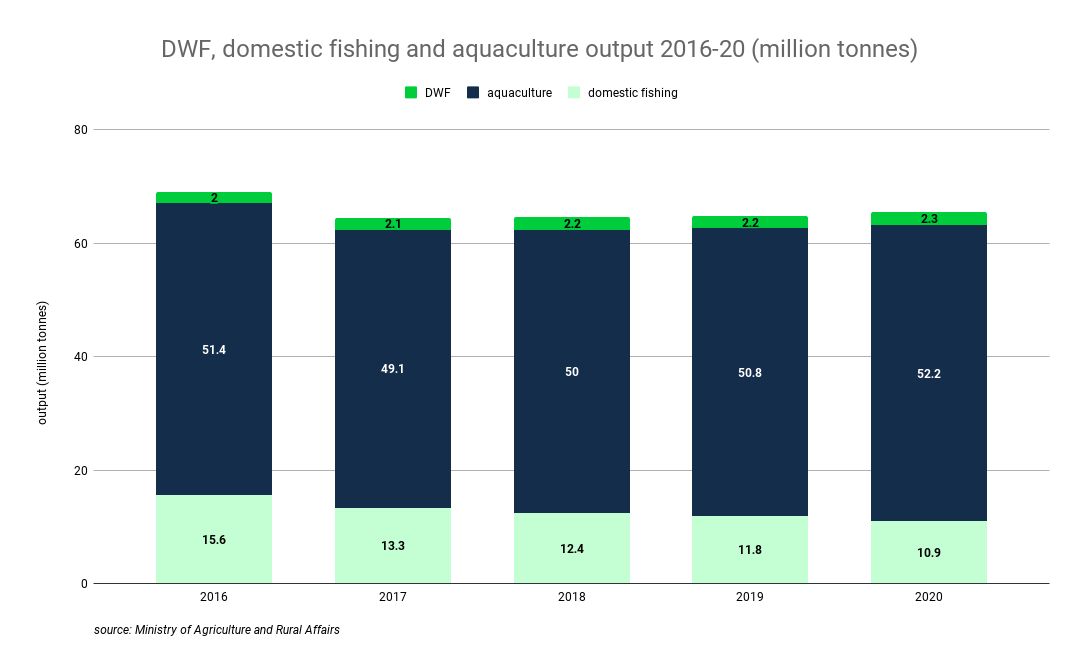
Sustainability tops the agenda of the 14th 5-year plan for fisheries and the one for the DWF industry. Rising in previous long-term planning, but now unchanged from 2021, the annual DWF output is to be capped at 2.3 million tonnes (see chart). The fleet's scale will be controlled, with vessels mandated to carry state-of-the-art equipment and IT to track their locations and poll their catches.
The 'quit on squid' emulates a successful domestic off-shore summer fishing ban. Stricter law enforcement coming into these offshore fisheries, including inspections at ports and markets for illegal catches, round-the-clock monitoring of vessels, interdepartmental cooperation, etc., are ripe to be transferred to the high seas.
Repairing its global image by claiming to enact a first-ever fishing ban on high seas beyond the scrutiny of RFMOs (regional fisheries management organisations) is consistent with Beijing's ambition to 'lead governance' in global fishing. Continuity with other patriotic imperatives is shown in its strategic/security narrative of a 'maritime community with a shared future'.
Compliance with international rules is flagged as well in performance evaluations of DWF operators: assisting the big firms (with higher productivity and cleaner records) to stand out, while squeezing the space of the weaker and smaller. A scoring protocol launched in 2019 subtracts merit points if firms stray onto the illegal side. Reflecting mounting international pressure, attention will be paid to assessments from RFMOs and coastal states. An operator confirmed by RFMOs to be operating IUU (illegal, unregistered, unreported) vessels will lose all 100 points in one swoop.
still on the hook
Amid intractable maritime territorial disputes, e.g. friction with Japan over the Diaoyu Islands and standoff with the Philippines in the Scarborough Shoal, Beijing has continued to build up its military presence, deploy coastguard vessels and repurpose atolls in the region for military use. Such dual-use maritime militia raises global concerns that question the role of PRC fishing vessels.
The strategic significance of the Indian Ocean was on the agenda at the recent Quadrilateral Security or 'Quad' Dialogue between the US, Japan, Australia and India, convening 24 May 2022. The meeting foreshadowed a satellite network tracking 'fishing vessels' in Asia-Pacific waters. Beijing predictably bristled; its state media dismissed the initiative as a NATO lookalike targeting legal PRC Indian and Pacific ocean operations and implicitly serving Washington's military intelligence.
who is shifting policy

Hu Bo 胡波 | Peking University Centre for Maritime Strategy Studies director
A maritime country, the PRC has legitimate rights to develop maritime power. An Asian version of NATO is unlikely, but the US is scaling up collaboration with other Asian states in intelligence sharing and military equipment manufacturing. Western states have long stigmatised legal PRC fishing and maritime peacekeeping in their anti-China rhetoric and influenced regional policy discourse. Beijing and Seoul have started talks on the Yellow Sea issues; severe friction is now unlikely.
The South China Sea has gone off the boil 2021-22 given the PRC's increasing military and economic presence, yet ramifications from the 2016 South China Sea tribunal persist. Disputes with Japan over the Diaoyu Islands in the East China Sea are escalating, as reactions from Tokyo to activities of Chinese coast guard vessels have intensified since 2020. Meanwhile, stepped-up US military presence in waters surrounding China heightens the risk of potential military clashes.
Maritime security specialist, Hu directs a South China Sea strategy studies at Peking University School of International Relations. A frequent media commentator and a prolific contributor to PRC and foreign academic journals, Hu is author of four books including Chinese Maritime Power in the 21st Century.
Li Chenggang 李成钢 | China's ambassador to the WTO
WTO negotiations remain stalled. Having overrun the 2020 deadline set by the UN Sustainable Development Goals target, the talks to end fishery subsidies were again postponed, ostensibly due to the Omicron crisis at end 2021. The talks are vital not only to the fisheries sector but to the WTO itself. Its charter, providing a negotiating forum, monitoring trade policies and resolving disputes among members is, Li says, poorly served at present. It should, he urges, work against trade unilateralism and protectionism, and protect the rights of least-developed countries.
Without discarding developing country status, Li revealed the PRC is prepared to forgo some of the preferential treatment it enjoys in ag and financial services in the coming fisheries talks. It will yield on all its special and differential treatment, a step towards controlling the harmful subsidies that fuel the growth of PRC's DWF fleet.
A Ministry of Commerce veteran, Li was the assistant minister before appointment as Beijing's representative at the WTO in 2021. He also became China's deputy permanent representative to the UN in Geneva and other international organisations based in Switzerland.