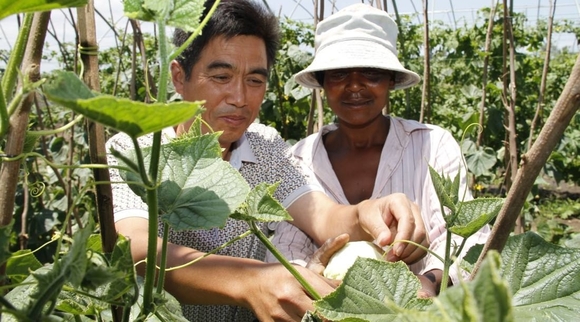
ag partnerships under BRI aim to secure both food security and global influence
Recent deals with ag-producing BRI (Belt and Road Initiative) countries serve to cultivate new food sources and, in theory, curb dependence on traditional suppliers, with whom tensions are growing. Yet Beijing frames them as intrinsically win-win, ‘South-South cooperation’, or a means to share Chinese wisdom with the world.
BRI ag links are promoted through a spaghetti junction of pathways: tech sharing, student exchange, governance models, investment, aid and the techniques of soft power. But a near decade of win-win rhetoric has not ended suspicion of major BRI projects as debt trap diplomacy that exacerbates financial and security risk and engenders political backlash in BRI partners.
the vision: expansion and involution
BRI began official life as a ‘dream’ program sketched by Xi Jinping in 2013 and mostly focused on infrastructure. The BRI label has since been added as branding to all manner of global initiatives: infrastructure and trade primarily, but also environmental protection, education, public health, tourism and cultural exchange. Evolving over the decade, BRI’s scope—as reflected in projects in digitisation, green development, debt sustainability and vaccine distribution—flags expansion to be sure, but not a little involution as well.
Long before BRI, Beijing was committed to externally sourcing ag commodities under the banner of ‘going global’. The synergy between global engagement and food security imperatives ensured ag goals would be tied into BRI from the outset. The PRC, argued Farmer’s Daily in 2017, feeds 22 percent of the world’s population from less than 9 percent of its arable land; this ability obliges it to contribute to global ag development by sharing knowledge and resources.
Early estimates indicated as much as C¥750 bn (~US$115 bn) in agricultural overseas markets could be opened up by the BRI scheme, and trade has certainly expanded. By 2019 annual trade in ag products with BRI countries was claimed to have reached US$93 bn, accounting for over 40 percent of the total. ASEAN partners took the lead, making up around half of the market. High-end items including seafood, animal products, fruit, and vegetable oils have made up some 55 percent of the total import value from BRI countries since 2015. ASEAN's fresh food trade with China took off following the free trade agreement in 2014 and installation of massive irradiation facilities in southern China to process ASEAN produce.
Trade wars, African swine fever and COVID-19 have all left their mark on BRI plans, but the dream lives on.
building ag capacity
Beyond encouraging ag investment to go global, BRI projects centre on ag-tech zones and education exchanges, each in practice a vector of domestic messaging.
Ag-tech zones are where the state encourages clustering of capital, resources and industries. Domestically, they are vehicles of ag upgrading. Cooperation is state-sanctioned, both within China and with overseas partners. Offshore zones, often called ‘parks’, mostly concentrate on improving crop yields and extending value chains through tech transfer, service delivery and marketing.
These parks are typically run by provinces: Beijing chooses a province to oversee each park and organise demonstrations and/or capacity building. They become strongholds for Chinese ag companies to 'go global' while improving opportunities for host countries. National and provincial-level ag-tech parks are visible around the world (see map). Africa and ASEAN get the lion’s share, followed by Latin America and eastern Europe. Western Europe and Oceania are in this sense BRI deserts.
major overseas ag tech zones
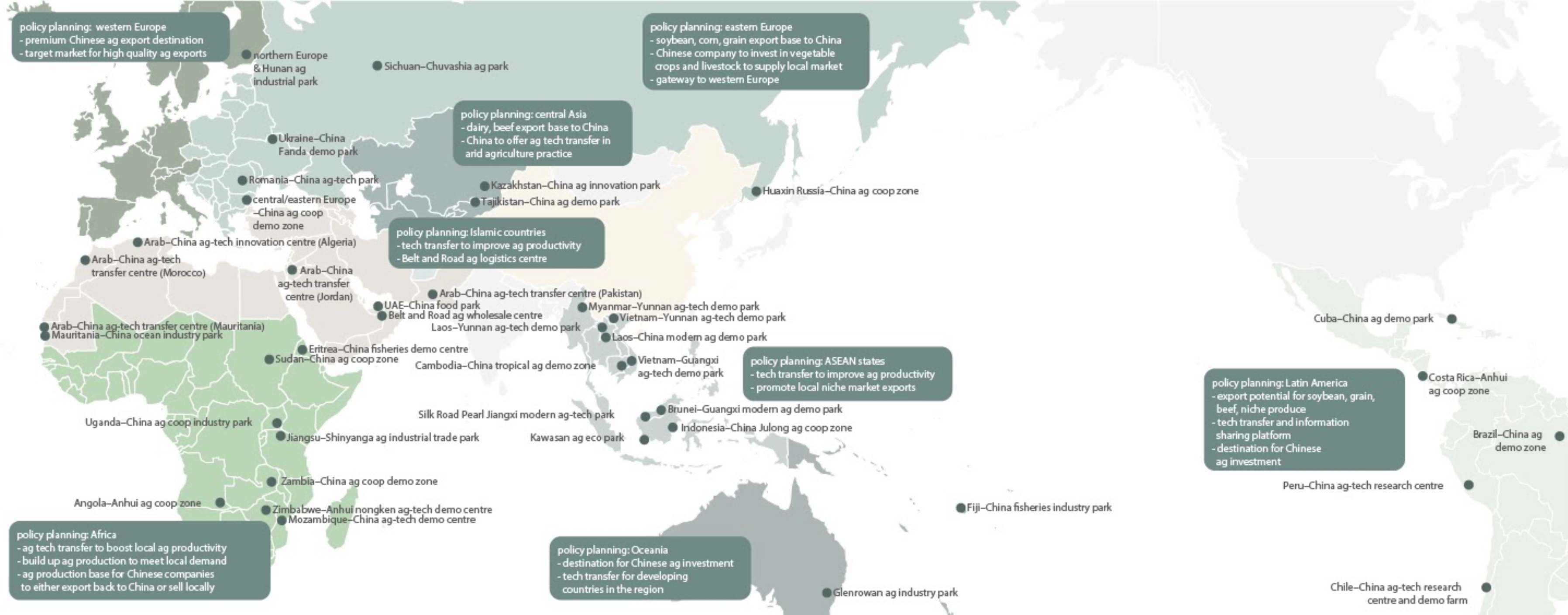 click to expand
 Academic exchange is another key plank of BRI ag activities. The PRC remains a top ag education destination for African and Asian states. Easily half of China is dry or semi-dry, similar to the conditions in some targeted countries. Salvaging ag capacity from a low if not zero base and dealing with unfavourable natural environments is thought to create exportable ‘China solutions’. Nearly 10,000 African ag officials, technicians and students have attended training in the PRC over the past decade; the Academy of Agricultural Sciences has had a steady throughput of postgrad students from BRI countries. Cross-border platforms for ag education and R&D are also being built. In 2016, Northwest Agriculture and Forestry University founded a ‘silk road ag tech innovation league’, now engaged in joint R&D with 76 institutions from 14 countries and regions.
farming ain't easy
Beijing can in principle mandate production at home, but territories traversed by BRI, such as Myanmar, Pakistan and Afghanistan (and others that might suit ag commodity production) are politically and socially fractured. Investment in these places carries higher risk; production capacity in BRI partners generally remains low. PRC ventures in many of them face the same intractable issues advanced country donors encounter: corruption, political instability and weak institutions.
Even success stories barely make a dent in import dependence and food security issues. For instance, reliance on soybeans imported from the US and Brazil is a perennial concern for Beijing. Aiming to stabilise imports at 100 million tonnes p.a. over the next decade, Beijing is opening up the market to new suppliers. BRI partner and prospective supplier Tanzania exported a first batch to China in 2021: (a largely symbolic) 120.2 tonnes. Russia, the leading BRI partner in this trade (currently comprising 1 percent of imports with plans to rise to 3.7 million tonnes by 2024), then turned tail and imposed a crippling 30 percent export tariff on 1 February.
PRC food security has long assumed the eagerness of large suppliers to sell into Chinese markets. Barley and beef tensions with Australia provide classic examples of the whack-a-mole school of global ag trade. Until recent tensions ended a golden era, Australia enjoyed as much as 50 percent of China’s barley market. What actions did Beijing take to replace Australian barley? Market access was granted to US suppliers. Similarly, restrictions on Australian beef imports coincided with expanded opportunities for Brazil.
stuck together
A history of food insecurity gnaws at the minds of policymakers. As tensions with established ag players steadily grow, the need to find new, secure food suppliers is constant. By the PRC's own calculations food imports will rise until 2030, not least as hundreds of millions of Chinese consumers in lower-tier cities engage with global ag and food supply chains. From BRI countries they will probably be eating more durian and mangoes. For grain and feed security, the PRC will find it difficult to replace its conventional commodity suppliers including the US, Brazil, Canada, France and Australia.
profiles
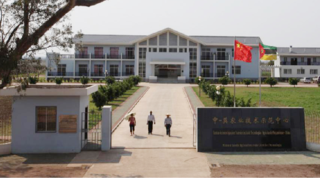
Mozambique-China ag-tech demo centre 莫桑比克—中国农业技术示范中心
Set up in 2006 as part of ag-tech aid and paired with Hubei state-owned enterprises, the centre adapts seeds from China to local conditions. It transfers tech and trains local farmers and ag technicians. Rice, corn, cotton, daikon, chillies and eggplant are the key crops. The centre partnered with the Bill and Melinda Gates Foundation in 2018 to promote ‘green super rice’ (high yielding with limited inputs). Shortcomings noticed at the centre include insufficient resourcing, cultural mismatch and inadequate involvement of local staff.
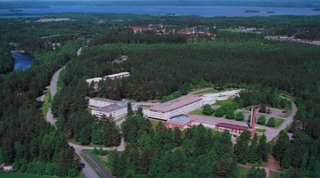
northern Europe & Hunan ag industrial park 北欧湖南农业产业园
The park, located in Finland, is funded by private stakeholders and backed by Hunan's provincial government. Unlike similar parks in Africa, it positions itself as a supply hub for European and international markets. Some 2.5 sq km in area and dedicated to farming, processing and logistics, the park claims to grow fruits and vegetables (particularly mushrooms). Proclaimed as Hunan’s flagship ‘going global’ and BRI project since 2015, there is doubt as to its actual achievements due to minimal follow up announcements and satellite images showing little if any greenhouse or crop development.
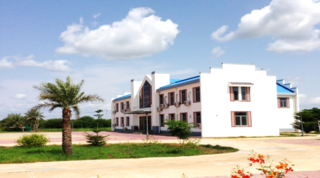
Sudan-China ag co-op open zone 中国-苏丹农业合作开发区
Located south of Khartoum, the zone was set up in 2011 with an initial focus on developing cotton seeds suited to local conditions. It plans by 2023 to incorporate five cotton and leather processing plants and three cotton oil factories, and have an annual production capacity of 3,000 tonnes of textiles, 48,500 ha of cotton and 20,000 sq metres of warehouse space. Major issues for the zone have been a lack of water, and limited tech capacity and farming skills in the region.
context
25 Feb 2021: MARA pledges to boost ag trade, promoting China’s competitive ag tech, machinery and inputs on global markets, while strengthening overseas ag demo zones
21 Feb 2021: No.1 Document stresses ag import diversification strategy, encouraging ag companies to participate in global supply chains
December 2019: of the 137 countries signed on to BRI, over 80 have signed ag and fisheries agreements with China; the volume of ag trade between China and BRI countries exceeds US$93 bn (40 percent of the total trade volume); over 650 investment projects, totalling US$9 bn, have been launched in partner countries
August 2017: MARA approves the first batch of overseas ag cooperation demo zones
May 2017: another US$1 bn added to the South-South Cooperation Fund
May 2017: BRI ag vision and action plan clarifies five pillars for cooperation: policy dialogue, tech exchange, trade development, mutual investment and people-to-people communication
2016: China-ASEAN Ag Cooperation Forum launched as part of the longstanding China-ASEAN Expo
September 2015: Xi Jinping announces C¥20 bn fund to support South-South cooperation and assist developing countries achieve the 2030 sustainable development goals
2013: China-Latin America and the Caribbean Ag Ministers Forum launched; US$50 million ag cooperation fund set up
2013: China-Central and Eastern European Countries Ag Cooperation Forum launched
2006: Forum on China-Africa Cooperation launched; held annually to promote mutual understanding and cooperation
2000s: Chinese ag starts to ‘go global’ as part of broader diplomatic goals