
New rules for national key projects, issued late June, are the latest move in a three-year overhaul of sci-tech project funding, which kicked off in December 2014. More transparent and less bureaucratic, the new funding model nonetheless fails to sever links between applicants and selection committees.
central sci-tech funding reform
Massive funding under the previous system failed to yield breakthroughs and commercialise sci-tech discoveries at the desired rate. Fragmentation and poor coordination were blamed for creating overlaps, crippling oversight and fostering rent-seeking. Seeking to realign sci-tech funding with national research priorities, the new model
- integrates most funds into a new category: ‘national key projects in R&D’ (NKP)
- shifts power from ministries to a joint inter-ministerial conference system
- delegates selecting projects to academic committees organised by professional third-party agencies
tenders
Research teams now apply for NKP funding through annual tenders. In 2017, Ministry of Science and Technology (MoST) budgeted C¥19.1 bn for 42 open NKPs, and by June had awarded C¥21.58 bn through 40 of them. The ministry also budgeted C¥6.6 bn for three international cooperation NKPs (Belt and Road, multilateral and bilateral) and C¥350 million for a separate NKP to fund China’s contribution to the International Thermonuclear Experimental Reactor. By August this year, MoST had announced six new NKPs for tender in 2018.
A joint inter-ministerial conference system led by MoST, with Ministry of Finance (MoF) and National Development and Reform Commission (NDRC) as vice convenors, sets the overall NKP framework, including the number and type of projects and their budgets. The conference is supervised by the country’s top decision-making body for sci-tech development, State Council’s Leading Group for National Sci-Tech System Reform and Innovation System Building, and advised by scientific, industrial and economic experts through the Strategic Consultation and Comprehensive Review Committee. Professional third-party agencies manage NKPs and their tenders, setting up an academic committee to write tender guidelines and another to select winners. MoST publishes these guidelines and eventual tender winners online.
national key project in quantum control and quantum information
MoST published draft application guidelines for the 2017 round of this NKP and its academic commission members, selected from a national list, in August 2016 (link), calling for one or two five-year projects in each of 18 research areas. Consolidated guidelines, published in October 2016 (link), specified a total budget of C¥1 bn. After announcing forthcoming applicant video interviews in March 2017 (link), and the selection committee in April 2017 (link), in May 2017 MoST issued details of the 27 winners (link), awarding C¥877 million in total. Draft guidelines for 2018 applications were issued a week earlier (link).
quantum entanglements
Officials praise the new model for consolidating fragmented schemes and ‘unleashing’ scientists. It specifically addresses lack of separation between the committees that assess applications, and applicants themselves. The previous system, argues one NKP review board member, favoured established over young scientists.
But conflicts of interest remain. In the 2017 NKP for quantum control and quantum information, for example, 78 percent (21 cases) of project-winning institutions took part in drafting its tender guidelines, and 89 percent (24 cases) served on the selection committee. For all 42 civil NKPs in 2017, these figures are 25 percent (286 cases) and 30 percent (329 cases) respectively, with only four (in the first instance) and six (in the second instance) of all NKPs free of such cases.
Developing a third-party system, cultivating a credible expert database, and devolving state functions takes time. Four of the seven professional third-party organisations are affiliated with MoST, and the other three with Ministry of Agriculture, Ministry of Industry and Information Technology, and National Health and Family Planning Commission. This hampers objectivity and fairness, according to a Chinese Academy of Sciences academician. MoST researchers also point out that these agencies lack suitable legal frameworks, policy support, personnel and management structures.
future trends
Though the new funding system creates more predictable and clearer application procedures, there is still some way to go before it can be considered fair, and for the centre to get more bang for its R&D buck. While much of the system is now in place, the state is signalling further moves to
- attract private investment in projects: March 2017 ‘National key research project fund management measures’ called for more diverse investment channels for NKPs; in June MoST signalled these will be opened to private capital
- support researchers in setting up companies to monetise discoveries: allowing small and medium-sized enterprises (SMEs) to deduct 75 percent of R&D expenses, and boosting other incentives for high-tech start-ups; giving state-employed researchers rather than their institutions control over discoveries and allowing companies set up on the basis of this IP
- encourage military–civil collaboration: for instance by allowing universities to use military research equipment, and by developing military–civil alliances for funding applications
- cut red tape: researchers complain of needing invoices for every expense; outdated restrictions limit daily reimbursement of expenses for specialist consultants to C¥800, which usually cost C¥1,000 to 2,000, for example—researchers circumvent this by submitting student labour costs, and then asking students to refund this money so they can transfer it to specialist consultants
- internationalise: recent 'Interim management measures for national key projects in R&D' allow overseas research institutions, universities and enterprises registered in China to lead or participate in NKP applications, and encourage professional organisations to invite foreign experts onto selection committees
professional third-party agencies
China Rural Technology Development Centre 中国农村技术开发中心
China National Centre for Biotechnology Development 中国生物技术发展中心
Administrative Centre for China's Agenda 21 中国21世纪议程管理中心
Ministry of Science and Technology High Technology Research and Development Centre 科技部高技术研究发展中心
Ministry of Agriculture Technology Development Centre 农业部科技发展中心
Ministry of Industry and Information Technology Industry Development and Promotion Centre 工信部产业发展促进中心
National Health and Family Planning Commission Development Centre for Medical Science and Technology 国家卫计委医药卫生科技发展中心
profiles
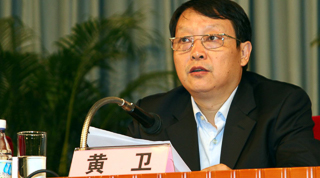
Huang Wei 黄卫 | MoST vice minister
Having taught road and traffic engineering at Southeast University for over a decade, Huang launched his political career as director of Jiangsu’s Department of Construction in 2003. Only half a year later he became vice minister at the Ministry of Construction, staying on for six months after it was renamed Ministry of Housing and Urban-Rural Development in 2008. Serving two years as Beijing vice mayor and six on the Xinjiang Party standing committee, Huang became vice minister of MoST in November 2016. In February 2017 Huang announced the basic structure and policy framework for central sci-tech funding reform had been completed, integrating fragmented funds and overcoming bureaucratic division. MoST now aims to energise and incentivise researchers, he said. Huang has also presented plans to streamline and reduce scientific awards from 400 to 300 (source), and encouraged private capital to participate in NKPs.
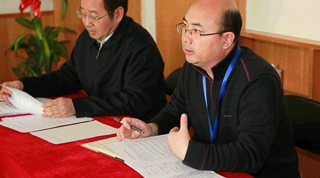
National Centre for Sci-Tech Evaluation (NCSTE) 国家科技部科技评估中心
Set up in 1997 under MoST, in 2004 NCSTE gained independent legal status as a professional sci-tech evaluation agency, advising the state on local, national and international sci-tech innovation programs and policies. Since 2009, the centre has monitored the ten civil sci-tech megaprojects, reporting directly to State Council, MoST, National Development and Reform Commission and Ministry of Finance (source). At the end of 2016, NCSTE reviewed the 2017 NKP tender guidelines, taking into account how requirements tally with NKP objectives, and with central sci-tech funding management regulations. Wang Ruijun 王瑞军 (pictured), NCSTE director, has said that evaluation by an outside party such as the NCSTE avoids overlap and the tailoring of guidelines to research teams.
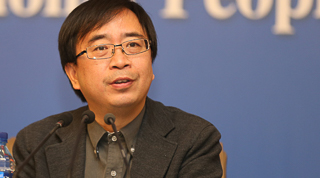
University of Science and Technology of China (USTC) 中国科学技术大学
Located in Hefei, Anhui, USTC is a national sci-tech research university under the Chinese Academy of Sciences (CAS). The largest recipient of funding through the quantum NKP, it won an undisclosed amount for five successful applications in 2016, and C¥174 million, 20 percent of the NKP’s awarded funds, for four projects in 2017. Quantum science at USTC is headed by Pan Jianwei 潘建伟 (pictured), a leading quantum physicist with a PhD from Vienna University (1999). Pan is one of nine members of the unchanged quantum NKP tender drafting committee of 2016 and 2017. His team is involved in the quantum satellite Mozi, and the world's first quantum computer, and holds the world record for the number of entangled superconducting qubits (source).
timeline
22 Jun 2017: MoF and MoST issues 'Interim management measures for national key projects in R&D', clarifying management guidelines and duties of the inter-ministerial joint conference, the strategic advisory and review committee, Ministry of Science and Technology, expert committees and professional project management institutions. The measures explicitly encourage international cooperation
9 Jun 2017: State Council General Office issues 'Measures for deepening sci-tech rewards system reform', aiming to improve rewards at national, ministerial and provincial levels, and encourage civil groups to set up rewards
5 Jun 2017: Huang Wei 黄卫 MoST vice minister announces NKPs will soon be open to private capital to better align development with application
1 Jun 2017: MoST, NDRC and MoF issue 'Notice on national megaprojects (civil) management provisions', clarifying the roles of the inter-ministerial joint conference, involving ministries, advisory committees and professional management institutions, and maps out procedural guidelines
16 May 2017: State-owned Assets Supervision and Administration Commission launches a C¥150 bn central enterprise investment guidance fund, looking to support projects that are world-class, ready for industrialisation, have huge market potential and can be developed quickly
26 Apr 2017: State Administration of Taxation (SAT) issues ‘Guidance of preferential tax policies for mass entrepreneurship and innovation’, clarifying 77 preferential tax policies covering initial phase (focusing on SMEs and special groups), growth phase (highlighting preferential treatment for R&D and accelerated depreciation of fixed assets), and mature phase (targeting high-tech support)
2 Mar 2017: MoST and MoF issue 'National key R&D program project fund management measures', redefining government's role as managing overall budget and promoting devolution by simplifying procedures, merging categories and becoming more service-minded, and incentivising researchers
31 Jul 2016: CCP Central Committee and State Council issue 'Opinions on improving central fund management of sci-tech projects', calling for more incentives for researchers, streamlining administrative procedures, and strengthening devolution by giving more power to university research institutes
24 Sep 2015: CCP Central Committee and State Council issue 'Implementation plan of deepening science and technology system reform', seeking to balance maintaining state dominance and absorbing market vitality to build a business-oriented innovation system
3 Dec 2014: State Council issues 'Plan on deepening central finance reform for science and technology (projects, funds) management', calling for integrating project application and resource allocation into five pillars: National Natural Science Foundation of China (NSFC), megaprojects, NKPs, guidance projects, and research base and talent projects. Aiming to reduce government power in sci-tech funding management, the plan gives more play to third-party evaluation, and more autonomy to research institutes and universities