signal
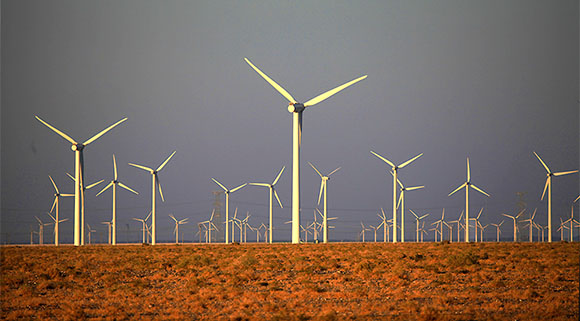
China aims to reach 20 percent non-fossil fuel energy by 2030. Green energy is in oversupply, yet currently contributes under 10 percent to consumption. Undoing the gridlock seems no nearer.
why gridlock?
How is it that renewable capacity remains poorly integrated with the grid in a country with so much to gain domestically and internationally by unleashing it?
weak buy-in by the grid
Renewable energy projects, launched with little regard for transmission, are poorly connected to the grid. The grid favours ultra-high-voltage (UHV) transmission that the NEA resists on safety grounds. The grid, however, tends to treat full use of all renewable energy as impossible without UHV. Renewable power produces variable output; the grid remains more amenable to thermal power.
anti-corruption and devolution
The heavy anti-corruption damage suffered by NEA has left officials wary of approving thermal power investments; meanwhile, the devolution campaign allows NDRC to shift such responsibilities to local governments, who see power investments mainly in terms of stimulating their economies.
local protectionism
As demand slackens, local economies become more self-sufficient in electric power, giving protectionist local governments even more incentive to reject imported power.
lower electricity demand
Slowing growth and reduced need for new power stations means less space for renewable energy to occupy; meanwhile, structural rebalancing to less energy-intensive services reduces power demand.
geography
Renewable energy sources abound in the north and west, but electricity demand is in the south and east, leading to excess supply in the least-developed regions.
unrealistic subsidy
NDRC pledged generous subsidies for renewable power; excessive capacity was encouraged in short time frames, and in sub-optimal regions. NDRC has since lowered subsidies, but the rate of reduction is out-paced by the fall in renewable generation cost.
cost competitiveness is not the cause
The grid pays the same benchmark price to renewable and conventional energy.
outlook
As unplanned power outages are deemed more damaging than overcapacity, the NEA is unlikely to halt coal-fired power projects, and renewable capacity will outpace grid building. China will probably overachieve its 2020 capacity targets; there is a small chance the 13th 5-year plan will show more renewable ambition.
- UHV transmission networks, if approved, will not be ready till 2025
the grid still retains monopoly power still forcing investment decisions in its favour, yet
- Xi Jinping 习近平 has urged power sector reform
- power transmission and distribution costs will be reviewed, though not necessarily made more transparent
- grid will no longer profit from on/off price differentials and will instead charge service fees
- power trading platforms will allow direct contract negotiations—including on prices—between generators and consumers
carbon pricing is unlikely to be effective in the short run
- design is technically difficult and implementation is heavily politicised
- supply-side: completing electricity reform before carbon prices reflect true coal costs will allow coal to retain a competitive edge
- demand-side: state-set retail electricity prices buffer consumers from the cost of carbon
more focus on distributed power in the east, but the effect will be marginal
- higher local power prices may make distributed power economical in the east
- the grid is not keen on distributed PV due to high connection cost and safety concerns
context
8 Oct 2015: NDRC’s provisional plans to maximise local renewable energy consumption, Gansu and Inner Mongolia are the first two pilots.
28 Sep 2015: Xi Jinping announced on US tour that China will set up a nation-wide ETS.
13 Apr 2015: third supplement to Document No.9, setting principles on power transmission and distribution reform.
7 Apr 2015: second supplement to Document No.9, demand side management.
20 Mar 2015: first supplement to Document No.9, prioritising renewable energy in overall electricity reform.
15 Mar 2015: central financial and economic leading workgroup and national energy committee disclosed the 9th Document of electricity reform, stemming Xi’s determination for reforming the electricity sector.
13 Nov 2014: China-US joint climate change declaration announced 2030 emissions peaking and non-fossil fuel targets.
19 Sep 2014: NDRC [NDRC climate 2014 2347] released 2020 non-fossil fuel targets and renewable power generation capacity targets.
30 Aug 2013: NDRC [NDRC price 2013 1638] rolled out feed-in-tariff scheme for solar PV; subsidies are promised for 20 years in principle.
roundtable
Don’t demean coal: clean energy is no energy security elixir either
Zuo Qianming 左前明 | Caijing
Clean energy is the future, but abandoning coal is ill-conceived. Current overcapacity does not imply future overcapacity: compared to Japan and the US, China has far from reached its electricity consumption limit. Clean energy is still heavily dependent on subsidies and not capable of supporting China’s energy security. The immediate solution to address air pollution lies in neither phasing out coal nor clean energy; instead, it lies in clean coal utilisation. Ultra low emission technology is available now with a minor additional C¥0.02/kWh. If this technology is employed nationwide, the main pollutants will decrease by 90 percent on 2013 level.
Nuclear, instead of wind and solar, is the future
Wei Jie 魏杰 | Caijing
Fiscal policies to encourage wind and solar power development are not viable in the short run, concludes Wei Jie 魏杰, Tsinghua University. Subsidies are not guaranteed, nor have promised subsidies been delivered. Local governments have also taxed wind and PV farms, even though they are exempt. Nuclear technologies are more reliable and cost-competitive, and high safety standards have been met. Hence large investments should concentrate in nuclear; wind and PV investment should be more tentative.
Phasing out fossil fuel subsidies vital to reducing carbon emissions
Cui Xuan 崔烜 | The Paper
Fossil fuel consumption creates large negative externalities. Coal exploitation, transportation and combustion, for example, damage geosphere, soil, vegetation, road, air and increases hospital bills. Fossil fuel subsidies need to be phased out; energy pricing mechanisms should reflect economic as well as social costs, stresses Lu Sicheng 卢思骋, World Wide Fund for Nature (WWF). Lu also believes renewable energy technologies are in fact cheaper than fossil fuel energy, once externalities are taken into account. Phasing out fossil fuel subsidies is already on China’s climate change mitigation agenda, among other G20 countries, says Zhu Guangyao 朱光耀 MoF deputy minister.
in the spotlight

Li Hejun 李河君 | Hanergy Holding Group Chairman, All-China Federation of Industry and Commerce’s New Energy Chamber of Commerce Chairman
Poster child for China's renewable over capacity. Li is domestically famous as a classic underdog, taking over a dam-building project bigger than Hoover Dam from NDRC in 2002 and turning it into the world's largest private hydropower station. But Li is internationally famous for making a bad bet: In 2010, Li began moving horizontally into solar, investing heavily in 'thin-film solar'. Higher cost and low efficiency prevented the more versatile product from gaining market share against conventional panels; meanwhile, excess subsidies led to a solar glut in China, while many of Hanergy's planned projects were failing to come on-line and lines of credit were drying up. Nonetheless, general market euphoria helped boost Hanergy's share prices through May 2015, until revelation of probe into HK-listed subsidiary spooked investors. For a fleeting second China's richest man, Li lost half his wealth in hours and has not regained it since. Has not lost official favour.

Liu Zhenya 刘振亚 | State Grid Chairman
Liu supports developing ultra high voltage (UHV) grids to allocate clean energy around the globe, a project that aims to provide 80 percent of global primary energy consumption by 2050. His and State Grid’s strong interest in building UHV and connecting eastern and western grids inclines them to use a potentially greater uptake of renewable energy as an argument for their case.
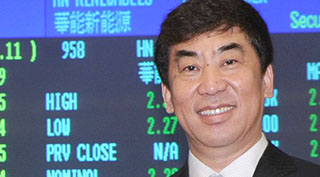
Cao Peixi 曹培玺 | China Huaneng Group CEO
CEO of China Huaneng since 2008, and becoming member of the 18th Central Party Disciplinary Committee in 2012, Cao has a long-established career as a professional manager in the power generation sector. Under him, Huaneng Renewables completed its IPO in Hong Kong in 2011 and accounted for 20 percent of China’s renewable energy generation capacity—the largest in China—in 2014. Cao’s priority for the second half of 2015 is Party discipline inspections, presumably in the power generation sector. He promotes faster clean energy development but also wants steady development in high efficiency thermal power.