geoeconomics: Busan breakthrough
US–China trade tension flared up in early October. Washington tightened export controls on more PRC firms, prompting Beijing to hit back with sweeping controls on rare earths and related technologies. Beijing imposed new port fees on US vessels and sanctioned subsidiaries of US-linked South Korean shipbuilder Hanwha Ocean in response to US Section 301 duties.
Beijing’s rare earth curbs, vital for numerous sectors, immediately shook global tech and industry markets. Analysts noted the strategic pressure; Yao Yang 姚洋 formerly Peking University and now Shanghai University of Finance and Economics, explained the move was designed to force the US back to talks, while Zhang Jianping 张建平 MofCOM Research Institute stated the US defence sector would be 'severely hit' by what he called Beijing’s 'symmetrical response' strategy.
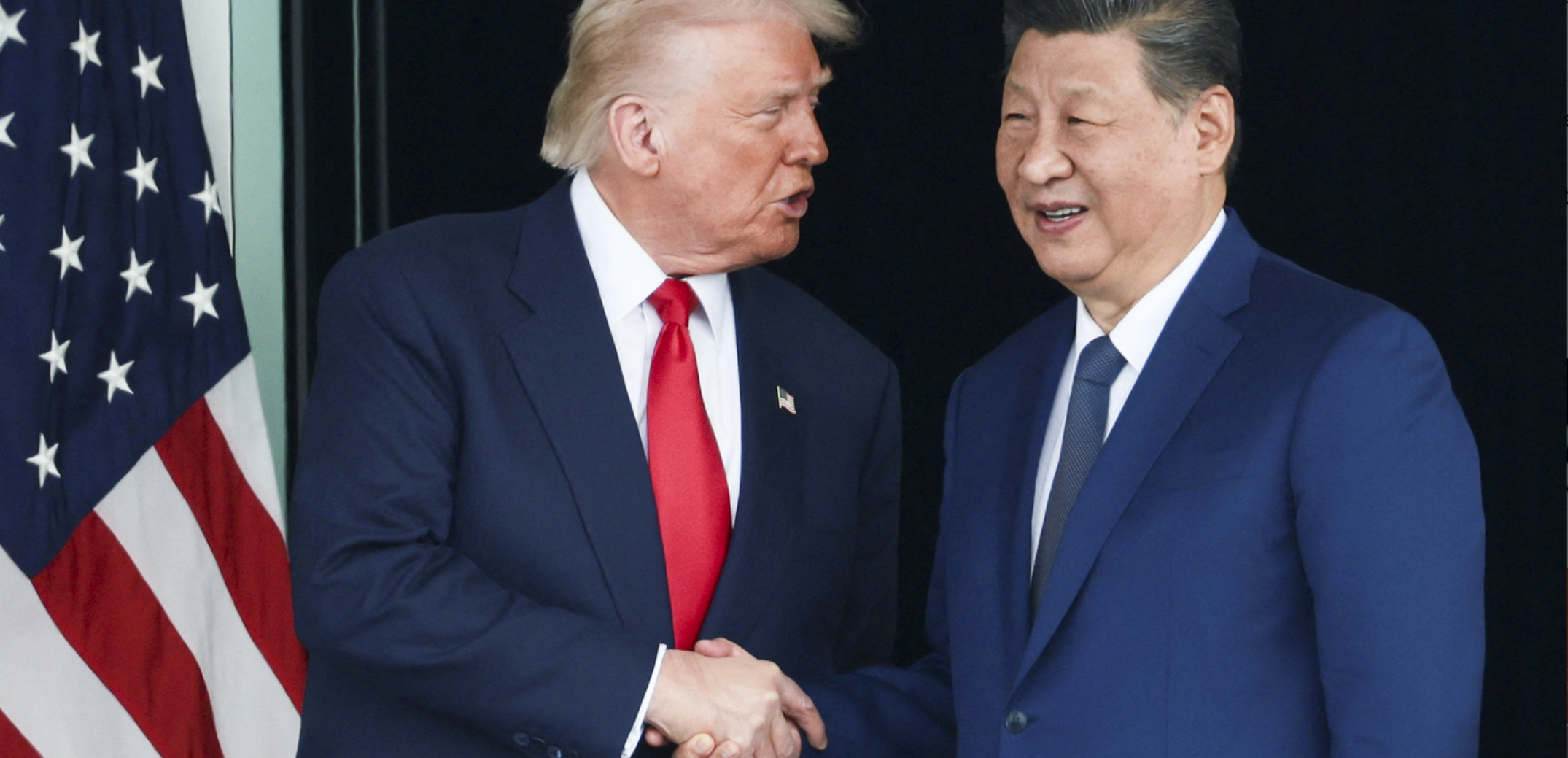
As PRC analysts foresaw, the pressure from the rare-earth limits drove Washington back to the table. The month-long spiral finally de-escalated when Presidents Xi and Trump met in Busan, South Korea, on 30 October at the APEC Summit.
Their first face-to-face meeting since 2019 resulted in a one-year agreement on several key issues.
- remove its 10 percent fentanyl tariffs on the PRC
- keep the 24 percent reciprocal tariffs freeze.
- suspend tech export control restrictions announced in late September 2025.
- halt ship and maritime duties for one year
- adjust tariff countermeasures
- suspend export controls announced on 9 October 2025 for a year
- halt ship and maritime sector countermeasures for one year
- resume some US farm imports, such as soybeans
Early reactions were positive, hailing the meeting as 'quite positive and very encouraging'. Issues beyond trade, such as Taiwan, were, however, left unaddressed. Trump had downplayed the risk of a PRC invasion earlier in October, making unusually direct remarks about how the island’s future is viewed. Days later, Zhou Bo 周波 retired PLA senior colonel, offered advice on how to avoid conflict over Taiwan in a Time magazine op-ed.
trade: ‘symmetrical response’
Exports rose 8.3 percent in September, and imports 7.4 percent, beating forecasts and earlier months. The rebound reflects stronger overseas demand and Beijing’s focus on diversifying trade. Shipments to the US fell by double digits for the sixth month, but as happened last month, gains in the EU, Southeast Asia, Africa and Latin America filled the gap.
stepping up guidance
Other trade moves this month
- PRC and ASEAN officially signed the 3.0 free trade agreement
- a first specialised policy document to expand green trade
- support firms to go green and low-carbon
- expand green design and manufacturing
- more financial help
macroeconomy: fuelling growth, managing risk
The economy in October saw a forward-looking pivot, set against a backdrop of weak domestic data. Following its Fourth Plenum, the CCP issued 'Recommendations' for the 15th 5-year plan, signalling a decisive shift from 'growth at all costs' toward 'high-quality' development. This new agenda is envisioned on two pillars: a state-led, high-tech industrial upgrade and a push to unlock domestic consumption.
This long-term planning was set against concerning September data that revealed no uptick in domestic demand, and a surprise return to consumer price deflation at -0.3 percent and the year's first contraction in fixed-asset investment at -0.5 percent. In response to this weakness, Pan Gongsheng 潘功胜 PBOC Governor, speaking at the Financial Street Forum, confirmed monetary policy would remain 'appropriately loose' to fund industrial upgrades, but balanced this with a strong emphasis on macroprudential risk control. To jumpstart the consumption pillar, the Ministry of Finance also announced a major liberalisation of duty-free retail rules to encourage wealthy consumers to spend at home.
industry: boost to high-tech and retail sector
Industry movements in October were dominated by the 15th 5-year plan's decisive move away from property-driven growth. This is forcing a structural split in heavy industry.
On one side, traditional sectors like steel are being actively managed for decline and consolidation. A new 2025–26 work plan will ban new steel capacity and reduce production, reinforced by a proposed 1.5-to-1 capacity swap policy. The inclusion of steel and cement in the national emissions trading scheme is also forcing these high-polluting sectors to invest in green tech or pay for their carbon.
On the other side, advanced manufacturing is being pushed to upgrade and expand into global markets. The construction machinery sector exemplifies this export model, with Sany Heavy Industry raising C¥12.8 billion in a Hong Kong IPO on October 28 to fund its 'global sales network' and decarbonisation; this strategy saw September excavator sales rise 25.4 percent, driven by strong exports. Shipbuilding shows similar global dominance, rebounding to a 75 percent market share for new Q3 orders. The aluminium sector reflects this split internally: while processing for the weak construction industry is contracting, primary alloy production for the resilient auto and EV sectors is recovering.
energy: charging up
New energy vehicles may dominate sales well before 2035, further cutting oil use. They made up 46.1 percent of sales from January to September 2025. To build buyer trust, an action plan aims to double charging points within two years, expanding into rural and highway areas. V2G links and faster charging are also planned.
Energy focus is shifting from building capacity to making better use of renewables. A draft plan sets binding targets for non‑power renewables like green heating, hydrogen, ammonia, methanol and biofuels. Wind must rise by 160–200 GW each year to meet 2035 goals, under a new Wind Energy Declaration. Offshore, especially deep‑sea wind, offers the richest potential for coastal growth.
agriculture: rain, repair and reform
Heavy rain across the Huang–Huai plain turned the autumn harvest into a logistics test. Corn fields in Henan, Shandong and Anhui were left waterlogged, with crawler harvesters and dryers deployed to prevent moulding and keep the wheat-planting window open. Prices stayed soft as wet grain flooded the market, but the risk of spoilage and regional shortages could tighten the corn balance later in the season.
The machinery sector shows fresh strain. The September AMI (Agricultural Machinery Market Index) fell to 46.5, down 9.4 points m-o-m, its lowest level in eleven years. Even the traditional ‘golden September’ failed to lift demand, as inventories climbed. MARA's six-month clean-up of substandard tractors doubles as a market correction and a pre-pilot step for the 2026 subsidy round.
scitech: self-sufficiency grip
Beijing plans to tighten rare-earth trade tied to semiconductors, rolling out export rules that cover ores, equipment, process know-how and overseas goods with PRC content of 0.1 percent or more. The reach will capture photolithography tools and key chip links worldwide.
The start date may slip after the Trump–Xi meeting, but the thrust is clear. Sanctions have home-grown R&D and output. Tech self‑reliance is now a core aim of the new plenum read‑out and the 15th 5‑year plan. Tech, industry and talent are to be bound closer, labs fused with plants, and Digital China rolled on, to turn research into scaled production.
environment: leading up to COP30
Beijing will take a global leadership position at COP30 in Belem, Brazil, from 6–21 November. It will highlight gains in renewable rollout, clean tech exports and firm emissions reduction targets. Talks on finance for the Global South, international carbon markets and stronger Nationally Determined Contributions will be crucial to success.
Plans to redefine China’s green factories will tighten rules on energy and carbon use in the steel, petrochemical, and building materials industries. The state has issued budget funds for low‑carbon investment, backing clean‑coal replacement and circular-industry projects.
governance: consolidating governance
Beijing advanced its cyber and grassroots governance capabilities. The state legislature approved PRC Cybersecurity Law amendments, establishing core AI governance principles—guiding research and infrastructure while mandating ethical and security vetting. The revised law aligned its personal information protection measures with the Civil Code.
Mid-October CAC measures further clarified certification requirements for personal data export, completing most of the PRC’s cross-border data framework. State authority is reaching deeper into communities. The NPC revised the Organic Laws for both village and urban resident committees, formalising the practice of Party chairs serving on self-governing bodies. The law bolstered Party control and made stability maintenance and public service delivery mandatory for grassroots committees.
social policy: education priorities and medical device law
Legislative research for the draft Medical Device Management Law was carried out in Beijing on 15 October by a team led by Shu Wei 束为 State Administration of Market Regulation and Xu Jinghe 徐景和 NMPA (National Medical Products Administration). They visited Varian and Sinomdt to understand R&D, production and distribution in medical devices, then collected feedback from regulators, firms and hospitals. The law aims to balance innovation with oversight—using legislation to boost incentives and address collaboration gaps, said Gao Guobiao 高国彪 NMPA’s Centre for Medical Device Evaluation, former secretary.
The 15th 5-year plan, issued on 28 October, sticks to backing tech self-reliance, with education, tech and talent cited as backbones of the innovation drive. Higher education is urged to serve industry and national goals, training scientists, engineers, skilled workers and artisans. Free education and lifelong learning are to be broadened, ensuring equity amid demographic shifts.