geopol: mending fences in Trump’s wake
Trump’s strike on Venezuela and ‘rendition’ of President Maduro on 3 January, widely deemed world-historic, had been foreseen weeks before by PRC analysts. Condemning the operation the next day, Foreign Minister Wang Yi 王毅 stated, 'We have never thought that any country can act as the world's police, nor do we accept that any nation can claim to be the world's judge.'
Yet the response was deemed mild, not least given that Maduro had hosted a senior PRC delegation the day before. January, in fact, yielded Beijing a string of foreign policy wins, with foreign leaders arriving to mend various fences in the wake of Trump 2.0.
4–7 January: South Korea’s Lee Jae Myung made the first presidential visit from Seoul since 2019. Restoring relations, 15 agreements on technology, intellectual property and transport cooperation were inked. Korean and PRC firms signed nine MoUs.
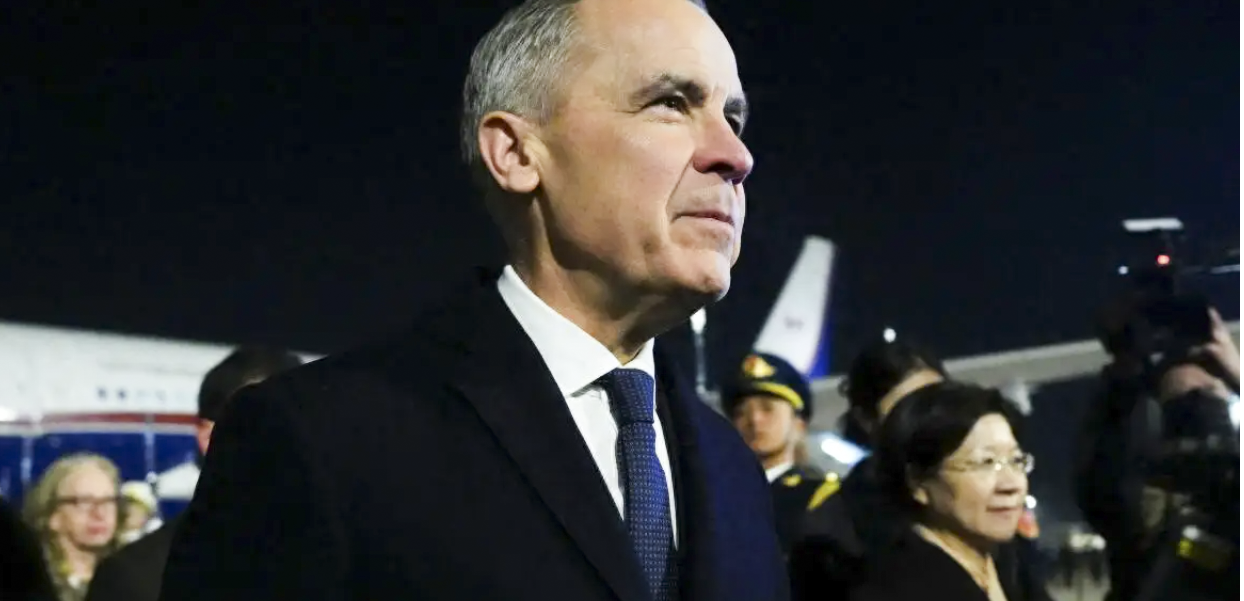
14–17 January: PM Mark Carney followed from Canada, the first high-level visit since relations soured with the Meng Wanzhou incident (2028). A preliminary trade deal lowers tariffs on PRC EVs and duties on Canadian farm exports. Xi and Carney jointly pledged to restart a high-level Economic and Financial Strategic Dialogue and to enact a bilateral economic and trade cooperation roadmap.
28–30 January: British PM Keir Starmer broke another drought dating from 2018. Beijing reported the visit as ‘fruitful’ and expressed readiness to develop a ‘long-term consistent comprehensive strategic partnership’. Brits gained 30-day visa-free access to China.
macro: bridging the two-speed economy
Cutting structural rates by 25 bps, the PRC Central Bank left room for further easing. Fiscal authorities pledged 'more proactive' spending to buttress the new 5-year plan, launching targeted interest subsidies for SMEs, the service sector and households.
The two-speed economy persists. While robust exports helped 2025 GDP meet the 5 percent target, domestic recovery remains patchy. 'Green shoots', glimpsed in a December CPI climb of 0.8 percent y-o-y and manufacturing PMI returning to expansion, subsided with fixed-asset investment shrinking, dragged by the unending property slump.
The divergence is reshaping markets: ‘old-economy’ steel demand is fading, while ‘new-economy’ metals like aluminium are rallying. The outlook now hinges on consumption filling the investment void. Boosting demand entails ‘integrating’ investment with consumption, prioritising policy coherence over intensity, notes Zhong Caiping 钟才平, an emerging authoritative nom-de-plume for central policy, setting the tone for 2026.
trade: focus on GNI
Beating forecasts, December exports rose 6.6 percent while imports grew 5.7 percent y-o-y, due to seasonal stock building, AI-driven chip demand, and partial global recovery. US shipments fell 30 percent, extending a nine-month decline. The 2025 trade surplus hit a record US$1.2tn, up 20 percent from 2024.
ODI climbed 7.4 percent. This was timely: experts and MofCOM Minister Wang Wentao 王文涛 have urged viewing growth via the lens of GNI (‘gross national income’: domestic+offshore), as well as GDP, conventionally a domestic metric. ODI helps allocate resources, spread risk, and capture higher returns, easing domestic growth constraints, enthused JD.com chief economist Shen Jianguang.
Geopolitics weighs on trade. Targeted export controls on dual-use goods to Japan were imposed amid Taiwan tensions, extending to an anti-dumping probe into dichlorosilane, used in China’s chip sector.
A draft law labels 'national reserve security' as 'urgent', given 'changes unseen in a century', covering grain, energy, minerals, and key equipment. Overseas purchases are viewed ever more strategically, linked to 'resource security' and 'self-reliance'.
Wins were scored with the EU and Canada.
- Brussels let PRC EV makers offer minimum prices, replacing tariffs.
- Canadian tariffs on EV will return to the MFN rate of 6.1 percent (initial quota of 49,000) plus tariff remissions on steel/aluminium in exchange for lower duties on Canadian canola. Both aim for 50 percent trade growth by 2030.
The 2026 tariff plan curbs duties on advanced manufacturing, green transition, medicine, and agriculture. Service-sector opening pilots expand to nine cities, using a 'differentiated exploration approach'.
A reported ‘action plan’ promotes digital RMB (e-CNY) to the status of interest-bearing deposit currency, enabling banks to offer more services. Cross-border payment ambitions, e.g. mBridge, are supported and reliance on the US dollar reduced. Researcher Dong Ximiao 董希淼 deems the PRC the first major economy to issue an interest-bearing CBDC, boosting its global influence in CBDCs.
energy: groundwork
State Grid promises record investment over the next five years to drive development of a ‘new-type’ power system. An increase of 40 percent over the 14th 5-year plan, the funds will help absorb renewable power capacity, strengthen its transmission and add flexibility and regulatory muscle.
A new microgrid plan aims to boost industrial green energy use at or near the source, easing pressure on the primary grid and supporting local renewable consumption.
Expired GECs (green electricity certificates) linked to voluntary emission reductions or green power consumption will be cancelled by the energy regulator, clarifying concerns about double-counting.
ag: new era beef trade
A three-year safeguard on beef was imposed in January. In-quota tariffs unchanged; out-of-quota at 55 per cent. Total quota: 2.688m tonnes. Brazil had shipped ~1.33m tonnes in the first eleven months of 2025, exceeding its 2026 quota of 1.106m tonnes, and creating an early quota wall. Expect importers to pull forward purchases, tighten landing dates, and shift routes. Prices will rise as quotas tighten.
Farm waste: Beijing shifts policy from 'treat' to 'use'. Under a solid-waste plan, farm waste is converted into inputs, scaling manure and straw reuse, promoting thicker and biodegradable films, and improving pesticide-pack take-back. Support is in store for source-level waste reduction, better collection, faster straw breakdown, and new crop–livestock loops.
Farm tech: Firms are to gain more control over trials with success measured by adoption and sales rather than reports, ensuring innovation reaches farmers as usable seeds, kits, and inputs.
scitech: price wars and AI
With auto sector price wars hitting new lows, ‘involution’ is in the policy cross-hairs. Regulators pledged in early 2026 to tighten cost checks, monitor prices, enforce, and review production consistency, curbing ‘disorderly’ competition.AI adoption in industrial sectors attracts heavy official spending, with MIIT and allied agencies pledged to reach global top-tier capabilities by 2027.
Echoing national priorities, localities are rolling out AI-centred industrial roadmaps. Of these Shanghai, leveraging its manufacturing base and financial strength, promises to build world-class high-end industrial clusters within five years.
environment: green producers, consumers, and waste clean up
From this year, Beijing is promoting consumer demand for greener products via green supply chains, procurement, and stricter labelling and certification of green goods.
A first batch of zero-carbon factories targets autos, batteries and solar PV. These model factories will be judged on energy efficiency, green power use, and carbon accounting.
Action to clean up solid waste will continue through 2030, with new targets on illegal dumping, recycling, and utilisation, above all, focusing on industrial waste.
governance: Xi sets discipline-first tone for 2026
The nation has been roiled by veiled rivalries in the military sector, with the true state of affairs the subject of much rumour and speculation. A longstanding anti-graft drive escalates as top military commander Zhang Youxia 张又侠—second only to Xi—is probed for political and other offences.
Xi Jinping had good reason to open 2026 by reaffirming Party discipline as the core priority for 2026, urging officials to demonstrate loyalty to the central leadership and ensure full rollout of major ‘15th 5-year plan’ strategic tasks.
Legal governance remains unsettled by ongoing modernisation—a process whose meaning continues to shift. An amended Public Security Administration Punishments Law, effective 1 January 2026, reinforces privacy protections for minor offenders. Meanwhile, new rules for disclosing supervisory information, due in March, aim to strengthen oversight of watchdog agencies and expand public access to official data.
health and pharma: faster drug entry and value-based care
A newly amended Drug Administration Law locks in clearer six‑year data protection and seven‑year rare‑disease exclusivity, with more reliable use of foreign clinical data, but imposing stricter local‑presence and compliance demands on EU drug makers.
Local market access for overseas-approved drugs is to be streamlined, prioritising treatment for rare and major infectious diseases and speeding up review to close the three-to-five-year lag with Europe and the US, notes Jin Chunlin 金春林 Shanghai Health Development Research Centre. Accepting overseas clinical data and shortening inspections will, he added, save firms time and the cost of duplicative China trials.
NHSA (National Healthcare Security Administration) foreshadows using real-world data to guide medical insurance decisions. This is a shift from ‘cost control to value purchasing’, as long urged by industry experts, observes Chen Qirui 陈奇锐 Medical Field. Yet NHSA may still struggle to reshape approvals, where duplicated research persists, and some new drugs lack solid evidence.
The silver economy is hoped to grow via international collaboration in aged-care tech—AI, robotics, smart rehab, and health monitoring—and certification of elder-focused medical devices, cosmetics, food, and clothing, expanding opportunities for foreign suppliers.