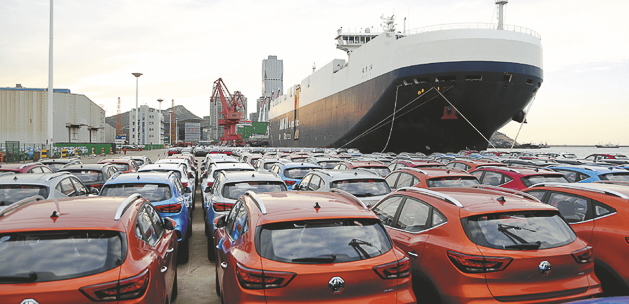
border rules relaxed—how is policy shifting?
- customs ease for autos and cross-border e-commerce
- speedier export tax rebates
- financial support for credit and insurance
export support
Beating expectations Q1 trade was up 15.5 percent, customs reported on 13 April 2023. Exports were up a whopping 23.4 percent y-o-y, fuelled by what PRC experts call a ‘retaliatory’ recovery: with COVID no longer restraining the economy, the rebound promises to exceed pre-pandemic levels. A sizable increase, the data suggests, came from EV exports, while expanded trade with ASEAN and Russia generated much of the rest.
This may be a blip. Offshore media foresaw a fragile PRC recovery, evidenced by a downward March manufacturing PMI and weak growth in neighbour economies such as South Korea.
The PRC is not immune from rising interest rates and the general slowdown of economies worldwide, says Wen Bin 温彬 Minsheng Bank chief economist. From now on, trade is going to be critical for GDP and employment, he adds.
Raising ‘volume and quality’ of imports and exports was also a message of the March 2023 government work report. Against sluggish trade growth in January and February, the State Council meeting of 7 April further urged local authorities to take steps to prop up exporters.
Support for the sector will not end soon. With this in mind, we surveyed recent measures to help exporters in several major ports: Shanghai, Guangzhou, Qingdao, Ningbo, Tianjin and Shenzhen.
latest trade trends
CBEC (cross-border e-commerce)’s importance in trade is rising, accounting for 37.3 percent of total value if we can go by a 2023 WJS Wangjingshe report. The PRC’s CBEC export market reached C¥12.3 tn in 2022, some 12 percent more than 2021. Tax policies and customs procedures for returned CBEC goods are being streamlined across all ports surveyed.
The ports are going all out to reap the advantages of RCEP (Regional Comprehensive Economic Partnership) for exporters. According to PRC customs, the agreement is now proving its value—accounting for almost one-third of PRC trade in 2022. PRC commentators call for RCEP rules of origin certificates to be made less complicated and cheaper using IT.
Autos, recording a remarkable 81.6 percent growth y-o-y, stayed the lead export in March thanks to high external demand. Guangzhou, Tianjin, and Shenzhen have also simplified customs clearance for autos destined for Europe via the China-Europe Railway Express.
A pilot program launched 13 March 2023 classifies specific ports—Qingdao, Ningbo-Zhoushan, and Tianjin—as ‘ports of departure’; exporters no longer have to wait for goods to be delivered before applying for export tax rebates.
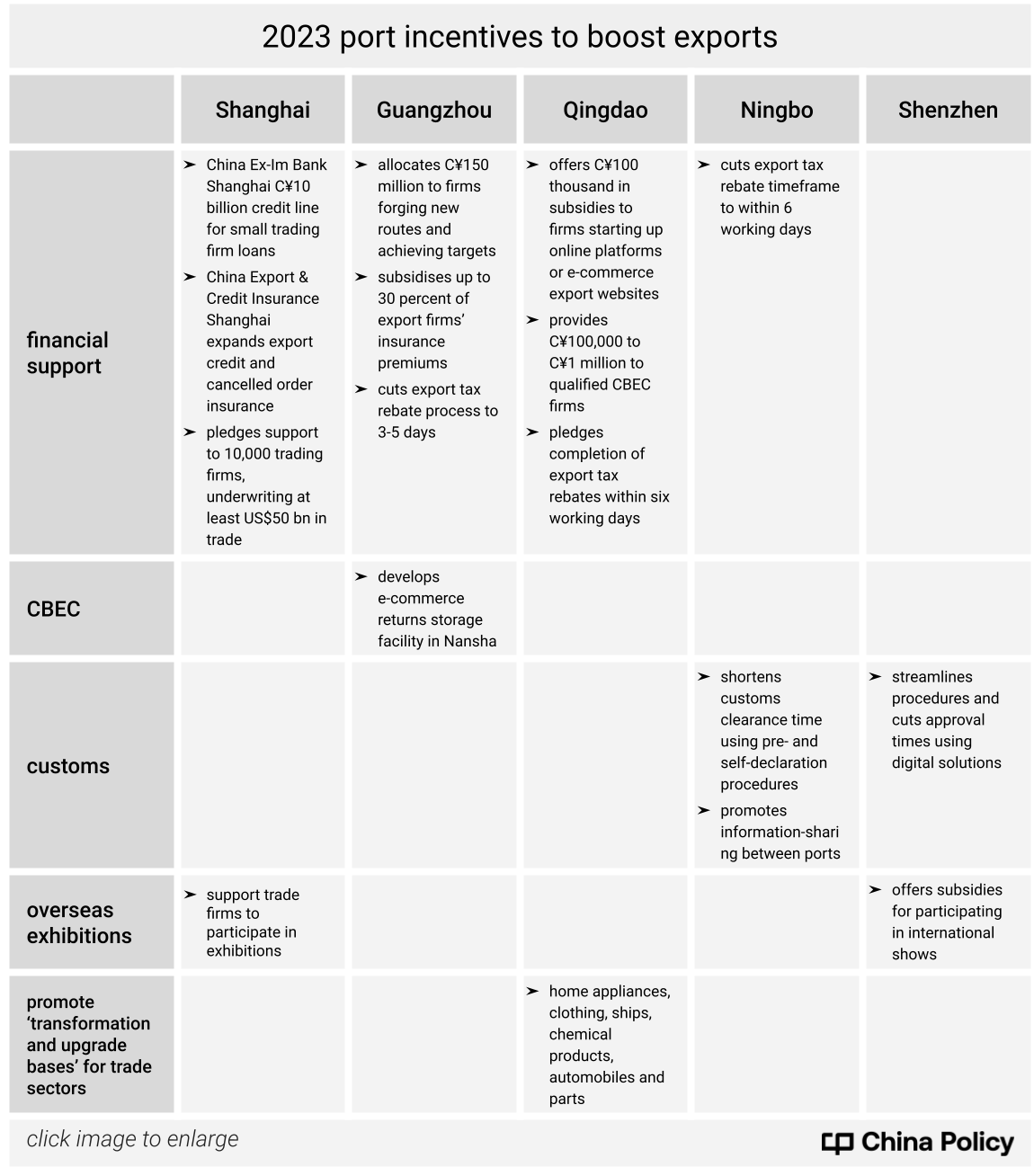
Incentives to boost exports have been launched by the ports themselves, as outlined below.
Beijing is averse to risk, not least inflation, slowing global demand, protectionism, and geopolitical drag on trade growth. A ‘combo punch’ is needed to kick start trade, Premier Li Qiang 李强 told the State Council on 7 April 2023. He called for trying a variety of measures to boost exports to advanced economies. Bolstering exports, he said, could take other forms than direct export support measures at ports. For instance, expanding trade ties with partners to push export growth, or building domestic consumption to attract higher-quality imports. This could better integrate local industry chains with the world and promote higher-quality exports.
With stagnant low average incomes, Beijing’s aspirations for a ‘quality’ consumption-driven economy will be a struggle. Moreover, upgrading PRC exports faces the impact of decoupling, which has reduced industrial chains’ access to advanced technology. Exports in the lower ranges may remain essential for the time being.
who is shifting policy?
Wen Bin 温彬 | Minsheng Bank chief economist
The State Council's calls to support exports serve multiple objectives. While helping enterprises secure orders, expand overseas markets, and take advantage of provincial trading infrastructure, the initiatives chime with recent PRC moves to diversify into the Middle East and Europe to shore up the domestic economy.
Chief economist at China Minsheng Bank, Wen Bin is a former senior analyst and strategist at China Bank. His influence was registered at an economic forum hosted by Premier Li Keqiang 李克强 in 2021, where he was scheduled as the first speaker.
Liu Xiangdong 刘向东 | China Centre for International Economic Exchanges economic research department deputy director
Exports are competitive and resilient, claims Liu: the PRC has the industry sector and networks to survive current exigencies. Electric vehicles, lithium batteries, solar cells and cross-border e-commerce as strong export drivers. To this end, Liu points to the lack of imports and spending—the PRC must leverage its ultra-large market to import high-quality goods that can, in turn, upgrade its exports.
Liu is a Deputy Director at the China Centre for International Economic Exchanges. A PhD in Management from Peking University, he works on international trade, industrial policy and trade agreements.
context
13 Apr 2023: GAC releases Q1 trade statistics
7 Apr 2023: State Council Executive Meeting urges local authorities to introduce policies to support exports
6 Apr 2023: Shanghai issues measures to support foreign trade
13 Mar 2023: GAC, MoF and SAT issue notice to designate specific ports, including Qingdao, Ningbo-Zhoushan, and Tianjin as ‘ports of departure’, which can facilitate export tax rebates
15 Mar 2023: Guangzhou Customs issue measures to support foreign trade
8 Feb 2023: Guangzhou issues measures to support foreign trade
2 Feb 2023: CCIEE expert notes that increasing imports has great significance
1 Feb 2023: MoF releases notice on tax policies for returned products exported in CBEC